


 癌症的基本特征包括细胞增殖、血管生成、迁移、凋亡逃避机制和细胞永生等。找到癌症发生过程中这些通路的关键标记物和对应的抗体用于检测至关重要。
 为您推荐一个泛素化位点预测神器——泛素化分析工具,可以为您的蛋白的泛素化位点作出预测和评分。
 细胞自噬受体图形绘图工具为你的蛋白的细胞受体结合位点作出预测和评分,识别结合到自噬通路中的蛋白是非常重要的,便于让我们理解自噬在正常生理、病理过程中的作用,如发育、细胞分化、神经退化性疾病、压力条件下、感染和癌症。
TRPV1 Antibody (N-term) 精选
Affinity Purified Rabbit Polyclonal Antibody (Pab)
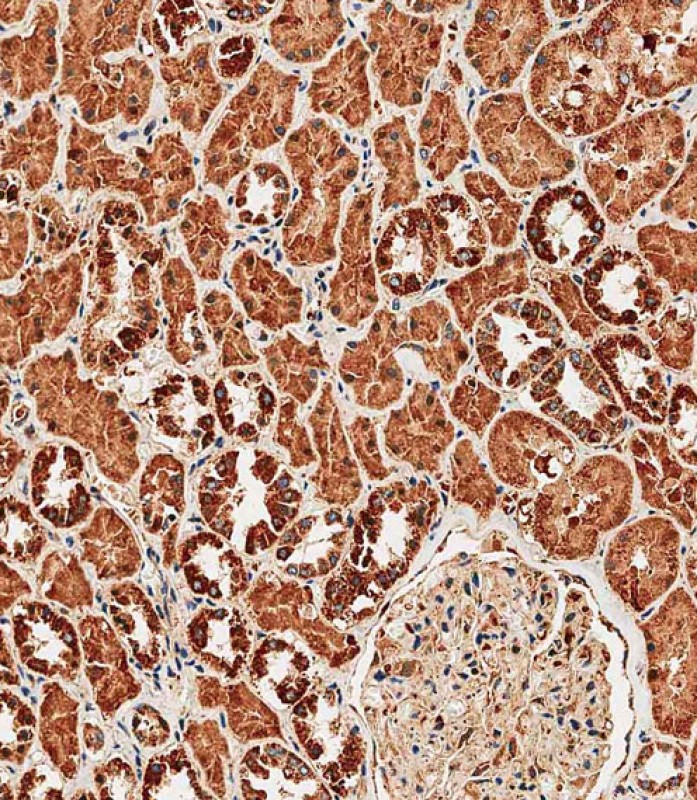

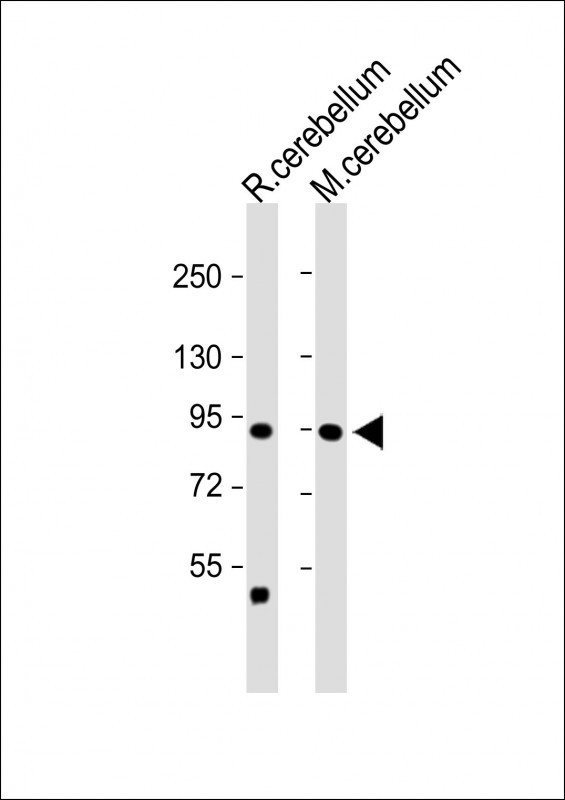
- 产品详情
- 文献引用 : 2
- 实验流程
- 背景知识
Application 
| IHC-P-Leica, WB, E |
|---|---|
| Primary Accession | Q8NER1 |
| Other Accession | NP_542437.2, NP_542435.2, NP_061197.4 |
| Reactivity | Human, Rat, Mouse |
| Predicted | Bovine, Canine, Rabbit |
| Host | Rabbit |
| Clonality | Polyclonal |
| Isotype | Rabbit IgG |
| Calculated MW | 94956 Da |
| Antigen Region | 124-153 aa |
| Gene ID | 7442 |
|---|---|
| Other Names | Transient receptor potential cation channel subfamily V member 1, TrpV1, Capsaicin receptor, Osm-9-like TRP channel 1, OTRPC1, Vanilloid receptor 1, TRPV1, VR1 |
| Target/Specificity | This TRPV1 antibody is generated from rabbits immunized with a KLH conjugated synthetic peptide between 124-153 amino acids from the N-terminal region of human TRPV1. |
| Dilution | IHC-P-Leica~~1:500 WB~~1:2000 E~~Use at an assay dependent concentration. |
| Format | Purified polyclonal antibody supplied in PBS with 0.09% (W/V) sodium azide. This antibody is purified through a protein A column, followed by peptide affinity purification. |
| Storage | Maintain refrigerated at 2-8°C for up to 2 weeks. For long term storage store at -20°C in small aliquots to prevent freeze-thaw cycles. |
| Precautions | TRPV1 Antibody (N-term) is for research use only and not for use in diagnostic or therapeutic procedures. |
For Research Use Only. Not For Use In Diagnostic Procedures.
| Name | TRPV1 |
|---|---|
| Synonyms | VR1 |
| Function | Non-selective calcium permeant cation channel involved in detection of noxious chemical and thermal stimuli (PubMed:11050376, PubMed:11243859, PubMed:11226139, PubMed:12077606). Seems to mediate proton influx and may be involved in intracellular acidosis in nociceptive neurons. Involved in mediation of inflammatory pain and hyperalgesia. Sensitized by a phosphatidylinositol second messenger system activated by receptor tyrosine kinases, which involves PKC isozymes and PCL. Activated by vanilloids, like capsaicin, and temperatures higher than 42 degrees Celsius (PubMed:37117175). Upon activation, exhibits a time- and Ca(2+)-dependent outward rectification, followed by a long-lasting refractory state. Mild extracellular acidic pH (6.5) potentiates channel activation by noxious heat and vanilloids, whereas acidic conditions (pH <6) directly activate the channel. Can be activated by endogenous compounds, including 12-hydroperoxytetraenoic acid and bradykinin. Acts as ionotropic endocannabinoid receptor with central neuromodulatory effects. Triggers a form of long-term depression (TRPV1-LTD) mediated by the endocannabinoid anandamine in the hippocampus and nucleus accumbens by affecting AMPA receptors endocytosis. |
| Cellular Location | Postsynaptic cell membrane {ECO:0000250|UniProtKB:O35433}; Multi-pass membrane protein. Cell projection, dendritic spine membrane {ECO:0000250|UniProtKB:O35433}; Multi-pass membrane protein. Cell membrane; Multi-pass membrane protein. Note=Mostly, but not exclusively expressed in postsynaptic dendritic spines {ECO:0000250|UniProtKB:O35433} |
| Tissue Location | Widely expressed at low levels. Expression is elevated in dorsal root ganglia. In skin, expressed in cutaneous sensory nerve fibers, mast cells, epidermal keratinocytes, dermal blood vessels, the inner root sheet and the infundibulum of hair follicles, differentiated sebocytes, sweat gland ducts, and the secretory portion of eccrine sweat glands (at protein level) |

Provided below are standard protocols that you may find useful for product applications.
BACKGROUND
Capsaicin, the main pungent ingredient in hot chili peppers, elicits a sensation of burning pain by selectively activating sensory neurons that convey information about noxious stimuli to the central nervous system. The protein encoded by this gene is a receptor for capsaicin and is a non-selective cation channel that is structurally related to members of the TRP family of ion channels. This receptor is also activated by increases in temperature in the noxious range, suggesting that it functions as a transducer of painful thermal stimuli in vivo. Four transcript variants encoding the same protein, but with different 5' UTR sequence, have been described for this gene.
REFERENCES
Bailey, S.D., et al. Diabetes Care 33(10):2250-2253(2010)
Cantero-Recasens, G., et al. J. Biol. Chem. 285(36):27532-27535(2010)
Shieh, K.R., et al. Neurogastroenterol. Motil. 22(9):971-977(2010)
Cheng, L.E., et al. Neuron 67(3):373-380(2010)
Westlund, K.N., et al. Mol Pain 6, 46 (2010) :

终于等到您。ABCEPTA(百远生物)抗体产品。
点击下方“我要评价 ”按钮提交您的反馈信息,您的反馈和评价是我们最宝贵的财富之一,
我们将在1-3个工作日内处理您的反馈信息。
如有疑问,联系:0512-88856768 tech-china@abcepta.com.


