


 癌症的基本特征包括细胞增殖、血管生成、迁移、凋亡逃避机制和细胞永生等。找到癌症发生过程中这些通路的关键标记物和对应的抗体用于检测至关重要。
 为您推荐一个泛素化位点预测神器——泛素化分析工具,可以为您的蛋白的泛素化位点作出预测和评分。
 细胞自噬受体图形绘图工具为你的蛋白的细胞受体结合位点作出预测和评分,识别结合到自噬通路中的蛋白是非常重要的,便于让我们理解自噬在正常生理、病理过程中的作用,如发育、细胞分化、神经退化性疾病、压力条件下、感染和癌症。
Anti-TSG6 Antibody
- 产品详情
- 实验流程
- 背景知识
Application 
| WB |
|---|---|
| Primary Accession | P98066 |
| Host | Rabbit |
| Reactivity | Human, Rat |
| Clonality | Polyclonal |
| Format | Lyophilized |
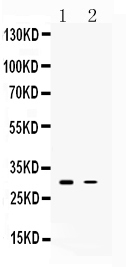
| Description | Rabbit IgG polyclonal antibody for Tumor necrosis factor-inducible gene 6 protein(TNFAIP6) detection. Tested with WB in Human;Rat. |
| Reconstitution | Add 0.2ml of distilled water will yield a concentration of 500ug/ml. |
| Gene ID | 7130 |
|---|---|
| Other Names | Tumor necrosis factor-inducible gene 6 protein, Hyaluronate-binding protein, TNF-stimulated gene 6 protein, TSG-6, Tumor necrosis factor alpha-induced protein 6, TNF alpha-induced protein 6, TNFAIP6, TSG6 |
| Calculated MW | 31203 Da |
| Application Details | Western blot, 0.1-0.5 µg/ml, Human, Rat |
| Tissue Specificity | Found in the synovial fluid of patients with rheumatoid arthritis. . |
| Source | Eukaryota |
| Protein Name | Tumor necrosis factor-inducible gene 6 protein |
| Contents | Each vial contains 5mg BSA, 0.9mg NaCl, 0.2mg Na2HPO4, 0.05mg NaN3. |
| Immunogen | A synthetic peptide corresponding to a sequence at the N-terminus of human TSG6 (46-91aa KYKLTYAEAKAVCEFEGGHLATYKQLEAARKIGFHVCAAGWMAKGR), different from the related mouse sequence by two amino acids. |
| Purification | Immunogen affinity purified. |
| Cross Reactivity | No cross reactivity with other proteins. |
| Storage | At -20˚C for one year. After r˚Constitution, at 4˚C for one month. It˚Can also be aliquotted and stored frozen at -20˚C for a longer time.Avoid repeated freezing and thawing. |
For Research Use Only. Not For Use In Diagnostic Procedures.
| Name | TNFAIP6 |
|---|---|
| Synonyms | TSG6 |
| Function | Major regulator of extracellular matrix organization during tissue remodeling (PubMed:15917224, PubMed:18042364, PubMed:26823460). Catalyzes the transfer of a heavy chain (HC) from inter-alpha-inhibitor (I-alpha-I) complex to hyaluronan. Cleaves the ester bond between the C-terminus of the HC and GalNAc residue of the chondroitin sulfate chain in I-alpha-I complex followed by transesterification of the HC to hyaluronan. In the process, potentiates the antiprotease function of I- alpha-I complex through release of free bikunin (PubMed:15917224, PubMed:16873769, PubMed:20463016). Acts as a catalyst in the formation of hyaluronan-HC oligomers and hyaluronan-rich matrix surrounding the cumulus cell-oocyte complex, a necessary step for oocyte fertilization (PubMed:26468290). Assembles hyaluronan in pericellular matrices that serve as platforms for receptor clustering and signaling. Enables binding of hyaluronan deposited on the surface of macrophages to LYVE1 on lymphatic endothelium and facilitates macrophage extravasation. Alters hyaluronan binding to functionally latent CD44 on vascular endothelium, switching CD44 into an active state that supports leukocyte rolling (PubMed:15060082, PubMed:26823460). Modulates the interaction of chemokines with extracellular matrix components and proteoglycans on endothelial cell surface, likely preventing chemokine gradient formation (PubMed:27044744). In a negative feedback mechanism, may limit excessive neutrophil recruitment at inflammatory sites by antagonizing the association of CXCL8 with glycosaminoglycans on vascular endothelium (PubMed:24501198). Has a role in osteogenesis and bone remodeling. Inhibits BMP2-dependent differentiation of mesenchymal stem cell to osteoblasts (PubMed:16771708, PubMed:18586671). Protects against bone erosion during inflammation by inhibiting TNFSF11/RANKL- dependent osteoclast activation (PubMed:18586671). |
| Cellular Location | Secreted. |
| Tissue Location | Expressed in airway epithelium and submucosal gland (at protein level). Colocalizes with bikunin at the ciliary border Present in bronchoalveolar lavage fluid (at protein level) (PubMed:16873769). Expressed in mesenchymal stem cells (PubMed:16771708). Found in the synovial fluid of patients with rheumatoid arthritis. |
Provided below are standard protocols that you may find useful for product applications.
BACKGROUND
Tumor necrosis factor-inducible gene 6 protein, also known as TSG-6, is a protein that in humans is encoded by the TNFAIP6 gene. The protein encoded by this gene is a secretory protein that contains a hyaluronan-binding domain, and thus is a member of the hyaluronan-binding protein family. The hyaluronan-binding domain is known to be involved in extracellular matrix stability and cell migration. This protein has been shown to form a stable complex with inter-alpha-inhibitor (I alpha I), and thus enhance the serine protease inhibitory activity of I alpha I, which is important in the protease network associated with inflammation. This gene can be induced by proinflammatory cytokines such as tumor necrosis factor alpha and interleukin-1. Enhanced levels of this protein are found in the synovial fluid of patients with osteoarthritis and rheumatoid arthritis.

终于等到您。ABCEPTA(百远生物)抗体产品。
点击下方“我要评价 ”按钮提交您的反馈信息,您的反馈和评价是我们最宝贵的财富之一,
我们将在1-3个工作日内处理您的反馈信息。
如有疑问,联系:0512-88856768 tech-china@abcepta.com.


