


 癌症的基本特征包括细胞增殖、血管生成、迁移、凋亡逃避机制和细胞永生等。找到癌症发生过程中这些通路的关键标记物和对应的抗体用于检测至关重要。
 为您推荐一个泛素化位点预测神器——泛素化分析工具,可以为您的蛋白的泛素化位点作出预测和评分。
 细胞自噬受体图形绘图工具为你的蛋白的细胞受体结合位点作出预测和评分,识别结合到自噬通路中的蛋白是非常重要的,便于让我们理解自噬在正常生理、病理过程中的作用,如发育、细胞分化、神经退化性疾病、压力条件下、感染和癌症。
Anti-S-100(Beta-subunit) Antibody (Monoclonal, SH-B1)
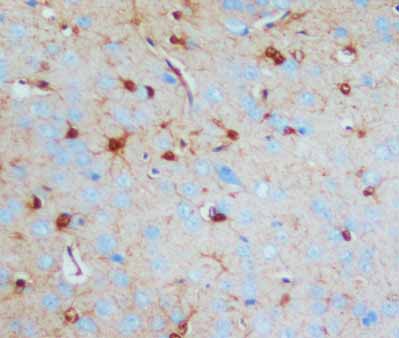
- 产品详情
- 实验流程
- 背景知识
Application 
| IHC-P |
|---|---|
| Primary Accession | P04631 |
| Host | Mouse |
| Isotype | Mouse IgG1 |
| Reactivity | Human, Rat |
| Clonality | Monoclonal |
| Format | Lyophilized |
| Description | Mouse IgG monoclonal antibody for S-100 (beta-subunit), S100 calcium binding protein B (S100B) detection. Tested with IHC-P in Human;rabbit;rat. No cross reactivity with other proteins. |
| Reconstitution | Add 1ml of PBS buffer will yield a concentration of 100ug/ml. |
| Gene ID | 25742 |
|---|---|
| Other Names | Protein S100-B, S-100 protein beta chain, S-100 protein subunit beta, S100 calcium-binding protein B, S100b |
| Calculated MW | 10744 Da |
| Application Details | Immunohistochemistry(Paraffin-embedded Section), 1-2 µg/ml, Human, rabbit, rat, By Heat |
| Subcellular Localization | Cytoplasm . Nucleus . |
| Tissue Specificity | Although predominant among the water-soluble brain proteins, S100 is also found in a variety of other tissues. . |
| Source | Eukaryota |
| Protein Name | Protein S100-B |
| Contents | Mouse ascites fluid, 1.2% sodium acetate, 2mg BSA, with 0.01mg NaN3 as preservative. |
| Clone Names | SH-B1 |
| Immunogen | Bovine brain S-100b. |
| Purification | Ascites |
| Cross Reactivity | No cross reactivity with other proteins |
| Storage | At -20˚C for one year. After r˚Constitution, at 4˚C for one month. It˚Can also be aliquotted and stored frozen at -20˚C for a longer time.Avoid repeated freezing and thawing. |
| Sequence Similarities | Belongs to the S-100 family. |
For Research Use Only. Not For Use In Diagnostic Procedures.
| Name | S100b {ECO:0000303|PubMed:19910580, ECO:0000312|RGD:3615} |
|---|---|
| Function | Small zinc- and- and calcium-binding protein that is highly expressed in astrocytes and constitutes one of the most abundant soluble proteins in brain (PubMed:14621986, PubMed:15823027, PubMed:18949447, PubMed:20351179). Weakly binds calcium but binds zinc very tightly-distinct binding sites with different affinities exist for both ions on each monomer (PubMed:15823027). Physiological concentrations of potassium ion antagonize the binding of both divalent cations, especially affecting high-affinity calcium-binding sites (By similarity). Acts as a neurotrophic factor that promotes astrocytosis and axonal proliferation (By similarity). Involved in innervation of thermogenic adipose tissue by acting as an adipocyte-derived neurotrophic factor that promotes sympathetic innervation of adipose tissue (By similarity). Binds to and initiates the activation of STK38 by releasing autoinhibitory intramolecular interactions within the kinase (By similarity). Interaction with AGER after myocardial infarction may play a role in myocyte apoptosis by activating ERK1/2 and p53/TP53 signaling (PubMed:19910580). Could assist ATAD3A cytoplasmic processing, preventing aggregation and favoring mitochondrial localization (By similarity). May mediate calcium- dependent regulation on many physiological processes by interacting with other proteins, such as TPR-containing proteins, and modulating their activity (By similarity). |
| Cellular Location | Cytoplasm {ECO:0000250|UniProtKB:P04271}. Nucleus {ECO:0000250|UniProtKB:P04271}. Secreted {ECO:0000250|UniProtKB:P50114}. Note=Secretion into the medium is promoted by interaction with isoform CLSTN3beta of CLSTN3 {ECO:0000250|UniProtKB:P50114} |
| Tissue Location | Although predominant among the water-soluble brain proteins, S100 is also found in a variety of other tissues |
Provided below are standard protocols that you may find useful for product applications.
BACKGROUND
S100 protein is a 21,000-Da component first isolated from brain by Moore(1965). Immunocytochemical studies demonstrated that S100 protein is produced by a wide variety of normal and neoplastic cells of mesodermal, neuroectodermal, and epithelial origin(Herrera et al., 1988). The S100 molecule is a dimer; thus there are 3 forms of S100: alpha-alpha, known as S-100a(0); alpha-beta, known as S-100a; and beta-beta, known as S-100b. S100 genes are clustered on human chromosome 1q21. S-100 protein expression by primary and metastatic adenocarcinomas.

终于等到您。ABCEPTA(百远生物)抗体产品。
点击下方“我要评价 ”按钮提交您的反馈信息,您的反馈和评价是我们最宝贵的财富之一,
我们将在1-3个工作日内处理您的反馈信息。
如有疑问,联系:0512-88856768 tech-china@abcepta.com.


