


 癌症的基本特征包括细胞增殖、血管生成、迁移、凋亡逃避机制和细胞永生等。找到癌症发生过程中这些通路的关键标记物和对应的抗体用于检测至关重要。
 为您推荐一个泛素化位点预测神器——泛素化分析工具,可以为您的蛋白的泛素化位点作出预测和评分。
 细胞自噬受体图形绘图工具为你的蛋白的细胞受体结合位点作出预测和评分,识别结合到自噬通路中的蛋白是非常重要的,便于让我们理解自噬在正常生理、病理过程中的作用,如发育、细胞分化、神经退化性疾病、压力条件下、感染和癌症。
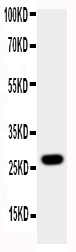
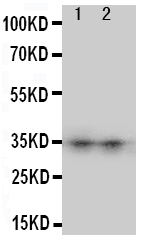
Anti-Aquaporin 8 Antibody
- 产品详情
- 实验流程
- 背景知识
Application 
| WB |
|---|---|
| Primary Accession | O94778 |
| Host | Rabbit |
| Reactivity | Human |
| Clonality | Polyclonal |
| Format | Lyophilized |
| Description | Rabbit IgG polyclonal antibody for Aquaporin-8(AQP8) detection. Tested with WB in Human. |
| Reconstitution | Add 0.2ml of distilled water will yield a concentration of 500ug/ml. |
| Gene ID | 343 |
|---|---|
| Other Names | Aquaporin-8, AQP-8, AQP8 |
| Calculated MW | 27381 Da |
| Application Details | Western blot, 0.1-0.5 µg/ml, Human |
| Subcellular Localization | Membrane; Multi-pass membrane protein. |
| Tissue Specificity | Expressed only in pancreas and colon. |
| Source | Eukaryota |
| Protein Name | Aquaporin-8(AQP-8) |
| Contents | Each vial contains 5mg BSA, 0.9mg NaCl, 0.2mg Na2HPO4, 0.05mg Thimerosal, 0.05mg NaN3. |
| Immunogen | A synthetic peptide corresponding to a sequence at the N-terminus of human Aquaporin 8(1-19aa MSGEIAMCEPEFGNDKARE). |
| Purification | Immunogen affinity purified. |
| Cross Reactivity | No cross reactivity with other proteins |
| Storage | At -20˚C for one year. After r˚Constitution, at 4˚C for one month. It˚Can also be aliquotted and stored frozen at -20˚C for a longer time.Avoid repeated freezing and thawing. |
For Research Use Only. Not For Use In Diagnostic Procedures.
| Name | AQP8 (HGNC:642) |
|---|---|
| Function | Channel that allows the facilitated permeation of water and uncharged molecules, such as hydrogen peroxide and the neutral form of ammonia (NH3), through cellular membranes such as plasma membrane, inner mitochondrial membrane and endoplasmic reticulum membrane of several tissues (PubMed:15948717, PubMed:18948439, PubMed:23541115, PubMed:26972385, PubMed:29732408, PubMed:30579780). The transport of the ammonia neutral form induces a parallel transport of proton, at alkaline pH when the concentration of ammonia is high (By similarity). However, it is unclear whether the transport of proton takes place via the aquaporin or via an endogenous pathway (By similarity). Also, may transport ammonia analogs such as formamide and methylamine, a transport favourited at basic pH due to the increase of unprotonated (neutral) form, which is expected to favor diffusion (PubMed:15948717). Does not transport urea or glycerol (PubMed:15948717). The water transport mechanism is mercury- and copper-sensitive and passive in response to osmotic driving forces (PubMed:15948717). At the canicular plasma membrane, mediates the osmotic transport of water toward the bile canaliculus and facilitates the cAMP-induced bile canalicular water secretion, a process involved in bile formation (PubMed:18948439). In addition, mediates the hydrogen peroxide release from hepatocyte mitochondria that modulates the SREBF2-mediated cholesterol synthesis and facilitates the mitochondrial ammonia uptake which is metabolized into urea, mainly under glucagon stimulation (PubMed:30579780, PubMed:34292591). In B cells, transports the CYBB- generated hydrogen peroxide from the external leaflet of the plasma membrane to the cytosol to promote B cell activation and differentiation for signal amplification (By similarity). In the small intestine and colon system, mediates water transport through mitochondria and apical membrane of epithelial cells (By similarity). May play an important role in the adaptive response of proximal tubule cells to acidosis possibly by facilitating the mitochondrial ammonia transport (PubMed:22622463). |
| Cellular Location | Cell membrane; Multi-pass membrane protein. Mitochondrion inner membrane; Multi-pass membrane protein. Apical cell membrane {ECO:0000250|UniProtKB:P56404, ECO:0000250|UniProtKB:P56405}; Multi-pass membrane protein. Basolateral cell membrane {ECO:0000250|UniProtKB:P56405}; Multi-pass membrane protein. Smooth endoplasmic reticulum membrane {ECO:0000250|UniProtKB:P56404}; Multi-pass membrane protein. Note=Localized at the hepatocyte canalicular plasma membrane (PubMed:18948439). Localized at the apical membrane of the gall-bladder epithelial cells lining both the neck and corpus regions, the pancreatic acinar cells and mucosal epithelium of the colon and jejunum (By similarity). Trafficking from intracellular vesicles to the hepatocyte canalicular plasma membrane is induced by glucagon or the second messenger 3',5'-cyclic AMP and the translocation is protein kinase A and microtubule-dependent. Localized at the brush border membranes of epithelial cells from jejunum (By similarity). Localized at the luminal membranes of crypts in ascending colon (By similarity) {ECO:0000250|UniProtKB:P56404, ECO:0000250|UniProtKB:P56405, ECO:0000269|PubMed:18948439} |
| Tissue Location | Detected in the sperm midpiece (at protein level) (PubMed:28042826). Expressed only in pancreas and colon |
Provided below are standard protocols that you may find useful for product applications.
BACKGROUND
AQP8, also known as Aquaporin-8, is a protein that in humans is encoded by the AQP8 gene. Aquaporin 8(AQP8) is a water channel protein. Aquaporins are a family of small integral membrane proteins related to the major intrinsic protein(MIP or AQP0). Aquaporin 8 mRNA is found in pancreas and colon but not other tissues. The AQP8 gene contains 6 exons. It is mapped to chromosome 16p12. Northern blot analysis of human tissues detected a 1.35-kb AQP8 mRNA only in pancreas and colon.

终于等到您。ABCEPTA(百远生物)抗体产品。
点击下方“我要评价 ”按钮提交您的反馈信息,您的反馈和评价是我们最宝贵的财富之一,
我们将在1-3个工作日内处理您的反馈信息。
如有疑问,联系:0512-88856768 tech-china@abcepta.com.


