


 癌症的基本特征包括细胞增殖、血管生成、迁移、凋亡逃避机制和细胞永生等。找到癌症发生过程中这些通路的关键标记物和对应的抗体用于检测至关重要。
 为您推荐一个泛素化位点预测神器——泛素化分析工具,可以为您的蛋白的泛素化位点作出预测和评分。
 细胞自噬受体图形绘图工具为你的蛋白的细胞受体结合位点作出预测和评分,识别结合到自噬通路中的蛋白是非常重要的,便于让我们理解自噬在正常生理、病理过程中的作用,如发育、细胞分化、神经退化性疾病、压力条件下、感染和癌症。
Anti-ALOX5 Antibody
- 产品详情
- 实验流程
- 背景知识
Application 
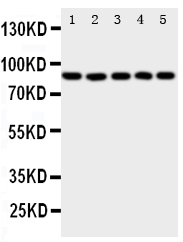
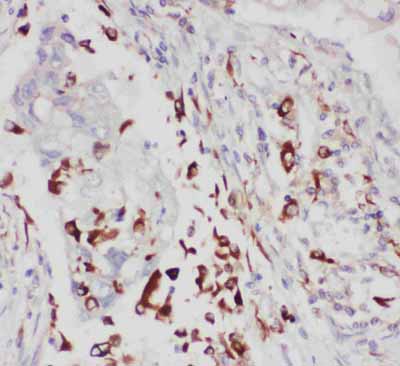
| WB, IHC-P |
|---|---|
| Primary Accession | P09917 |
| Host | Rabbit |
| Reactivity | Human |
| Clonality | Polyclonal |
| Format | Lyophilized |
| Description | Rabbit IgG polyclonal antibody for Arachidonate 5-lipoxygenase(ALOX5) detection. Tested with WB, IHC-P in Human. |
| Reconstitution | Add 0.2ml of distilled water will yield a concentration of 500ug/ml. |
| Gene ID | 240 |
|---|---|
| Other Names | Arachidonate 5-lipoxygenase, 5-LO, 5-lipoxygenase, 1.13.11.34, ALOX5, LOG5 |
| Calculated MW | 77983 Da |
| Application Details | Immunohistochemistry(Paraffin-embedded Section), 0.5-1 µg/ml, Human, By Heat Western blot, 0.1-0.5 µg/ml, Human |
| Subcellular Localization | Cytoplasm. Nucleus matrix. Nucleus membrane; Peripheral membrane protein. Shuttles between cytoplasm and nucleus. Found exclusively in the nucleus, when phosphorylated on Ser-272. Calcium binding promotes translocation from the cytosol and the nuclear matrix to the nuclear envelope and membrane association. |
| Source | Eukaryota |
| Protein Name | Arachidonate 5-lipoxygenase(5-LO/5-lipoxygenase) |
| Contents | Each vial contains 5mg BSA, 0.9mg NaCl, 0.2mg Na2HPO4, 0.05mg Thimerosal, 0.05mg NaN3. |
| Immunogen | A synthetic peptide corresponding to a sequence at the C-terminus of human ALOX5 (650-667aa AERNKKKQLPYYYLSPDR), different from the related rat and mouse sequences by two amino acids. |
| Purification | Immunogen affinity purified. |
| Cross Reactivity | No cross reactivity with other proteins |
| Storage | At -20˚C for one year. After r˚Constitution, at 4˚C for one month. It˚Can also be aliquotted and stored frozen at -20˚C for a longer time.Avoid repeated freezing and thawing. |
| Sequence Similarities | Belongs to the lipoxygenase family. |
For Research Use Only. Not For Use In Diagnostic Procedures.
| Name | ALOX5 (HGNC:435) |
|---|---|
| Synonyms | LOG5 |
| Function | Catalyzes the oxygenation of arachidonate ((5Z,8Z,11Z,14Z)- eicosatetraenoate) to 5-hydroperoxyeicosatetraenoate (5-HPETE) followed by the dehydration to 5,6- epoxyeicosatetraenoate (Leukotriene A4/LTA4), the first two steps in the biosynthesis of leukotrienes, which are potent mediators of inflammation (PubMed:19022417, PubMed:21233389, PubMed:22516296, PubMed:23246375, PubMed:24282679, PubMed:24893149, PubMed:31664810, PubMed:8615788, PubMed:8631361). Also catalyzes the oxygenation of arachidonate into 8- hydroperoxyicosatetraenoate (8-HPETE) and 12- hydroperoxyicosatetraenoate (12-HPETE) (PubMed:23246375). Displays lipoxin synthase activity being able to convert (15S)-HETE into a conjugate tetraene (PubMed:31664810). Although arachidonate is the preferred substrate, this enzyme can also metabolize oxidized fatty acids derived from arachidonate such as (15S)-HETE, eicosapentaenoate (EPA) such as (18R)- and (18S)-HEPE or docosahexaenoate (DHA) which lead to the formation of specialized pro-resolving mediators (SPM) lipoxin and resolvins E and D respectively, therefore it participates in anti-inflammatory responses (PubMed:17114001, PubMed:21206090, PubMed:31664810, PubMed:32404334, PubMed:32841762, PubMed:8615788). Oxidation of DHA directly inhibits endothelial cell proliferation and sprouting angiogenesis via peroxisome proliferator-activated receptor gamma (PPARgamma) (By similarity). It does not catalyze the oxygenation of linoleic acid and does not convert (5S)-HETE to lipoxin isomers (PubMed:31664810). In addition to inflammatory processes, it participates in dendritic cell migration, wound healing through an antioxidant mechanism based on heme oxygenase-1 (HO-1) regulation expression, monocyte adhesion to the endothelium via ITGAM expression on monocytes (By similarity). Moreover, it helps establish an adaptive humoral immunity by regulating primary resting B cells and follicular helper T cells and participates in the CD40-induced production of reactive oxygen species (ROS) after CD40 ligation in B cells through interaction with PIK3R1 that bridges ALOX5 with CD40 (PubMed:21200133). May also play a role in glucose homeostasis, regulation of insulin secretion and palmitic acid-induced insulin resistance via AMPK (By similarity). Can regulate bone mineralization and fat cell differentiation increases in induced pluripotent stem cells (By similarity). |
| Cellular Location | Cytoplasm {ECO:0000250|UniProtKB:P48999, ECO:0000269|PubMed:18978352}. Nucleus matrix. Nucleus membrane; Peripheral membrane protein. Cytoplasm, perinuclear region. Cytoplasm, cytosol. Nucleus envelope. Nucleus intermembrane space. Note=Shuttles between cytoplasm and nucleus (PubMed:19233132). Found exclusively in the nucleus, when phosphorylated on Ser-272 (PubMed:18978352). Calcium binding promotes translocation from the cytosol and the nuclear matrix to the nuclear envelope and membrane association (PubMed:16275640, PubMed:19233132, PubMed:3118366, PubMed:8245774). |
Provided below are standard protocols that you may find useful for product applications.
BACKGROUND
ALOX5(ARACHIDONATE 5-LIPOXYGENASE), also known as LOG5 or 5-LO(5-LIPOXYGENASE), is an enzyme that in humans is encoded by the ALOX5 gene. ALOX5 is a member of the lipoxygenase family of enzymes which also transforms EFAs into leukotrienes and is a current target for pharmaceutical intervention in a number of diseases. The enzyme 5-lipoxygenase catalyzes 2 reactions in the formation of leukotrienes. The ALOX5 gene is mapped to chromosome 10q11.21 based on an alignment of the ALOX5 sequence with the genomic sequence. Human 5-LO contains 3 nuclear localization sequences(NLSs) and a phosphorylation site involved in nuclear localization. Compared with age-matched 5-LO competent mice, the 5-LO knockout mice developed less right heart hypertrophy. Pharmacologic inhibition or ALOX5 gene disruption resulted in a significant decrease of beta-amyloid production and gamma-secretase levels. ALOX5 activity is short-lived, apparently in part because of an intrinsic instability of the enzyme.

终于等到您。ABCEPTA(百远生物)抗体产品。
点击下方“我要评价 ”按钮提交您的反馈信息,您的反馈和评价是我们最宝贵的财富之一,
我们将在1-3个工作日内处理您的反馈信息。
如有疑问,联系:0512-88856768 tech-china@abcepta.com.


