


 癌症的基本特征包括细胞增殖、血管生成、迁移、凋亡逃避机制和细胞永生等。找到癌症发生过程中这些通路的关键标记物和对应的抗体用于检测至关重要。
 为您推荐一个泛素化位点预测神器——泛素化分析工具,可以为您的蛋白的泛素化位点作出预测和评分。
 细胞自噬受体图形绘图工具为你的蛋白的细胞受体结合位点作出预测和评分,识别结合到自噬通路中的蛋白是非常重要的,便于让我们理解自噬在正常生理、病理过程中的作用,如发育、细胞分化、神经退化性疾病、压力条件下、感染和癌症。
Anti-CIAS1/NALP3 Antibody
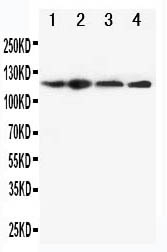
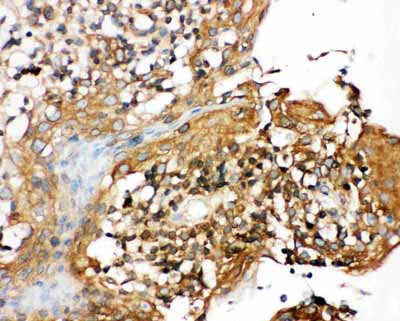
- 产品详情
- 实验流程
- 背景知识
Application 
| WB, IHC-P |
|---|---|
| Primary Accession | Q96P20 |
| Host | Rabbit |
| Reactivity | Human, Mouse, Rat |
| Clonality | Polyclonal |
| Format | Lyophilized |
| Description | Rabbit IgG polyclonal antibody for NACHT, LRR and PYD domains-containing protein 3(NLRP3) detection. Tested with WB, IHC-P in Human;Mouse;Rat. |
| Reconstitution | Add 0.2ml of distilled water will yield a concentration of 500ug/ml. |
| Gene ID | 114548 |
|---|---|
| Other Names | NACHT, LRR and PYD domains-containing protein 3, Angiotensin/vasopressin receptor AII/AVP-like, Caterpiller protein 1.1, CLR1.1, Cold-induced autoinflammatory syndrome 1 protein, Cryopyrin, PYRIN-containing APAF1-like protein 1, NLRP3, C1orf7, CIAS1, NALP3, PYPAF1 |
| Calculated MW | 118173 Da |
| Application Details | Immunohistochemistry(Paraffin-embedded Section), 0.5-1 µg/ml, Human, Rat, Mouse, By Heat Western blot, 0.1-0.5 µg/ml, Human |
| Subcellular Localization | Cytoplasm . |
| Tissue Specificity | Expressed in blood leukocytes. Strongly expressed in polymorphonuclear cells and osteoblasts. Undetectable or expressed at a lower magnitude in B- and T-lymphoblasts, respectively. High level of expression detected in chondrocytes. Detected in non-keratinizing epithelia of oropharynx, esophagus and ectocervix and in the urothelial layer of the bladder. . |
| Source | Eukaryota |
| Protein Name | NACHT, LRR and PYD domains-containing protein 3 |
| Contents | Each vial contains 5mg BSA, 0.9mg NaCl, 0.2mg Na2HPO4, 0.05mg Thimerosal, 0.05mg NaN3. |
| Immunogen | A synthetic peptide corresponding to a sequence at the N-terminus of human CIAS1(12-31aa RYLEDLEDVDLKKFKMHLED), different from the related rat and mouse sequences by one amino acid. |
| Purification | Immunogen affinity purified. |
| Cross Reactivity | No cross reactivity with other proteins |
| Storage | At -20˚C for one year. After r˚Constitution, at 4˚C for one month. It˚Can also be aliquotted and stored frozen at -20˚C for a longer time.Avoid repeated freezing and thawing. |
| Sequence Similarities | Belongs to the NLRP family. |
For Research Use Only. Not For Use In Diagnostic Procedures.
| Name | NLRP3 {ECO:0000303|PubMed:17907925, ECO:0000312|HGNC:HGNC:16400} |
|---|---|
| Function | Sensor component of the NLRP3 inflammasome, which mediates inflammasome activation in response to defects in membrane integrity, leading to secretion of inflammatory cytokines IL1B and IL18 and pyroptosis (PubMed:16407889, PubMed:18403674, PubMed:18604214, PubMed:23582325, PubMed:25686105, PubMed:27929086, PubMed:28656979, PubMed:28847925, PubMed:30487600, PubMed:30612879, PubMed:31086327, PubMed:31086329, PubMed:31189953, PubMed:33231615, PubMed:34133077, PubMed:34341353, PubMed:34512673, PubMed:36442502, PubMed:40250624, PubMed:40450990). In response to pathogens and other damage-associated signals that affect the integrity of membranes, initiates the formation of the inflammasome polymeric complex composed of NLRP3, CASP1 and PYCARD/ASC (PubMed:16407889, PubMed:18403674, PubMed:27432880, PubMed:28847925, PubMed:31189953, PubMed:33231615, PubMed:34133077, PubMed:34341353, PubMed:36142182, PubMed:36442502). Recruitment of pro- caspase-1 (proCASP1) to the NLRP3 inflammasome promotes caspase-1 (CASP1) activation, which subsequently cleaves and activates inflammatory cytokines IL1B and IL18 and gasdermin-D (GSDMD), promoting cytokine secretion and pyroptosis (PubMed:23582325, PubMed:28847925, PubMed:31189953, PubMed:33231615, PubMed:34133077, PubMed:34341353). Activation of NLRP3 inflammasome is also required for HMGB1 secretion; stimulating inflammatory responses (PubMed:22801494). Involved in the homeostatic wound healing response to tissue injury, a multistep cascade that guides neutrophil migration to necrotic sites while avoiding collateral damage of healthy tissues. ATP released from necrotic cells triggers activation of NLRP3 inflammasome through P2RX7 signaling leading to neutrophil adhesion to the vascular endothelium close to the injury site (By similarity). Under resting conditions, ADP-bound NLRP3 is autoinhibited (PubMed:35114687). NLRP3 activation stimuli include extracellular ATP, nigericin, reactive oxygen species, crystals of monosodium urate or cholesterol, amyloid-beta fibers, environmental or industrial particles and nanoparticles, such as asbestos, silica, aluminum salts, cytosolic dsRNA, etc (PubMed:16407889, PubMed:18403674, PubMed:18604214, PubMed:19414800, PubMed:23871209). Almost all stimuli trigger intracellular K(+) efflux (By similarity). These stimuli lead to membrane perturbation and activation of NLRP3 (By similarity). Upon activation, NLRP3 is transported to microtubule organizing center (MTOC), where it is unlocked by NEK7, leading to its relocalization to dispersed trans- Golgi network (dTGN) vesicle membranes and formation of an active inflammasome complex (PubMed:36442502, PubMed:39173637). Associates with dTGN vesicle membranes by binding to phosphatidylinositol 4- phosphate (PtdIns4P) (PubMed:30487600, PubMed:34554188). Shows ATPase activity (PubMed:17483456). |
| Cellular Location | Cytoplasm, cytosol. Inflammasome. Cytoplasm, cytoskeleton, microtubule organizing center. Golgi apparatus membrane. Endoplasmic reticulum {ECO:0000250|UniProtKB:Q8R4B8}. Mitochondrion. Secreted. Nucleus {ECO:0000250|UniProtKB:Q8R4B8} Note=In macrophages, under resting conditions, mainly located in the cytosol and on membranes of various organelles, such as endoplasmic reticulum, mitochondria and Golgi: forms an inactive double-ring cage that is primarily localized on membranes (By similarity). Upon activation, NLRP3 is transported to microtubule organizing center (MTOC), where it is unlocked by NEK7, leading to its relocalization to dispersed trans-Golgi network (dTGN) vesicle membranes for the formation of an active inflammasome complex (PubMed:39173637) Recruited to dTGN vesicle membranes by binding to phosphatidylinositol 4-phosphate (PtdIns4P) (PubMed:30487600). After the induction of pyroptosis, inflammasome specks are released into the extracellular space where they can further promote IL1B processing and where they can be engulfed by macrophages (PubMed:24952504). Phagocytosis induces lysosomal damage and inflammasome activation in the recipient cells (PubMed:24952504). In the Th2 subset of CD4(+) helper T cells, mainly located in the nucleus (By similarity). Nuclear localization depends upon KPNA2 (By similarity). In the Th1 subset of CD4(+) helper T cells, mainly cytoplasmic (By similarity). {ECO:0000250|UniProtKB:Q8R4B8, ECO:0000269|PubMed:24952504, ECO:0000269|PubMed:30487600, ECO:0000269|PubMed:39173637} |
| Tissue Location | Predominantly expressed in macrophages (PubMed:33231615, PubMed:34133077). Also expressed in dendritic cells, B- and T-cells (at protein level) (PubMed:11786556, PubMed:17164409) Expressed in LPS-treated granulocytes, but not in resting cells (at protein level) (PubMed:17164409). Expression in monocytes is very weak (at protein level) (PubMed:17164409). Expressed in stratified non- keratinizing squamous epithelium, including oral, esophageal and ectocervical mucosa and in the Hassall's corpuscles in the thymus Also, detected in the stratified epithelium covering the bladder and ureter (transitional mucosa) (at protein level) (PubMed:17164409) Expressed in lung epithelial cells (at protein level) (PubMed:23229815). Expressed in chondrocytes (PubMed:12032915) Expressed at low levels in resting osteoblasts (PubMed:17907925) |
Provided below are standard protocols that you may find useful for product applications.
BACKGROUND
NLRP3(NLR FAMILY, PYRIN DOMAIN-CONTAINING 3), also known as CIAS1, CRYOPYRIN, NALP3 or PYPAF1, is a protein that in humans is encoded by the NLRP3(NOD-like receptor family, pryin domain containing 3) gene. The NLRP3 gene encodes a pyrin-like protein expressed predominantly in peripheral blood leukocytes. And the NLRP3 gene is mapped on 1q44. NLRP3 interacts with apoptosis-associated speck-like protein containing a CARD(ASC). The encoded protein may play a role in the regulation of inflammation and apoptosis. Mutation of the NALP3 nucleotide-binding domain reduced ATP binding, CASP1 activation, IL1B production, cell death, macromolecular complex formation, self-association, and association with ASC. Consistent with an essential role for Nlrp3 inflammasomes in antifungal immunity, Gross et al.showed that Nlrp3-deficient mice are hypersusceptible to C. albicans infection. Activation of the NLRP3 inflammasome in response to virus or to RNA was dependent upon lysosomal maturation and reactive oxygen species production in human cells. The NLRP3 inflammasome senses obesity-associated danger signals and contributes to obesity-induced inflammation and insulin resistance.

终于等到您。ABCEPTA(百远生物)抗体产品。
点击下方“我要评价 ”按钮提交您的反馈信息,您的反馈和评价是我们最宝贵的财富之一,
我们将在1-3个工作日内处理您的反馈信息。
如有疑问,联系:0512-88856768 tech-china@abcepta.com.


