


 癌症的基本特征包括细胞增殖、血管生成、迁移、凋亡逃避机制和细胞永生等。找到癌症发生过程中这些通路的关键标记物和对应的抗体用于检测至关重要。
 为您推荐一个泛素化位点预测神器——泛素化分析工具,可以为您的蛋白的泛素化位点作出预测和评分。
 细胞自噬受体图形绘图工具为你的蛋白的细胞受体结合位点作出预测和评分,识别结合到自噬通路中的蛋白是非常重要的,便于让我们理解自噬在正常生理、病理过程中的作用,如发育、细胞分化、神经退化性疾病、压力条件下、感染和癌症。
Anti-Daxx Antibody
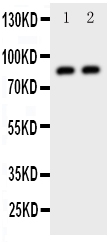
- 产品详情
- 实验流程
- 背景知识
Application 
| WB |
|---|---|
| Primary Accession | Q9UER7 |
| Host | Rabbit |
| Reactivity | Human, Mouse, Rat |
| Clonality | Polyclonal |
| Format | Lyophilized |
| Description | Rabbit IgG polyclonal antibody for Death domain-associated protein 6(DAXX) detection. Tested with WB in Human;Mouse;Rat. |
| Reconstitution | Add 0.2ml of distilled water will yield a concentration of 500ug/ml. |
| Gene ID | 1616 |
|---|---|
| Other Names | Death domain-associated protein 6, Daxx, hDaxx, ETS1-associated protein 1, EAP1, Fas death domain-associated protein, DAXX, BING2, DAP6 |
| Calculated MW | 81373 Da |
| Application Details | Western blot, 0.1-0.5 µg/ml, Human, Mouse, Rat |
| Subcellular Localization | Cytoplasm. Nucleus, nucleoplasm. Nucleus, PML body . Nucleus, nucleolus. Chromosome, centromere. Dispersed throughout the nucleoplasm, in PML/POD/ND10 nuclear bodies, and in nucleoli. Colocalizes with histone H3.3, ATRX, HIRA and ASF1A at PML-nuclear bodies. Colocalizes with a subset of interphase centromeres, but is absent from mitotic centromeres. Detected in cytoplasmic punctate structures. Translocates from the nucleus to the cytoplasm upon glucose deprivation or oxidative stress. Colocalizes with RASSF1 in the nucleus. Colocalizes with USP7 in nucleoplasma with accumulation in speckled structures. |
| Tissue Specificity | Ubiquitous. |
| Source | Eukaryota |
| Protein Name | Death domain-associated protein 6 |
| Contents | Each vial contains 5mg BSA, 0.9mg NaCl, 0.2mg Na2HPO4, 0.05mg Thimerosal, 0.05mg NaN3. |
| Immunogen | A synthetic peptide corresponding to a sequence in the middle region of human Daxx(325-341aa QERRHLDLIYNFGCHLT), identical to the related mouse and rat sequences. |
| Purification | Immunogen affinity purified. |
| Cross Reactivity | No cross reactivity with other proteins |
| Storage | At -20˚C for one year. After r˚Constitution, at 4˚C for one month. It˚Can also be aliquotted and stored frozen at -20˚C for a longer time.Avoid repeated freezing and thawing. |
| Sequence Similarities | Belongs to the DAXX family. |
For Research Use Only. Not For Use In Diagnostic Procedures.
| Name | DAXX |
|---|---|
| Synonyms | BING2, DAP6 |
| Function | Transcription corepressor known to repress transcriptional potential of several sumoylated transcription factors. Down-regulates basal and activated transcription. Its transcription repressor activity is modulated by recruiting it to subnuclear compartments like the nucleolus or PML/POD/ND10 nuclear bodies through interactions with MCSR1 and PML, respectively. Seems to regulate transcription in PML/POD/ND10 nuclear bodies together with PML and may influence TNFRSF6-dependent apoptosis thereby. Inhibits transcriptional activation of PAX3 and ETS1 through direct protein-protein interactions. Modulates PAX5 activity; the function seems to involve CREBBP. Acts as an adapter protein in a MDM2-DAXX-USP7 complex by regulating the RING-finger E3 ligase MDM2 ubiquitination activity. Under non-stress condition, in association with the deubiquitinating USP7, prevents MDM2 self-ubiquitination and enhances the intrinsic E3 ligase activity of MDM2 towards TP53, thereby promoting TP53 ubiquitination and subsequent proteasomal degradation. Upon DNA damage, its association with MDM2 and USP7 is disrupted, resulting in increased MDM2 autoubiquitination and consequently, MDM2 degradation, which leads to TP53 stabilization. Acts as a histone chaperone that facilitates deposition of histone H3.3. Acts as a targeting component of the chromatin remodeling complex ATRX:DAXX which has ATP-dependent DNA translocase activity and catalyzes the replication-independent deposition of histone H3.3 in pericentric DNA repeats outside S-phase and telomeres, and the in vitro remodeling of H3.3-containing nucleosomes. Does not affect the ATPase activity of ATRX but alleviates its transcription repression activity. Upon neuronal activation associates with regulatory elements of selected immediate early genes where it promotes deposition of histone H3.3 which may be linked to transcriptional induction of these genes. Required for the recruitment of histone H3.3:H4 dimers to PML-nuclear bodies (PML-NBs); the process is independent of ATRX and facilitated by ASF1A; PML-NBs are suggested to function as regulatory sites for the incorporation of newly synthesized histone H3.3 into chromatin. In case of overexpression of centromeric histone variant CENPA (as found in various tumors) is involved in its mislocalization to chromosomes; the ectopic localization involves a heterotypic tetramer containing CENPA, and histones H3.3 and H4 and decreases binding of CTCF to chromatin. Proposed to mediate activation of the JNK pathway and apoptosis via MAP3K5 in response to signaling from TNFRSF6 and TGFBR2. Interaction with HSPB1/HSP27 may prevent interaction with TNFRSF6 and MAP3K5 and block DAXX-mediated apoptosis. In contrast, in lymphoid cells JNC activation and TNFRSF6-mediated apoptosis may not involve DAXX. Shows restriction activity towards human cytomegalovirus (HCMV). Plays a role as a positive regulator of the heat shock transcription factor HSF1 activity during the stress protein response (PubMed:15016915). |
| Cellular Location | Cytoplasm. Nucleus, nucleoplasm. Nucleus, PML body. Nucleus, nucleolus. Chromosome, centromere Note=Dispersed throughout the nucleoplasm, in PML/POD/ND10 nuclear bodies, and in nucleoli (Probable). Colocalizes with histone H3.3, ATRX, HIRA and ASF1A at PML-nuclear bodies (PubMed:12953102, PubMed:14990586, PubMed:23222847, PubMed:24200965). Colocalizes with a subset of interphase centromeres, but is absent from mitotic centromeres (PubMed:9645950). Detected in cytoplasmic punctate structures (PubMed:11842083). Translocates from the nucleus to the cytoplasm upon glucose deprivation or oxidative stress (PubMed:12968034). Colocalizes with RASSF1 in the nucleus (PubMed:18566590). Colocalizes with USP7 in nucleoplasma with accumulation in speckled structures (PubMed:16845383) [Isoform gamma]: Nucleus. Note=Diffuse nuclear distribution pattern and no comparable dot-like accumulation of isoform 1 |
| Tissue Location | Ubiquitous. |
Provided below are standard protocols that you may find useful for product applications.
BACKGROUND
DAXX(death-domain associated protein) also known as DAP6(Death-associated protein 6) or BING2, was first discovered through its cytoplasmic interaction with the classical death receptor Fas. Human DAXX encodes a 740-amino acid polypeptide containing a nuclear localization signal. Functional analyses by Yang et al.(1997) demonstrated that Daxx binds to the Fas death domain and enhances Fas-mediated apoptosis. The authors suggested that DAXX and FADD define 2 distinct apoptotic pathways downstream of Fas. The DAXX gene is mapped to human chromosome 6p21.3 by somatic cell hybrid panels and fluorescence in situ hybridization, a region containing the HLA and putative autoimmune disease genes. MSP58 overexpression relieved DAXX-mediated transcriptional repression. Immunoprecipitation and Western blot analysis with DAXX mutants showed that the N terminus of DAXX interacts with the C terminus of DMAP. Transient expression of DAXX or DMAP1 caused repression of glucocorticoid receptor-mediated transcription.

终于等到您。ABCEPTA(百远生物)抗体产品。
点击下方“我要评价 ”按钮提交您的反馈信息,您的反馈和评价是我们最宝贵的财富之一,
我们将在1-3个工作日内处理您的反馈信息。
如有疑问,联系:0512-88856768 tech-china@abcepta.com.


