


 癌症的基本特征包括细胞增殖、血管生成、迁移、凋亡逃避机制和细胞永生等。找到癌症发生过程中这些通路的关键标记物和对应的抗体用于检测至关重要。
 为您推荐一个泛素化位点预测神器——泛素化分析工具,可以为您的蛋白的泛素化位点作出预测和评分。
 细胞自噬受体图形绘图工具为你的蛋白的细胞受体结合位点作出预测和评分,识别结合到自噬通路中的蛋白是非常重要的,便于让我们理解自噬在正常生理、病理过程中的作用,如发育、细胞分化、神经退化性疾病、压力条件下、感染和癌症。
Anti-GRP78 BiP Antibody
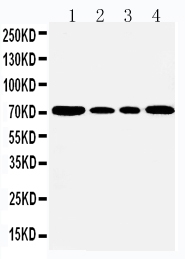
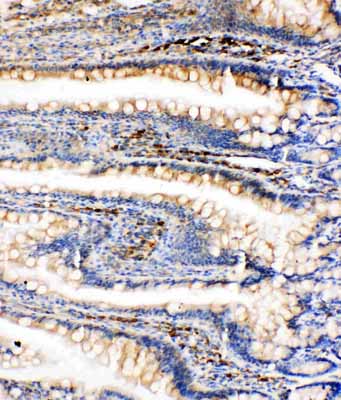
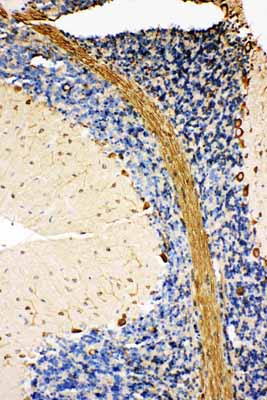
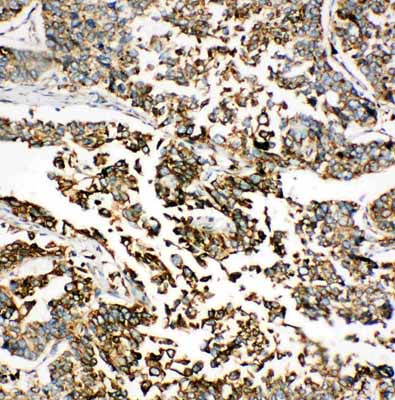
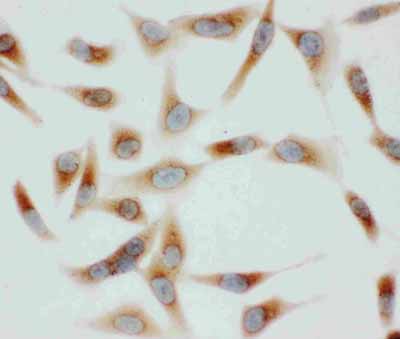
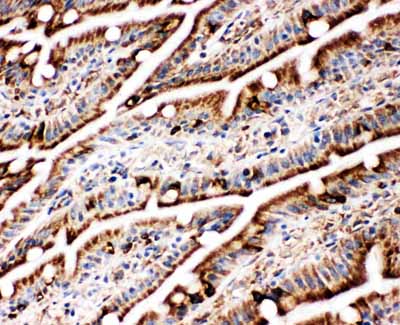
- 产品详情
- 实验流程
- 背景知识
Application 
| WB, IHC-P, IHC-F, ICC |
|---|---|
| Primary Accession | P11021 |
| Host | Rabbit |
| Reactivity | Human, Mouse, Rat |
| Clonality | Polyclonal |
| Format | Lyophilized |
| Description | Rabbit IgG polyclonal antibody for 78 kDa glucose-regulated protein(HSPA5) detection. Tested with WB, IHC-P, IHC-F, ICC in Human;Mouse;Rat. |
| Reconstitution | Add 0.2ml of distilled water will yield a concentration of 500ug/ml. |
| Gene ID | 3309 |
|---|---|
| Other Names | 78 kDa glucose-regulated protein, GRP-78, Endoplasmic reticulum lumenal Ca(2+)-binding protein grp78, Heat shock 70 kDa protein 5, Immunoglobulin heavy chain-binding protein, BiP, HSPA5, GRP78 |
| Calculated MW | 72333 Da |
| Application Details | Immunocytochemistry , 0.5-1 µg/ml, Human, Mouse, Rat Immunohistochemistry(Frozen Section), 0.5-1 µg/ml, Rat, Human, Mouse Immunohistochemistry(Paraffin-embedded Section), 0.5-1 µg/ml, Human, Rat, Mouse, By Heat Western blot, 0.1-0.5 µg/ml, Human, Rat, Mouse |
| Subcellular Localization | Endoplasmic reticulum lumen. Melanosome. Cytoplasm . Identified by mass spectrometry in melanosome fractions from stage I to stage IV. |
| Source | Eukaryota |
| Protein Name | 78 kDa glucose-regulated protein |
| Contents | Each vial contains 5mg BSA, 0.9mg NaCl, 0.2mg Na2HPO4, 0.05mg Thimerosal, 0.05mg NaN3. |
| Immunogen | A synthetic peptide corresponding to a sequence at the C-terminus of human GRP78 BiP(603-617aa EWLESHQDADIEDFK), identical to the related mouse and rat sequences. |
| Purification | Immunogen affinity purified. |
| Cross Reactivity | No cross reactivity with other proteins |
| Storage | At -20˚C for one year. After r˚Constitution, at 4˚C for one month. It˚Can also be aliquotted and stored frozen at -20˚C for a longer time.Avoid repeated freezing and thawing. |
| Sequence Similarities | Belongs to the heat shock protein 70 family. |
For Research Use Only. Not For Use In Diagnostic Procedures.
| Name | HSPA5 (HGNC:5238) |
|---|---|
| Function | Endoplasmic reticulum chaperone that plays a key role in protein folding and quality control in the endoplasmic reticulum lumen (PubMed:2294010, PubMed:23769672, PubMed:23990668, PubMed:28332555). Involved in the correct folding of proteins and degradation of misfolded proteins via its interaction with DNAJC10/ERdj5, probably to facilitate the release of DNAJC10/ERdj5 from its substrate (By similarity). Acts as a key repressor of the EIF2AK3/PERK and ERN1/IRE1- mediated unfolded protein response (UPR) (PubMed:11907036, PubMed:1550958, PubMed:19538957, PubMed:36739529). In the unstressed endoplasmic reticulum, recruited by DNAJB9/ERdj4 to the luminal region of ERN1/IRE1, leading to disrupt the dimerization of ERN1/IRE1, thereby inactivating ERN1/IRE1 (By similarity). Also binds and inactivates EIF2AK3/PERK in unstressed cells (PubMed:11907036). Accumulation of misfolded protein in the endoplasmic reticulum causes release of HSPA5/BiP from ERN1/IRE1 and EIF2AK3/PERK, allowing their homodimerization and subsequent activation (PubMed:11907036). Plays an auxiliary role in post-translational transport of small presecretory proteins across endoplasmic reticulum (ER). May function as an allosteric modulator for SEC61 channel-forming translocon complex, likely cooperating with SEC62 to enable the productive insertion of these precursors into SEC61 channel. Appears to specifically regulate translocation of precursors having inhibitory residues in their mature region that weaken channel gating. May also play a role in apoptosis and cell proliferation (PubMed:26045166). |
| Cellular Location | Endoplasmic reticulum lumen. Melanosome. Cytoplasm {ECO:0000250|UniProtKB:P20029}. Cell surface Note=Identified by mass spectrometry in melanosome fractions from stage I to stage IV (PubMed:12643545). Localizes to the cell surface of epithelial cells in response to high levels of free iron (PubMed:20484814, PubMed:24355926, PubMed:27159390) |
Provided below are standard protocols that you may find useful for product applications.
BACKGROUND
HSPA5(heat shock 70kDa protein 5) also known as glucose-regulated protein, 78kD(GRP78) or BiP, is a member of the heat-shock protein-70(HSP70) family and is involved in the folding and assembly of proteins in the endoplasmic reticulum. BiP is also an essential component of the translocation machinery, as well as playing a role in retrograde transport across the ER membrane of aberrant proteins destined for degradation by the proteasome. The HSPA5 gene is mapped on 9q33.3. Shen et al.(2002) concluded that HSPA5 retains ATF6 in the ER by inhibiting its Golgi localization signals and that dissociation of HSPA5 during ER stress allows ATF6 to be transported to the Golgi. The findings of Shen et al.(2002) demonstrated that HSPA5 is a key element in sensing the folding capacity within the ER.

终于等到您。ABCEPTA(百远生物)抗体产品。
点击下方“我要评价 ”按钮提交您的反馈信息,您的反馈和评价是我们最宝贵的财富之一,
我们将在1-3个工作日内处理您的反馈信息。
如有疑问,联系:0512-88856768 tech-china@abcepta.com.


