


 癌症的基本特征包括细胞增殖、血管生成、迁移、凋亡逃避机制和细胞永生等。找到癌症发生过程中这些通路的关键标记物和对应的抗体用于检测至关重要。
 为您推荐一个泛素化位点预测神器——泛素化分析工具,可以为您的蛋白的泛素化位点作出预测和评分。
 细胞自噬受体图形绘图工具为你的蛋白的细胞受体结合位点作出预测和评分,识别结合到自噬通路中的蛋白是非常重要的,便于让我们理解自噬在正常生理、病理过程中的作用,如发育、细胞分化、神经退化性疾病、压力条件下、感染和癌症。
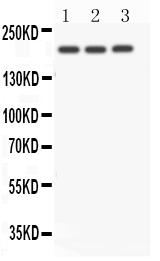
Anti-NOTCH4 Antibody
- 产品详情
- 实验流程
- 背景知识
Application 
| WB |
|---|---|
| Primary Accession | Q99466 |
| Host | Rabbit |
| Reactivity | Human |
| Clonality | Polyclonal |
| Format | Lyophilized |
| Description | Rabbit IgG polyclonal antibody for Neurogenic locus notch homolog protein 4(NOTCH4) detection. Tested with WB in Human. |
| Reconstitution | Add 0.2ml of distilled water will yield a concentration of 500ug/ml. |
| Gene ID | 4855 |
|---|---|
| Other Names | Neurogenic locus notch homolog protein 4, Notch 4, hNotch4, Notch 4 extracellular truncation, Notch 4 intracellular domain, NOTCH4, INT3 |
| Calculated MW | 209622 Da |
| Application Details | Western blot, 0.1-0.5 µg/ml, Human |
| Subcellular Localization | Cell membrane; Single-pass type I membrane protein. |
| Tissue Specificity | Highly expressed in the heart, moderately in the lung and placenta and at low levels in the liver, skeletal muscle, kidney, pancreas, spleen, lymph node, thymus, bone marrow and fetal liver. No expression was seen in adult brain or peripheral blood leukocytes. |
| Source | Eukaryota |
| Protein Name | Neurogenic locus notch homolog protein 4(Notch 4) |
| Contents | Each vial contains 5mg BSA, 0.9mg NaCl, 0.2mg Na2HPO4, 0.05mg Thimerosal, 0.05mg NaN3. |
| Immunogen | A synthetic peptide corresponding to a sequence at the C-terminus of human NOTCH4(1805-1818aa DVAHQRNHWDLLTL). |
| Purification | Immunogen affinity purified. |
| Cross Reactivity | No cross reactivity with other proteins |
| Storage | At -20˚C for one year. After r˚Constitution, at 4˚C for one month. It˚Can also be aliquotted and stored frozen at -20˚C for a longer time.Avoid repeated freezing and thawing. |
| Sequence Similarities | Belongs to the NOTCH family. |
For Research Use Only. Not For Use In Diagnostic Procedures.
| Name | NOTCH4 (HGNC:7884) |
|---|---|
| Synonyms | INT3 |
| Function | Functions as a receptor for membrane-bound ligands Jagged1, Jagged2 and Delta1 to regulate cell-fate determination. Upon ligand activation through the released notch intracellular domain (NICD) it forms a transcriptional activator complex with RBPJ/RBPSUH and activates genes of the enhancer of split locus. Affects the implementation of differentiation, proliferation and apoptotic programs. May regulate branching morphogenesis in the developing vascular system (By similarity). |
| Cellular Location | Cell membrane; Single-pass type I membrane protein |
| Tissue Location | Highly expressed in the heart, moderately in the lung and placenta and at low levels in the liver, skeletal muscle, kidney, pancreas, spleen, lymph node, thymus, bone marrow and fetal liver. No expression was seen in adult brain or peripheral blood leukocytes |
Provided below are standard protocols that you may find useful for product applications.
BACKGROUND
NOTCH4(NOTCH, DROSOPHILA, HOMOLOG OF, 4) also known as INT3 or NOTCH3, FORMERLY, is a member of the Notch family. In situ hybridization revealed that Notch4 transcripts are primarily restricted to endothelial cells in embryonic and adult life, suggesting a specific role forNotch4 during development of vertebrate endothelium. The sequences of the mouse and human NOTCH4 proteins are 82% identical. Northern blot analysis revealed that NOTCH4(S) is the major transcript and is expressed in a wide variety of tissues. Fluorescence in situ hybridization confirmed the location of the NOTCH4 gene at chromosome 6p21.3. In linkage disequilibrium mapping of the MHC region in 80 British parent-offspring trios, Wei and Hemmings(2000) found that NOTCH4 was highly associated with schizophrenia. Repression of Notch4 resolved ataxia and reversed the disease progression, demonstrating that Notch4 is not only sufficient to induce but also required to sustain the disease.Â

终于等到您。ABCEPTA(百远生物)抗体产品。
点击下方“我要评价 ”按钮提交您的反馈信息,您的反馈和评价是我们最宝贵的财富之一,
我们将在1-3个工作日内处理您的反馈信息。
如有疑问,联系:0512-88856768 tech-china@abcepta.com.


