


 癌症的基本特征包括细胞增殖、血管生成、迁移、凋亡逃避机制和细胞永生等。找到癌症发生过程中这些通路的关键标记物和对应的抗体用于检测至关重要。
 为您推荐一个泛素化位点预测神器——泛素化分析工具,可以为您的蛋白的泛素化位点作出预测和评分。
 细胞自噬受体图形绘图工具为你的蛋白的细胞受体结合位点作出预测和评分,识别结合到自噬通路中的蛋白是非常重要的,便于让我们理解自噬在正常生理、病理过程中的作用,如发育、细胞分化、神经退化性疾病、压力条件下、感染和癌症。
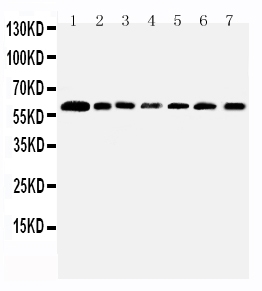
Anti-PRMT4 Antibody
- 产品详情
- 实验流程
- 背景知识
Application 
| WB |
|---|---|
| Primary Accession | Q86X55 |
| Host | Rabbit |
| Reactivity | Human, Mouse, Rat |
| Clonality | Polyclonal |
| Format | Lyophilized |
| Description | Rabbit IgG polyclonal antibody for Histone-arginine methyltransferase CARM1(CARM1) detection. Tested with WB in Human;Mouse;Rat. |
| Reconstitution | Add 0.2ml of distilled water will yield a concentration of 500ug/ml. |
| Gene ID | 10498 |
|---|---|
| Other Names | Histone-arginine methyltransferase CARM1, 2.1.1.319, Coactivator-associated arginine methyltransferase 1, Protein arginine N-methyltransferase 4, CARM1, PRMT4 |
| Calculated MW | 65854 Da |
| Application Details | Western blot, 0.1-0.5 µg/ml, Human, Rat, Mouse |
| Subcellular Localization | Nucleus. Cytoplasm. Mainly nuclear during the G1, S and G2 phases of the cell cycle. Cytoplasmic during mitosis, after breakup of the nuclear membrane. |
| Tissue Specificity | Overexpressed in prostate adenocarcinomas and high-grade prostatic intraepithelial neoplasia. . |
| Source | Eukaryota |
| Protein Name | Histone-arginine methyltransferase CARM1 |
| Contents | Each vial contains 5mg BSA, 0.9mg NaCl, 0.2mg Na2HPO4, 0.05mg Thimerosal, 0.05mg NaN3. |
| Immunogen | A synthetic peptide corresponding to a sequence in the middle region of human PRMT4(267-284aa HLAPFTDEQLYMEQFTKA), identical to the related mouse and rat sequences. |
| Purification | Immunogen affinity purified. |
| Cross Reactivity | No cross reactivity with other proteins |
| Storage | At -20˚C for one year. After r˚Constitution, at 4˚C for one month. It˚Can also be aliquotted and stored frozen at -20˚C for a longer time.Avoid repeated freezing and thawing. |
| Sequence Similarities | Belongs to the class I-like SAM-binding methyltransferase superfamily. Protein arginine N- methyltransferase family. |
For Research Use Only. Not For Use In Diagnostic Procedures.
| Name | CARM1 |
|---|---|
| Synonyms | PRMT4 |
| Function | Methylates (mono- and asymmetric dimethylation) the guanidino nitrogens of arginyl residues in several proteins involved in DNA packaging, transcription regulation, pre-mRNA splicing, and mRNA stability (PubMed:12237300, PubMed:16497732, PubMed:19405910). Recruited to promoters upon gene activation together with histone acetyltransferases from EP300/P300 and p160 families, methylates histone H3 at 'Arg-17' (H3R17me), forming mainly asymmetric dimethylarginine (H3R17me2a), leading to activation of transcription via chromatin remodeling (PubMed:12237300, PubMed:16497732, PubMed:19405910). During nuclear hormone receptor activation and TCF7L2/TCF4 activation, acts synergically with EP300/P300 and either one of the p160 histone acetyltransferases NCOA1/SRC1, NCOA2/GRIP1 and NCOA3/ACTR or CTNNB1/beta-catenin to activate transcription (By similarity). During myogenic transcriptional activation, acts together with NCOA3/ACTR as a coactivator for MEF2C (By similarity). During monocyte inflammatory stimulation, acts together with EP300/P300 as a coactivator for NF-kappa-B (By similarity). Acts as a coactivator for PPARG, promotes adipocyte differentiation and the accumulation of brown fat tissue (By similarity). Plays a role in the regulation of pre-mRNA alternative splicing by methylation of splicing factors (By similarity). Also seems to be involved in p53/TP53 transcriptional activation (By similarity). Methylates EP300/P300, both at 'Arg-2142', which may loosen its interaction with NCOA2/GRIP1, and at 'Arg-580' and 'Arg-604' in the KIX domain, which impairs its interaction with CREB and inhibits CREB-dependent transcriptional activation (PubMed:15731352). Also methylates arginine residues in RNA-binding proteins PABPC1, ELAVL1 and ELAV4, which may affect their mRNA- stabilizing properties and the half-life of their target mRNAs (By similarity). Acts as a transcriptional coactivator of ACACA/acetyl-CoA carboxylase by enriching H3R17 methylation at its promoter, thereby positively regulating fatty acid synthesis (By similarity). Independently of its methyltransferase activity, involved in replication fork progression: promotes PARP1 recruitment to replication forks, leading to poly-ADP-ribosylation of chromatin at replication forks and reduced fork speed (PubMed:33412112). |
| Cellular Location | Nucleus. Cytoplasm. Chromosome. Note=Mainly nuclear during the G1, S and G2 phases of the cell cycle (PubMed:19843527). Cytoplasmic during mitosis, after breakup of the nuclear membrane (PubMed:19843527) Localizes to replication forks (PubMed:33412112) |
| Tissue Location | Overexpressed in prostate adenocarcinomas and high- grade prostatic intraepithelial neoplasia |
Provided below are standard protocols that you may find useful for product applications.
BACKGROUND
CARM1(coactivator-associated arginine methyltransferase 1), also known as PRMT4, is an enzyme encoded by the CARM1 gene found in human beings, as well as many other mammals. This gene is mapped to 19p13.2. CARM1 is a regulator of cyclin E1 and DHFR mRNA expression. Its main function includes catalyzing the transfer of a methyl group from S-adenosyl-L-methionine to the side chain nitrogens of arginine residues within proteins to form methylated arginine derivatives and S-adenosyl-L-homocysteine. CARM1 is a secondary coactivator through its association with p160 family(SRC-1, GRIP1, AIB) of coactivators. It is responsible for moving cells toward the inner cell mass in developing blastocysts. This gene also plays an important role in androgen receptors and may play a role in prostate cancer progression.

终于等到您。ABCEPTA(百远生物)抗体产品。
点击下方“我要评价 ”按钮提交您的反馈信息,您的反馈和评价是我们最宝贵的财富之一,
我们将在1-3个工作日内处理您的反馈信息。
如有疑问,联系:0512-88856768 tech-china@abcepta.com.


