


 癌症的基本特征包括细胞增殖、血管生成、迁移、凋亡逃避机制和细胞永生等。找到癌症发生过程中这些通路的关键标记物和对应的抗体用于检测至关重要。
 为您推荐一个泛素化位点预测神器——泛素化分析工具,可以为您的蛋白的泛素化位点作出预测和评分。
 细胞自噬受体图形绘图工具为你的蛋白的细胞受体结合位点作出预测和评分,识别结合到自噬通路中的蛋白是非常重要的,便于让我们理解自噬在正常生理、病理过程中的作用,如发育、细胞分化、神经退化性疾病、压力条件下、感染和癌症。
Anti-Plakophilin 2 Antibody
- 产品详情
- 实验流程
- 背景知识
Application 
| WB |
|---|---|
| Primary Accession | Q99959 |
| Host | Rabbit |
| Reactivity | Human, Mouse, Rat |
| Clonality | Polyclonal |
| Format | Lyophilized |
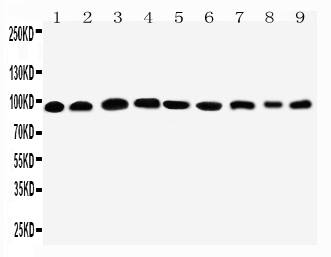
| Description | Rabbit IgG polyclonal antibody for Plakophilin-2(PKP2) detection. Tested with WB in Human;Mouse;Rat. |
| Reconstitution | Add 0.2ml of distilled water will yield a concentration of 500ug/ml. |
| Gene ID | 5318 |
|---|---|
| Other Names | Plakophilin-2, PKP2 |
| Calculated MW | 97415 Da |
| Application Details | Western blot, 0.1-0.5 µg/ml, Human, Rat, Mouse |
| Subcellular Localization | Nucleus . Cell junction, desmosome . Nuclear and associated with desmosomes. |
| Tissue Specificity | Detected in heart right ventricle (at protein level). Widely expressed. Found at desmosomal plaques in simple and stratified epithelia and in non-epithelial tissues such as myocardium and lymph node follicles. In most stratified epithelia found in the desmosomes of the basal cell layer and seems to be absent from suprabasal strata. . |
| Source | Eukaryota |
| Protein Name | Plakophilin-2 |
| Contents | Each vial contains 5mg BSA, 0.9mg NaCl, 0.2mg Na2HPO4, 0.05mg Thimerosal, 0.05mg NaN3. |
| Immunogen | A synthetic peptide corresponding to a sequence at the C-terminus of human Plakophilin 2(863-881aa KKTDFVNSRTAKAYHSLKD), identical to the related mouse sequence, and different from the related rat sequence by one amino acid. |
| Purification | Immunogen affinity purified. |
| Cross Reactivity | No cross reactivity with other proteins |
| Storage | At -20˚C for one year. After r˚Constitution, at 4˚C for one month. It˚Can also be aliquotted and stored frozen at -20˚C for a longer time.Avoid repeated freezing and thawing. |
| Sequence Similarities | Belongs to the beta-catenin family. |
For Research Use Only. Not For Use In Diagnostic Procedures.
| Name | PKP2 (HGNC:9024) |
|---|---|
| Function | A component of desmosome cell-cell junctions which are required for positive regulation of cellular adhesion (PubMed:25208567). Regulates focal adhesion turnover resulting in changes in focal adhesion size, cell adhesion and cell spreading, potentially via transcriptional modulation of beta-integrins (PubMed:23884246). Required to maintain gingival epithelial barrier function (PubMed:34368962). Important component of the desmosome that is also required for localization of desmosome component proteins such as DSC2, DSG2 and JUP to the desmosome cell-cell junction (PubMed:22781308, PubMed:25208567). Required for the formation of desmosome cell junctions in cardiomyocytes, thereby required for the correct formation of the heart, specifically trabeculation and formation of the atria walls (By similarity). Loss of desmosome cell junctions leads to mis-localization of DSP and DSG2 resulting in disruption of cell-cell adhesion and disordered intermediate filaments (By similarity). Modulates profibrotic gene expression in cardiomyocytes via regulation of DSP expression and subsequent activation of downstream TGFB1 and MAPK14/p38 MAPK signaling (By similarity). Required for cardiac sodium current propagation and electrical synchrony in cardiac myocytes, via ANK3 stabilization and modulation of SCN5A/Nav1.5 localization to cell-cell junctions (By similarity). Required for mitochondrial function, nuclear envelope integrity and positive regulation of SIRT3 transcription via maintaining DES localization at its nuclear envelope and cell tip anchoring points, and thereby preserving regulation of the transcriptional program (PubMed:35959657). Maintenance of nuclear envelope integrity protects against DNA damage and transcriptional dysregulation of genes, especially those involved in the electron transport chain, thereby preserving mitochondrial function and protecting against superoxide radical anion generation (PubMed:35959657). Binds single-stranded DNA (ssDNA) (PubMed:20613778). May regulate the localization of GJA1 to gap junctions in intercalated disks of the heart (PubMed:18662195). Involved in the inhibition of viral infection by influenza A viruses (IAV) (PubMed:28169297). Acts as a host restriction factor for IAV viral propagation, potentially via disrupting the interaction of IAV polymerase complex proteins (PubMed:28169297). |
| Cellular Location | Nucleus. Cell junction, desmosome. Cell junction. Cytoplasm Note=Colocalizes with CTNNA3 and SCN5A/Nav1.5 at intercalated disks in the heart. {ECO:0000250|UniProtKB:Q9CQ73} |
| Tissue Location | Expressed at myocyte intercalated disks in the heart (at protein level) (PubMed:18662195, PubMed:31845994). Expressed in gingival epithelial, endothelial and fibroblast cells (at protein level) (PubMed:34368962). Faintly expressed in tracheal epithelial cells (at protein level) (PubMed:28169297). Widely expressed. Found at desmosomal plaques in simple and stratified epithelia and in non- epithelial tissues such as myocardium and lymph node follicles. In most stratified epithelia found in the desmosomes of the basal cell layer and seems to be absent from suprabasal strata |
Provided below are standard protocols that you may find useful for product applications.
BACKGROUND
Plakophilin-2 is a protein that in humans is encoded by the PKP2 gene. This gene encodes a member of the arm-repeat(armadillo) and plakophilin gene families. It is mapped to 12p11.21. PKP2 is a constituent of the desmosomal plaque in simple epithelia, some stratified epithelia, and some nonepithelial cells. PKP2 is also enriched in the karyoplasm of cells of various types, including those lacking desmosomes. Plakophilin proteins participate in linking cadherins to intermediate filaments in the cytoskeleton and this gene product may regulate the signaling activity of beta-catenin. PKP2 has been shown to interact with Desmoplakin, Plakoglobin and Desmoglein 1.

终于等到您。ABCEPTA(百远生物)抗体产品。
点击下方“我要评价 ”按钮提交您的反馈信息,您的反馈和评价是我们最宝贵的财富之一,
我们将在1-3个工作日内处理您的反馈信息。
如有疑问,联系:0512-88856768 tech-china@abcepta.com.


