


 癌症的基本特征包括细胞增殖、血管生成、迁移、凋亡逃避机制和细胞永生等。找到癌症发生过程中这些通路的关键标记物和对应的抗体用于检测至关重要。
 为您推荐一个泛素化位点预测神器——泛素化分析工具,可以为您的蛋白的泛素化位点作出预测和评分。
 细胞自噬受体图形绘图工具为你的蛋白的细胞受体结合位点作出预测和评分,识别结合到自噬通路中的蛋白是非常重要的,便于让我们理解自噬在正常生理、病理过程中的作用,如发育、细胞分化、神经退化性疾病、压力条件下、感染和癌症。
Anti-AKR1C1/C2 Picoband Antibody
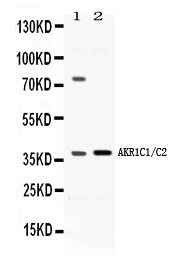
- 产品详情
- 实验流程
- 背景知识
Application 
| WB |
|---|---|
| Primary Accession | P52895 |
| Host | Rabbit |
| Reactivity | Human, Rat |
| Clonality | Polyclonal |
| Format | Lyophilized |
| Description | Rabbit IgG polyclonal antibody for Aldo-keto reductase family 1 member C1/C2(AKR1C1/C2) detection. Tested with WB in Human;Rat. |
| Reconstitution | Add 0.2ml of distilled water will yield a concentration of 500ug/ml. |
| Gene ID | 1646 |
|---|---|
| Other Names | Aldo-keto reductase family 1 member C2, 1.-.-.-, 3-alpha-HSD3, Chlordecone reductase homolog HAKRD, Dihydrodiol dehydrogenase 2, DD-2, DD2, Dihydrodiol dehydrogenase/bile acid-binding protein, DD/BABP, Trans-1, 2-dihydrobenzene-1, 2-diol dehydrogenase, 1.3.1.20, Type III 3-alpha-hydroxysteroid dehydrogenase, 1.1.1.357, AKR1C2, DDH2 |
| Calculated MW | 36735 Da |
| Application Details | Western blot, 0.1-0.5 µg/ml, Human, Rat |
| Subcellular Localization | Cytoplasm . |
| Tissue Specificity | Expressed in fetal testes. Expressed in fetal and adult adrenal glands. . |
| Source | Eukaryota |
| Protein Name | Aldo-keto reductase family 1 member C1/C2 |
| Contents | Each vial contains 5mg BSA, 0.9mg NaCl, 0.2mg Na2HPO4, 0.05mg NaN3. |
| Immunogen | E. coli-derived human AKR1C1/C2 recombinant protein (Position: M1-K123). |
| Purification | Immunogen affinity purified. |
| Cross Reactivity | No cross reactivity with other proteins. |
| Storage | At -20˚C for one year. After r˚Constitution, at 4˚C for one month. It˚Can also be aliquotted and stored frozen at -20˚C for a longer time.Avoid repeated freezing and thawing. |
For Research Use Only. Not For Use In Diagnostic Procedures.
| Name | AKR1C2 {ECO:0000303|PubMed:9716498} |
|---|---|
| Synonyms | DDH2 |
| Function | Cytosolic aldo-keto reductase that catalyzes NADPH-dependent reduction of ketosteroids to hydroxysteroids. Displays broad substrate specificity with distinct positional and stereochemistry, primarily generating 3alpha-hydroxysteroids, but also 3beta-, 17beta- and 20alpha-hydroxysteroids (PubMed:8920937, PubMed:9716498, PubMed:10998348, PubMed:12416991, PubMed:11995921, PubMed:12604236, PubMed:14672942, PubMed:19218247, PubMed:21802064, PubMed:11514561, PubMed:15929998, PubMed:17034817, PubMed:17442338, PubMed:24434280). Required for male sex determination as a component of the 'backdoor' androgen biosynthesis pathway that generates 5alpha-dihydrotestosterone (5alpha-DHT) via pregnanes. Acts together with AKR1C4 to convert 5alpha-dihydroprogesterone (5alpha-DHP) to 3alpha-hydroxy-5alpha- pregnan-20-one (3alpha,5alpha-THP/allopregnanolone), leading to 5alpha- DHT secretion necessary for embryonic gonad differentiation into testis (PubMed:12416991, PubMed:21802064). In androgen catabolism, may predominantly act as a phase I enzyme by introducing a hydroxyl group prior to conjugation. It can nevertheless participate in the alternative phase II pathway by directly reducing sulfate- or glucuronide-conjugated androgens (PubMed:10998348, PubMed:11514561, PubMed:14672942, PubMed:15929998, PubMed:19218247, PubMed:24434280). In neurosteroid biosynthesis, may preferentially reduce 5alpha- dihydroprogesterone (5-alpha-DHP) and 5alpha-dihydrodeoxycorticosterone (5-alpha-DHDOC) precursors to 3alpha-hydroxy-5alpha-pregnan-20-one (3alpha,5alpha-THP/allopregnanolone) and 3alpha,21-dihydroxy-5alpha- pregnane-20-one (3alpha,5alpha-THDOC) neuroactive steroids known to alter neural excitability via allosteric activation of gamma- aminobutyric acid type A receptors (GABAAR) (PubMed:11995921, PubMed:12416991, PubMed:12604236). Regulates ligand availability for steroid hormone receptors. Catalyzes the inactivation of 5alpha-DHT and progesterone converting them into 3alpha/beta-androstanediols and (20S)-hydroxypregn-4-en-3-one, respectively (PubMed:10998348, PubMed:24434280). Can form 17beta-hydroxysteroids such as testosterone and estradiol albeit with lower efficiency when compared to AKR1C3 (PubMed:10998348). May contribute to the metabolism of adrenal-derived androgens via reduction of 11-keto-5alpha-androstane-3,17-dione (11K- Adione) into 11-ketoandrosterone (11KAST) and of 11- ketodihydrotestosterone (11KDHT) into 11-keto-5alpha-androstane- 3alpha/beta,17beta-diol (11K-A3alphadiol) (PubMed:31926269). May also play a role in prostaglandin (PG) metabolism by reducing PGD2 to 11beta-PGF2 (PubMed:9716498). Also able to metabolize xenobiotics (S)- indan-1-ol and trans-1,2-dihydrobenzene-1,2-diols (PubMed:8573067, PubMed:9716498). In vitro can efficiently catalyze bidirectional conversion between ketosteroids and hydroxysteroids using NADPH/NADP(+) or NADH/NAD(+) as cofactors. In vivo however, the reductase activity prevails since the major reducing cofactor NADPH inhibits NAD(+)- dependent oxidase activity (PubMed:14672942, PubMed:21802064). |
| Cellular Location | Cytoplasm, cytosol. |
| Tissue Location | Expressed in fetal testes. Expressed in fetal and adult adrenal glands. |
Provided below are standard protocols that you may find useful for product applications.
BACKGROUND
This gene encodes a member of the aldo/keto reductase superfamily, which consists of more than 40 known enzymes and proteins. These enzymes catalyze the conversion of aldehydes and ketones to their corresponding alcohols using NADH and/or NADPH as cofactors. The enzymes display overlapping but distinct substrate specificity. This enzyme binds bile acid with high affinity, and shows minimal 3-alpha-hydroxysteroid dehydrogenase activity. And this gene shares high sequence identity with three other gene members and is clustered with those three genes at chromosome 10p15-p14. Three transcript variants encoding two different isoforms have been found for this gene.

终于等到您。ABCEPTA(百远生物)抗体产品。
点击下方“我要评价 ”按钮提交您的反馈信息,您的反馈和评价是我们最宝贵的财富之一,
我们将在1-3个工作日内处理您的反馈信息。
如有疑问,联系:0512-88856768 tech-china@abcepta.com.


