


 癌症的基本特征包括细胞增殖、血管生成、迁移、凋亡逃避机制和细胞永生等。找到癌症发生过程中这些通路的关键标记物和对应的抗体用于检测至关重要。
 为您推荐一个泛素化位点预测神器——泛素化分析工具,可以为您的蛋白的泛素化位点作出预测和评分。
 细胞自噬受体图形绘图工具为你的蛋白的细胞受体结合位点作出预测和评分,识别结合到自噬通路中的蛋白是非常重要的,便于让我们理解自噬在正常生理、病理过程中的作用,如发育、细胞分化、神经退化性疾病、压力条件下、感染和癌症。
Anti-PML Protein Picoband Antibody
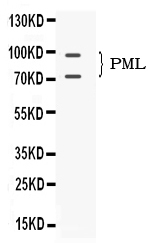
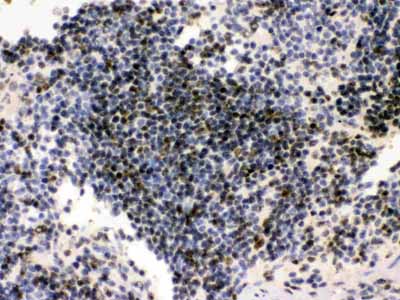
- 产品详情
- 实验流程
- 背景知识
Application 
| WB, IHC-P |
|---|---|
| Primary Accession | Q60953 |
| Host | Rabbit |
| Reactivity | Mouse |
| Clonality | Polyclonal |
| Format | Lyophilized |
| Description | Rabbit IgG polyclonal antibody for Protein PML(PML) detection. Tested with WB, IHC-P in Mouse. |
| Reconstitution | Add 0.2ml of distilled water will yield a concentration of 500ug/ml. |
| Gene ID | 18854 |
|---|---|
| Other Names | Protein PML, Pml |
| Calculated MW | 98242 Da |
| Application Details | Immunohistochemistry(Paraffin-embedded Section), 0.5-1 µg/ml, Mouse, By Heat Western blot, 0.1-0.5 µg/ml, Mouse |
| Subcellular Localization | Nucleus . Nucleus, nucleoplasm. Cytoplasm. Nucleus, PML body. Nucleus, nucleolus . Endoplasmic reticulum membrane; Peripheral membrane protein; Cytoplasmic side. Early endosome membrane ; Peripheral membrane protein ; Cytoplasmic side . Detected in the nucleolus after DNA damage. Acetylation at Lys-497 is essential for its nuclear localization. Within the nucleus, most of PML is expressed in the diffuse nuclear fraction of the nucleoplasm and only a small fraction is found in the matrix-associated nuclear bodies (PML-NBs). The transfer of PML from the nucleoplasm to PML-NBs depends on its phosphorylation and sumoylation. The B1 box and the RING finger are also required for the localization in PML-NBs. Also found in specific membrane structures termed mitochondria-associated membranes (MAMs) which connect the endoplasmic reticulum (ER) and the mitochondria (By similarity). . |
| Source | Eukaryota |
| Protein Name | Protein PML |
| Contents | Each vial contains 5mg BSA, 0.9mg NaCl, 0.2mg Na2HPO4, 0.05mg NaN3. |
| Immunogen | A synthetic peptide corresponding to a sequence at the N-terminus of mouse PML Protein (140-177aa LADFWCFECEQLICSKCFEAHQWYLKHEARPLADLRDN), different from the related human sequence by six amino acids. |
| Purification | Immunogen affinity purified. |
| Cross Reactivity | No cross reactivity with other proteins |
| Storage | At -20˚C for one year. After r˚Constitution, at 4˚C for one month. It˚Can also be aliquotted and stored frozen at -20˚C for a longer time.Avoid repeated freezing and thawing. |
For Research Use Only. Not For Use In Diagnostic Procedures.
| Name | Pml |
|---|---|
| Function | Functions via its association with PML-nuclear bodies (PML- NBs) in a wide range of important cellular processes, including tumor suppression, transcriptional regulation, apoptosis, senescence, DNA damage response, and viral defense mechanisms. Acts as the scaffold of PML-NBs allowing other proteins to shuttle in and out, a process which is regulated by SUMO-mediated modifications and interactions. Inhibits EIF4E-mediated mRNA nuclear export by reducing EIF4E affinity for the 5' 7-methylguanosine (m7G) cap of target mRNAs (By similarity). Positively regulates p53/TP53 by acting at different levels (by promoting its acetylation and phosphorylation and by inhibiting its MDM2-dependent degradation). Regulates phosphorylation of ITPR3 and plays a role in the regulation of calcium homeostasis at the endoplasmic reticulum. Regulates RB1 phosphorylation and activity. Acts as both a negative regulator of PPARGC1A acetylation and a potent activator of PPAR signaling and fatty acid oxidation. Regulates translation of HIF1A by sequestering MTOR, and thereby plays a role in neoangiogenesis and tumor vascularization. Regulates PER2 nuclear localization and circadian function. Cytoplasmic PML is involved in the regulation of the TGF-beta signaling pathway. Required for normal development of the brain cortex during embryogenesis. Plays a role in granulopoiesis or monopoiesis of myeloid progenitor cells. May play a role regulating stem and progenitor cell fate in tissues as diverse as blood, brain and breast. Shows antiviral activity towards lymphocytic choriomeningitis virus (LCMV) and the vesicular stomatitis virus (VSV). |
| Cellular Location | Nucleus. Nucleus, nucleoplasm. Cytoplasm. Nucleus, PML body. Nucleus, nucleolus Endoplasmic reticulum membrane; Peripheral membrane protein; Cytoplasmic side. Early endosome membrane; Peripheral membrane protein; Cytoplasmic side Note=Detected in the nucleolus after DNA damage. Acetylation at Lys-497 is essential for its nuclear localization. Within the nucleus, most of PML is expressed in the diffuse nuclear fraction of the nucleoplasm and only a small fraction is found in the matrix-associated nuclear bodies (PML-NBs). The transfer of PML from the nucleoplasm to PML-NBs depends on its phosphorylation and sumoylation. The B1 box and the RING finger are also required for the localization in PML-NBs. Also found in specific membrane structures termed mitochondria-associated membranes (MAMs) which connect the endoplasmic reticulum (ER) and the mitochondria (By similarity). |
Provided below are standard protocols that you may find useful for product applications.
BACKGROUND
The protein encoded by this gene is a member of the tripartite motif (TRIM) family. The TRIM motif includes three zinc-binding domains, a RING, a B-box type 1 and a B-box type 2, and a coiled-coil region. This phosphoprotein localizes to nuclear bodies where it functions as a transcription factor and tumor suppressor. Its expression is cell-cycle related and it regulates the p53 response to oncogenic signals. The gene is often involved in the translocation with the retinoic acid receptor alpha gene associated with acute promyelocytic leukemia (APL). Extensive alternative splicing of this gene results in several variations of the protein's central and C-terminal regions; all variants encode the same N-terminus. Alternatively spliced transcript variants encoding different isoforms have been identified.

终于等到您。ABCEPTA(百远生物)抗体产品。
点击下方“我要评价 ”按钮提交您的反馈信息,您的反馈和评价是我们最宝贵的财富之一,
我们将在1-3个工作日内处理您的反馈信息。
如有疑问,联系:0512-88856768 tech-china@abcepta.com.


