


 癌症的基本特征包括细胞增殖、血管生成、迁移、凋亡逃避机制和细胞永生等。找到癌症发生过程中这些通路的关键标记物和对应的抗体用于检测至关重要。
 为您推荐一个泛素化位点预测神器——泛素化分析工具,可以为您的蛋白的泛素化位点作出预测和评分。
 细胞自噬受体图形绘图工具为你的蛋白的细胞受体结合位点作出预测和评分,识别结合到自噬通路中的蛋白是非常重要的,便于让我们理解自噬在正常生理、病理过程中的作用,如发育、细胞分化、神经退化性疾病、压力条件下、感染和癌症。
Anti-LRRK2 Picoband Antibody
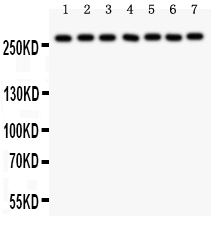
- 产品详情
- 实验流程
- 背景知识
Application 
| WB |
|---|---|
| Primary Accession | Q5S007 |
| Host | Rabbit |
| Reactivity | Human, Mouse, Rat |
| Clonality | Polyclonal |
| Format | Lyophilized |
| Description | Rabbit IgG polyclonal antibody for Leucine-rich repeat serine/threonine-protein kinase 2(LRRK2) detection. Tested with WB in Human;Mouse;Rat. |
| Reconstitution | Add 0.2ml of distilled water will yield a concentration of 500ug/ml. |
| Gene ID | 120892 |
|---|---|
| Other Names | Leucine-rich repeat serine/threonine-protein kinase 2, 2.7.11.1, Dardarin, LRRK2, PARK8 |
| Calculated MW | 286103 Da |
| Application Details | Western blot, 0.1-0.5 µg/ml, Human, Mouse, Rat |
| Subcellular Localization | Membrane; Peripheral membrane protein. Cytoplasm. Perikaryon. Mitochondrion. Golgi apparatus. Cell projection, axon. Cell projection, dendrite. Endoplasmic reticulum . Cytoplasmic vesicle, secretory vesicle, synaptic vesicle membrane ; Peripheral membrane protein ; Cytoplasmic side . Endosome . Lysosome . Mitochondrion outer membrane . Mitochondrion inner membrane . Mitochondrion matrix . Predominantly associated with intracytoplasmic vesicular and membranous structures (By similarity). Localized in the cytoplasm and associated with cellular membrane structures. Predominantly associated with the mitochondrial outer membrane of the mitochondria. Colocalized with RAB29 along tubular structures emerging from Golgi apparatus. Localizes in intracytoplasmic punctate structures of neuronal perikarya and dendritic and axonal processes. . |
| Tissue Specificity | Expressed in the brain. Expressed in pyramidal neurons in all cortical laminae of the visual cortex, in neurons of the substantia nigra pars compacta and caudate putamen (at protein level). Expressed throughout the adult brain, but at a lower level than in heart and liver. Also expressed in placenta, lung, skeletal muscle, kidney and pancreas. In the brain, expressed in the cerebellum, cerebral cortex, medulla, spinal cord occipital pole, frontal lobe, temporal lobe and putamen. Expression is particularly high in brain dopaminoceptive areas. . |
| Source | Eukaryota |
| Protein Name | Leucine-rich repeat serine/threonine-protein kinase 2 |
| Contents | Each vial contains 5mg BSA, 0.9mg NaCl, 0.2mg Na2HPO4, 0.05mg NaN3. |
| Immunogen | E.coli-derived human LRRK2 recombinant protein (Position: E10-L350). Human LRRK2 shares 82% amino acid (aa) sequence identity with mouse LRRK2. |
| Purification | Immunogen affinity purified. |
| Cross Reactivity | No cross reactivity with other proteins |
| Storage | At -20˚C for one year. After r˚Constitution, at 4˚C for one month. It˚Can also be aliquotted and stored frozen at -20˚C for a longer time.Avoid repeated freezing and thawing. |
| Sequence Similarities | Belongs to the protein kinase superfamily. TKL Ser/Thr protein kinase family. |
For Research Use Only. Not For Use In Diagnostic Procedures.
| Name | LRRK2 |
|---|---|
| Synonyms | PARK8 |
| Function | Serine/threonine-protein kinase which phosphorylates a broad range of proteins involved in multiple processes such as neuronal plasticity, innate immunity, autophagy, and vesicle trafficking (PubMed:17114044, PubMed:20949042, PubMed:21850687, PubMed:22012985, PubMed:23395371, PubMed:24687852, PubMed:25201882, PubMed:26014385, PubMed:26824392, PubMed:27830463, PubMed:28720718, PubMed:29125462, PubMed:29127255, PubMed:29212815, PubMed:30398148, PubMed:30635421). Is a key regulator of RAB GTPases by regulating the GTP/GDP exchange and interaction partners of RABs through phosphorylation (PubMed:26824392, PubMed:28720718, PubMed:29125462, PubMed:29127255, PubMed:29212815, PubMed:30398148, PubMed:30635421). Phosphorylates RAB3A, RAB3B, RAB3C, RAB3D, RAB5A, RAB5B, RAB5C, RAB8A, RAB8B, RAB10, RAB12, RAB29, RAB35, and RAB43 (PubMed:23395371, PubMed:26824392, PubMed:28720718, PubMed:29125462, PubMed:29127255, PubMed:29212815, PubMed:30398148, PubMed:30635421, PubMed:38127736). Regulates the RAB3IP-catalyzed GDP/GTP exchange for RAB8A through the phosphorylation of 'Thr-72' on RAB8A (PubMed:26824392). Inhibits the interaction between RAB8A and GDI1 and/or GDI2 by phosphorylating 'Thr-72' on RAB8A (PubMed:26824392). Regulates primary ciliogenesis through phosphorylation of RAB8A and RAB10, which promotes SHH signaling in the brain (PubMed:29125462, PubMed:30398148). Together with RAB29, plays a role in the retrograde trafficking pathway for recycling proteins, such as mannose-6-phosphate receptor (M6PR), between lysosomes and the Golgi apparatus in a retromer-dependent manner (PubMed:23395371). Regulates neuronal process morphology in the intact central nervous system (CNS) (PubMed:17114044). Plays a role in synaptic vesicle trafficking (PubMed:24687852). Plays an important role in recruiting SEC16A to endoplasmic reticulum exit sites (ERES) and in regulating ER to Golgi vesicle-mediated transport and ERES organization (PubMed:25201882). Positively regulates autophagy through a calcium-dependent activation of the CaMKK/AMPK signaling pathway (PubMed:22012985). The process involves activation of nicotinic acid adenine dinucleotide phosphate (NAADP) receptors, increase in lysosomal pH, and calcium release from lysosomes (PubMed:22012985). Phosphorylates PRDX3 (PubMed:21850687). By phosphorylating APP on 'Thr-743', which promotes the production and the nuclear translocation of the APP intracellular domain (AICD), regulates dopaminergic neuron apoptosis (PubMed:28720718). Acts as a positive regulator of innate immunity by mediating phosphorylation of RIPK2 downstream of NOD1 and NOD2, thereby enhancing RIPK2 activation (PubMed:27830463). Independent of its kinase activity, inhibits the proteasomal degradation of MAPT, thus promoting MAPT oligomerization and secretion (PubMed:26014385). In addition, has GTPase activity via its Roc domain which regulates LRRK2 kinase activity (PubMed:18230735, PubMed:26824392, PubMed:28720718, PubMed:29125462, PubMed:29212815). Recruited by RAB29/RAB7L1 to overloaded lysosomes where it phosphorylates and stabilizes RAB8A and RAB10 which promote lysosomal content release and suppress lysosomal enlargement through the EHBP1 and EHBP1L1 effector proteins (PubMed:30209220, PubMed:38227290). |
| Cellular Location | Cytoplasmic vesicle. Perikaryon. Golgi apparatus membrane; Peripheral membrane protein. Cell projection, axon. Cell projection, dendrite. Endoplasmic reticulum membrane; Peripheral membrane protein. Cytoplasmic vesicle, secretory vesicle, synaptic vesicle membrane. Endosome {ECO:0000250|UniProtKB:Q5S006}. Lysosome Mitochondrion outer membrane; Peripheral membrane protein. Cytoplasm, cytoskeleton. Cytoplasmic vesicle, phagosome {ECO:0000250|UniProtKB:Q5S006}. Note=Colocalized with RAB29 along tubular structures emerging from Golgi apparatus (PubMed:23395371, PubMed:38127736). Localizes to endoplasmic reticulum exit sites (ERES), also known as transitional endoplasmic reticulum (tER) (PubMed:25201882). Detected on phagosomes and stressed lysosomes but not detected on autophagosomes induced by starvation (By similarity). Recruitment to stressed lysosomes is dependent on the ATG8 conjugation system composed of ATG5, ATG12 and ATG16L1 and leads to lysosomal stress-induced activation of LRRK2 (By similarity) {ECO:0000250|UniProtKB:Q5S006, ECO:0000269|PubMed:23395371, ECO:0000269|PubMed:25201882, ECO:0000269|PubMed:38127736} |
| Tissue Location | Expressed in pyramidal neurons in all cortical laminae of the visual cortex, in neurons of the substantia nigra pars compacta and caudate putamen (at protein level). Expressed in neutrophils (at protein level) (PubMed:29127255). Expressed in the brain. Expressed throughout the adult brain, but at a lower level than in heart and liver. Also expressed in placenta, lung, skeletal muscle, kidney and pancreas. In the brain, expressed in the cerebellum, cerebral cortex, medulla, spinal cord occipital pole, frontal lobe, temporal lobe and putamen. Expression is particularly high in brain dopaminoceptive areas. |
Provided below are standard protocols that you may find useful for product applications.
BACKGROUND
Leucine-rich repeat kinase 2 (LRRK2), also known as dardarin, is anenzyme that in humans is encoded by the PARK8 gene. It is a member of the leucine-rich repeat kinase family. This gene is mapped to 12q12. The protein is present largely in the cytoplasm but also associates with the mitochondrial outer membrane. Expression of mutant LRRK2 induced apoptotic cell death in neuroblastoma cells and in mouse cortical neurons. It has been determined that LRRK2 possesses mixed-lineage kinase activity, and LRRK2 also showed autophosphorylation activity. What’s more, LRRK2 has an affinity for lipids or lipid-associated proteins and may play a role in the biogenesis or regulation of membranous intracellular structures in the brain. It is also an IFNG target gene that may be involved in signaling pathways relevant to Crohn disease.

终于等到您。ABCEPTA(百远生物)抗体产品。
点击下方“我要评价 ”按钮提交您的反馈信息,您的反馈和评价是我们最宝贵的财富之一,
我们将在1-3个工作日内处理您的反馈信息。
如有疑问,联系:0512-88856768 tech-china@abcepta.com.


