


 癌症的基本特征包括细胞增殖、血管生成、迁移、凋亡逃避机制和细胞永生等。找到癌症发生过程中这些通路的关键标记物和对应的抗体用于检测至关重要。
 为您推荐一个泛素化位点预测神器——泛素化分析工具,可以为您的蛋白的泛素化位点作出预测和评分。
 细胞自噬受体图形绘图工具为你的蛋白的细胞受体结合位点作出预测和评分,识别结合到自噬通路中的蛋白是非常重要的,便于让我们理解自噬在正常生理、病理过程中的作用,如发育、细胞分化、神经退化性疾病、压力条件下、感染和癌症。
Anti-CTCF Picoband Antibody
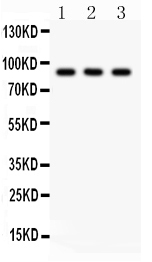
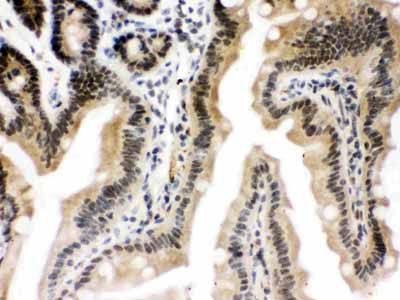
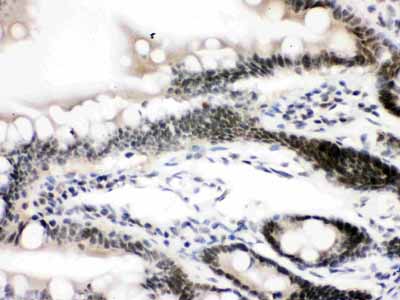
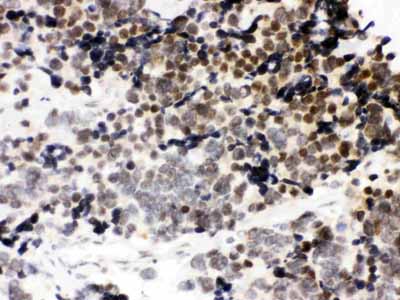
- 产品详情
- 实验流程
- 背景知识
Application 
| WB, IHC-P |
|---|---|
| Primary Accession | P49711 |
| Host | Rabbit |
| Reactivity | Human, Mouse, Rat |
| Clonality | Polyclonal |
| Format | Lyophilized |
| Description | Rabbit IgG polyclonal antibody for Transcriptional repressor CTCF(CTCF) detection. Tested with WB, IHC-P in Human;Mouse;Rat. |
| Reconstitution | Add 0.2ml of distilled water will yield a concentration of 500ug/ml. |
| Gene ID | 10664 |
|---|---|
| Other Names | Transcriptional repressor CTCF, 11-zinc finger protein, CCCTC-binding factor, CTCFL paralog, CTCF |
| Calculated MW | 82785 Da |
| Application Details | Immunohistochemistry(Paraffin-embedded Section), 0.5-1 µg/ml, Human, Mouse, Rat, By Heat Western blot, 0.1-0.5 µg/ml, Human, Rat |
| Subcellular Localization | Nucleus, nucleoplasm. Chromosome. Chromosome, centromere. May translocate to the nucleolus upon cell differentiation. Associates with both centromeres and chromosomal arms during metaphase. Associates with the H19 ICR in mitotic chromosomes. May be preferentially excluded from heterochromatin during interphase. |
| Tissue Specificity | Ubiquitous. Absent in primary spermatocytes. . |
| Source | Eukaryota |
| Protein Name | Transcriptional repressor CTCF |
| Contents | Each vial contains 5mg BSA, 0.9mg NaCl, 0.2mg Na2HPO4, 0.05mg NaN3. |
| Immunogen | E.coli-derived human CTCF recombinant protein (Position: K521-R727). Human CTCF shares 94% and 93.1% amino acid (aa) sequence identity with mouse and rat CTCF, respectively. |
| Purification | Immunogen affinity purified. |
| Cross Reactivity | No cross reactivity with other proteins |
| Storage | At -20˚C for one year. After r˚Constitution, at 4˚C for one month. It˚Can also be aliquotted and stored frozen at -20˚C for a longer time.Avoid repeated freezing and thawing. |
| Sequence Similarities | Belongs to the CTCF zinc-finger protein family. |
For Research Use Only. Not For Use In Diagnostic Procedures.
| Name | CTCF |
|---|---|
| Function | Chromatin binding factor that binds to DNA sequence specific sites and regulates the 3D structure of chromatin (PubMed:16949368, PubMed:18347100, PubMed:18654629, PubMed:19322193). Binds together strands of DNA, thus forming chromatin loops, and anchors DNA to cellular structures, such as the nuclear lamina (PubMed:18347100, PubMed:18654629, PubMed:19322193). Defines the boundaries between active and heterochromatic DNA via binding to chromatin insulators, thereby preventing interaction between promoter and nearby enhancers and silencers (PubMed:18347100, PubMed:18654629, PubMed:19322193). Participates in the allele-specific gene expression at the imprinted IGF2/H19 gene locus (PubMed:16107875, PubMed:16815976, PubMed:17827499). On the maternal allele, binding within the H19 imprinting control region (ICR) mediates maternally inherited higher- order chromatin conformation to restrict enhancer access to IGF2 (By similarity). Mediates interchromosomal association between IGF2/H19 and WSB1/NF1 and may direct distant DNA segments to a common transcription factory (By similarity). Regulates asynchronous replication of IGF2/H19 (By similarity). Plays a critical role in gene silencing over considerable distances in the genome (By similarity). Preferentially interacts with unmethylated DNA, preventing spreading of CpG methylation and maintaining methylation-free zones (PubMed:18413740). Inversely, binding to target sites is prevented by CpG methylation (PubMed:18413740). Plays an important role in chromatin remodeling (PubMed:18413740). Can dimerize when it is bound to different DNA sequences, mediating long-range chromatin looping (PubMed:12191639). Causes local loss of histone acetylation and gain of histone methylation in the beta-globin locus, without affecting transcription (PubMed:12191639). When bound to chromatin, it provides an anchor point for nucleosomes positioning (PubMed:12191639). Seems to be essential for homologous X-chromosome pairing (By similarity). May participate with Tsix in establishing a regulatable epigenetic switch for X chromosome inactivation (PubMed:11743158). May play a role in preventing the propagation of stable methylation at the escape genes from X-inactivation (PubMed:11743158). Involved in sister chromatid cohesion (PubMed:12191639). Associates with both centromeres and chromosomal arms during metaphase and required for cohesin localization to CTCF sites (PubMed:18550811). Plays a role in the recruitment of CENPE to the pericentromeric/centromeric regions of the chromosome during mitosis (PubMed:26321640). Acts as a transcriptional repressor binding to promoters of vertebrate MYC gene and BAG1 gene (PubMed:18413740, PubMed:8649389, PubMed:9591631). Also binds to the PLK and PIM1 promoters (PubMed:12191639). Acts as a transcriptional activator of APP (PubMed:9407128). Regulates APOA1/C3/A4/A5 gene cluster and controls MHC class II gene expression (PubMed:18347100, PubMed:19322193). Plays an essential role in oocyte and preimplantation embryo development by activating or repressing transcription (By similarity). Seems to act as tumor suppressor (PubMed:12191639). |
| Cellular Location | Nucleus, nucleoplasm. Chromosome. Chromosome, centromere. Note=May translocate to the nucleolus upon cell differentiation. Associates with both centromeres and chromosomal arms during metaphase. Associates with the H19 ICR in mitotic chromosomes. May be preferentially excluded from heterochromatin during interphase |
| Tissue Location | Ubiquitous. Absent in primary spermatocytes. |
Provided below are standard protocols that you may find useful for product applications.
BACKGROUND
Transcriptional repressor CTCF also known as 11-zinc finger protein or CCCTC-binding factor is a transcription factor that in humans is encoded by the CTCF gene. This gene is a member of the BORIS + CTCF gene family and encodes a transcriptional regulator protein with 11 highly conserved zinc finger (ZF) domains. And this nuclear protein is able to use different combinations of the ZF domains to bind different DNA target sequences and proteins. Depending upon the context of the site, the protein can bind a histone acetyltransferase (HAT)-containing complex and function as a transcriptional activator or bind a histone deacetylase (HDAC)-containing complex and function as a transcriptional repressor. If the protein is bound to a transcriptional insulator element, it can block communication between enhancers and upstream promoters, thereby regulating imprinted expression. Mutations in this gene have been associated with invasive breast cancers, prostate cancers, and Wilms' tumors. Alternatively spliced transcript variants encoding different isoforms have been found for this gene.

终于等到您。ABCEPTA(百远生物)抗体产品。
点击下方“我要评价 ”按钮提交您的反馈信息,您的反馈和评价是我们最宝贵的财富之一,
我们将在1-3个工作日内处理您的反馈信息。
如有疑问,联系:0512-88856768 tech-china@abcepta.com.


