


 癌症的基本特征包括细胞增殖、血管生成、迁移、凋亡逃避机制和细胞永生等。找到癌症发生过程中这些通路的关键标记物和对应的抗体用于检测至关重要。
 为您推荐一个泛素化位点预测神器——泛素化分析工具,可以为您的蛋白的泛素化位点作出预测和评分。
 细胞自噬受体图形绘图工具为你的蛋白的细胞受体结合位点作出预测和评分,识别结合到自噬通路中的蛋白是非常重要的,便于让我们理解自噬在正常生理、病理过程中的作用,如发育、细胞分化、神经退化性疾病、压力条件下、感染和癌症。
Anti-CYP1A1 Picoband Antibody
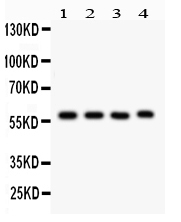
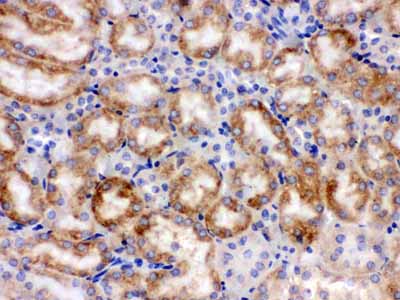
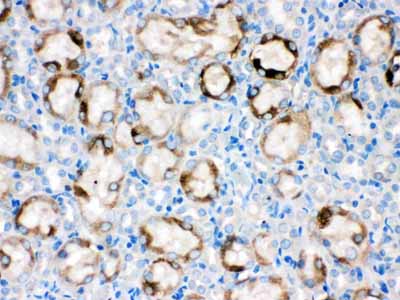
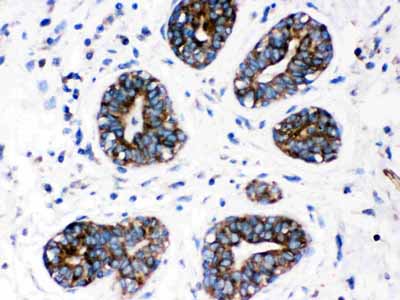
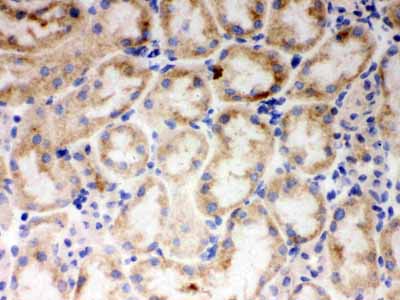
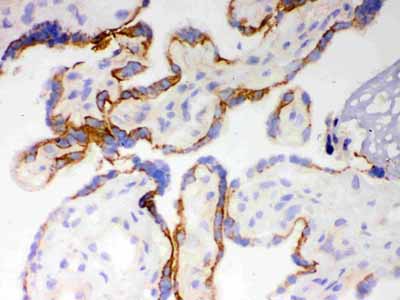
- 产品详情
- 实验流程
- 背景知识
Application 
| WB, IHC-P, IHC-F |
|---|---|
| Primary Accession | P04798 |
| Host | Rabbit |
| Reactivity | Human, Mouse, Rat |
| Clonality | Polyclonal |
| Format | Lyophilized |
| Description | Rabbit IgG polyclonal antibody for Cytochrome P450 1A1(CYP1A1) detection. Tested with WB, IHC-P, IHC-F in Human;Mouse;Rat. |
| Reconstitution | Add 0.2ml of distilled water will yield a concentration of 500ug/ml. |
| Gene ID | 1543 |
|---|---|
| Other Names | Cytochrome P450 1A1, 1.14.14.1, CYPIA1, Cytochrome P450 form 6, Cytochrome P450-C, Cytochrome P450-P1, CYP1A1 |
| Calculated MW | 58165 Da |
| Application Details | Immunohistochemistry(Frozen Section), 0.5-1 µg/ml, Human, Mouse, - Immunohistochemistry(Paraffin-embedded Section), 0.5-1 µg/ml, Human, Mouse, Rat, By Heat Western blot, 0.1-0.5 µg/ml, Human, Mouse, Rat |
| Subcellular Localization | Endoplasmic reticulum membrane; Peripheral membrane protein. Microsome membrane; Peripheral membrane protein. |
| Tissue Specificity | Lung, lymphocytes and placenta. |
| Source | Eukaryota |
| Protein Name | Cytochrome P450 1A1 |
| Contents | Each vial contains 5mg BSA, 0.9mg NaCl, 0.2mg Na2HPO4, 0.05mg NaN3. |
| Immunogen | E.coli-derived human CYP1A1 recombinant protein (Position: H183-D320). Human CYP1A1 shares 81.2% amino acid (aa) sequence identity with both mouse and rat CYP1A1. |
| Purification | Immunogen affinity purified. |
| Cross Reactivity | No cross reactivity with other proteins |
| Storage | At -20˚C for one year. After r˚Constitution, at 4˚C for one month. It˚Can also be aliquotted and stored frozen at -20˚C for a longer time.Avoid repeated freezing and thawing. |
| Sequence Similarities | Belongs to the cytochrome P450 family. |
For Research Use Only. Not For Use In Diagnostic Procedures.
| Name | CYP1A1 {ECO:0000303|PubMed:10681376, ECO:0000312|HGNC:HGNC:2595} |
|---|---|
| Function | A cytochrome P450 monooxygenase involved in the metabolism of various endogenous substrates, including fatty acids, steroid hormones and vitamins (PubMed:10681376, PubMed:11555828, PubMed:12865317, PubMed:14559847, PubMed:15041462, PubMed:15805301, PubMed:18577768, PubMed:19965576, PubMed:20972997). Mechanistically, uses molecular oxygen inserting one oxygen atom into a substrate, and reducing the second into a water molecule, with two electrons provided by NADPH via cytochrome P450 reductase (NADPH--hemoprotein reductase) (PubMed:10681376, PubMed:11555828, PubMed:12865317, PubMed:14559847, PubMed:15041462, PubMed:15805301, PubMed:18577768, PubMed:19965576, PubMed:20972997). Catalyzes the hydroxylation of carbon-hydrogen bonds. Exhibits high catalytic activity for the formation of hydroxyestrogens from estrone (E1) and 17beta-estradiol (E2), namely 2-hydroxy E1 and E2, as well as D-ring hydroxylated E1 and E2 at the C15-alpha and C16- alpha positions (PubMed:11555828, PubMed:12865317, PubMed:14559847, PubMed:15805301). Displays different regioselectivities for polyunsaturated fatty acids (PUFA) hydroxylation (PubMed:15041462, PubMed:18577768). Catalyzes the epoxidation of double bonds of certain PUFA (PubMed:15041462, PubMed:19965576, PubMed:20972997). Converts arachidonic acid toward epoxyeicosatrienoic acid (EET) regioisomers, 8,9-, 11,12-, and 14,15-EET, that function as lipid mediators in the vascular system (PubMed:20972997). Displays an absolute stereoselectivity in the epoxidation of eicosapentaenoic acid (EPA) producing the 17(R),18(S) enantiomer (PubMed:15041462). May play an important role in all-trans retinoic acid biosynthesis in extrahepatic tissues. Catalyzes two successive oxidative transformation of all-trans retinol to all-trans retinal and then to the active form all-trans retinoic acid (PubMed:10681376). May also participate in eicosanoids metabolism by converting hydroperoxide species into oxo metabolites (lipoxygenase-like reaction, NADPH-independent) (PubMed:21068195). |
| Cellular Location | Endoplasmic reticulum membrane {ECO:0000250|UniProtKB:P00185}; Peripheral membrane protein {ECO:0000250|UniProtKB:P00185}. Mitochondrion inner membrane {ECO:0000250|UniProtKB:P00185}; Peripheral membrane protein {ECO:0000250|UniProtKB:P00185}. Microsome membrane {ECO:0000250|UniProtKB:P00185}; Peripheral membrane protein {ECO:0000250|UniProtKB:P00185}. Cytoplasm {ECO:0000250|UniProtKB:P00185} |
| Tissue Location | Lung, lymphocytes and placenta. |
Provided below are standard protocols that you may find useful for product applications.
BACKGROUND
CYP1A1 is involved in phase I xenobiotic and drug metabolism (one substrate of it is theophylline). It is inhibited by fluoroquinolones and macrolides and induced by aromatic hydrocarbons. CYP1A1 is also known as AHH (aryl hydrocarbon hydroxylase). It is involved in the metabolic activation of aromatic hydrocarbons (polycyclic aromatic hydrocarbons, PAH), for example, benzo(a)pyrene (BP), by transforming it to an epoxide. In this reaction, the oxidation of benzo[a]pyrene is catalysed by CYP1A1 to form BP-7,8-epoxide, which can be further oxidized by epoxide hydrolase (EH) to form BP-7,8-dihydrodiol. Finally CYP1A1 catalyses this intermediate to form BP-7,8-dihydrodiol-9,10-epoxide, which is the ultimate carcinogen. However, an in vivo experiment with gene-deficient mice has found that the hydroxylation of benzo(a)pyrene by CYP1A1 can have an overall protective effect on the DNA, rather than contributing to potentially carcinogenic DNA modifications. This effect is likely due to the fact that CYP1A1 is highly active in the intestinal mucosa, and thus inhibits infiltration of ingested benzo(a)pyrene carcinogen into the systemic circulation.

终于等到您。ABCEPTA(百远生物)抗体产品。
点击下方“我要评价 ”按钮提交您的反馈信息,您的反馈和评价是我们最宝贵的财富之一,
我们将在1-3个工作日内处理您的反馈信息。
如有疑问,联系:0512-88856768 tech-china@abcepta.com.


