


 癌症的基本特征包括细胞增殖、血管生成、迁移、凋亡逃避机制和细胞永生等。找到癌症发生过程中这些通路的关键标记物和对应的抗体用于检测至关重要。
 为您推荐一个泛素化位点预测神器——泛素化分析工具,可以为您的蛋白的泛素化位点作出预测和评分。
 细胞自噬受体图形绘图工具为你的蛋白的细胞受体结合位点作出预测和评分,识别结合到自噬通路中的蛋白是非常重要的,便于让我们理解自噬在正常生理、病理过程中的作用,如发育、细胞分化、神经退化性疾病、压力条件下、感染和癌症。
Anti-Cathepsin G Picoband Antibody
- 产品详情
- 实验流程
- 背景知识
Application 
| WB |
|---|---|
| Primary Accession | P28293 |
| Host | Rabbit |
| Reactivity | Mouse |
| Clonality | Polyclonal |
| Format | Lyophilized |
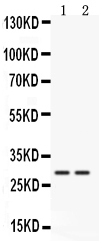
| Description | Rabbit IgG polyclonal antibody for Cathepsin G(CTSG) detection. Tested with WB in Mouse. |
| Reconstitution | Add 0.2ml of distilled water will yield a concentration of 500ug/ml. |
| Gene ID | 13035 |
|---|---|
| Other Names | Cathepsin G, 3.4.21.20, Vimentin-specific protease, VSP, Ctsg |
| Calculated MW | 29096 Da |
| Application Details | Western blot, 0.1-0.5 µg/ml, Mouse |
| Subcellular Localization | Membrane. Strongly associated with membranes. |
| Source | Eukaryota |
| Protein Name | Cathepsin G |
| Contents | Each vial contains 5mg BSA, 0.9mg NaCl, 0.2mg Na2HPO4, 0.05mg NaN3. |
| Immunogen | E.coli-derived mouse Cathepsin G recombinant protein (Position: I21-T261). Mouse Cathepsin G shares 70.2% amino acid (aa) sequence identity with human Cathepsin G. |
| Purification | Immunogen affinity purified. |
| Cross Reactivity | No cross reactivity with other proteins. |
| Storage | At -20˚C for one year. After r˚Constitution, at 4˚C for one month. It˚Can also be aliquotted and stored frozen at -20˚C for a longer time.Avoid repeated freezing and thawing. |
For Research Use Only. Not For Use In Diagnostic Procedures.
| Name | Ctsg |
|---|---|
| Function | Serine protease with trypsin- and chymotrypsin-like specificity. Also displays antibacterial activity against Gram-negative and Gram-positive bacteria independent of its protease activity. Prefers Phe and Tyr residues in the P1 position of substrates but also cleaves efficiently after Trp and Leu. Shows a preference for negatively charged amino acids in the P2' position and for aliphatic amino acids both upstream and downstream of the cleavage site. Required for recruitment and activation of platelets which is mediated by the F2RL3/PAR4 platelet receptor. Binds reversibly to and stimulates B cells and CD4(+) and CD8(+) T cells. Also binds reversibly to natural killer (NK) cells and enhances NK cell cytotoxicity through its protease activity. Cleaves complement C3 (By similarity). Cleaves vimentin (PubMed:1577012). Cleaves thrombin receptor F2R/PAR1. Cleaves the synovial mucin-type protein PRG4/lubricin. Cleaves and activates IL36G which promotes expression of chemokines CXCL1 and CXLC8 in keratinocytes. Cleaves IL33 into mature forms which have greater activity than the unprocessed form. Cleaves coagulation factor F8 to produce a partially activated form. Also cleaves and activates coagulation factor F10. Cleaves leukocyte cell surface protein SPN/CD43 to release its extracellular domain and trigger its intramembrane proteolysis by gamma-secretase, releasing the CD43 cytoplasmic tail chain (CD43-ct) which translocates to the nucleus. During apoptosis, cleaves SMARCA2/BRM to produce a 160 kDa cleavage product which localizes to the cytosol. Cleaves MBP in B cell lysosomes at '221- Phe-|-Lys-222', degrading the major immunogenic MBP epitope and preventing the activation of MBP-specific autoreactive T cells. Cleaves annexin ANXA1 and antimicrobial peptide CAMP to produce peptides which act on neutrophil N-formyl peptide receptors to enhance the release of CXCL2. Acts as a ligand for the N-formyl peptide receptor FPR1, enhancing phagocyte chemotaxis. Has antibacterial activity against the Gram-negative bacteria N.gonorrhoeae and P.aeruginosa. Likely to act against N.gonorrhoeae by interacting with N.gonorrhoeae penA/PBP2. Exhibits potent antimicrobial activity against the Gram-positive bacterium L.monocytogenes. Has antibacterial activity against the Gram- positive bacterium S.aureus and degrades S.aureus biofilms, allowing polymorphonuclear leukocytes to penetrate the biofilm and phagocytose bacteria. Has antibacterial activity against M.tuberculosis (By similarity). Induces platelet aggregation which is strongly potentiated in the presence of ELANE (By similarity). |
| Cellular Location | Cell membrane {ECO:0000250|UniProtKB:P08311}; Peripheral membrane protein. Cytoplasmic granule {ECO:0000250|UniProtKB:P08311}. Secreted {ECO:0000250|UniProtKB:P08311}. Cytoplasm, cytosol {ECO:0000250|UniProtKB:P08311}. Lysosome {ECO:0000250|UniProtKB:P08311}. Nucleus {ECO:0000250|UniProtKB:P08311} Note=Secreted by activated neutrophils. Detected in synovial fluid Localizes to lysosomes in B cells where it is not endogenously synthesized but is internalized from the cell membrane. Localizes to the nucleus during apoptosis. {ECO:0000250|UniProtKB:P08311} |
| Tissue Location | In adult, detected only in bone marrow where expression is restricted to a small population of early myeloid cells |
Provided below are standard protocols that you may find useful for product applications.
BACKGROUND
Cathepsin G is an enzymatic protein belonging to the peptidase or protease families. In humans, it is coded by the CTSG gene. This gene is mapped to 14q12. In transgenic mice, it was found that human Cathepsin G gene was expressed in early myeloid precursors in a manner coordinate with the expression of the endogenous murine gene in the bone marrow and spleen. The protein encoded by this gene, a member of the peptidase S1 protein family, is found in azurophil granules of neutrophilic polymorphonuclear leukocytes. The encoded protease has a specificity similar to that of chymotrypsin C, and may participate in the killing and digestion of engulfed pathogens, and in connective tissue remodeling at sites of inflammation.Â

终于等到您。ABCEPTA(百远生物)抗体产品。
点击下方“我要评价 ”按钮提交您的反馈信息,您的反馈和评价是我们最宝贵的财富之一,
我们将在1-3个工作日内处理您的反馈信息。
如有疑问,联系:0512-88856768 tech-china@abcepta.com.


