


 癌症的基本特征包括细胞增殖、血管生成、迁移、凋亡逃避机制和细胞永生等。找到癌症发生过程中这些通路的关键标记物和对应的抗体用于检测至关重要。
 为您推荐一个泛素化位点预测神器——泛素化分析工具,可以为您的蛋白的泛素化位点作出预测和评分。
 细胞自噬受体图形绘图工具为你的蛋白的细胞受体结合位点作出预测和评分,识别结合到自噬通路中的蛋白是非常重要的,便于让我们理解自噬在正常生理、病理过程中的作用,如发育、细胞分化、神经退化性疾病、压力条件下、感染和癌症。
Anti-HSD11B2 Antibody
- 产品详情
- 实验流程
- 背景知识
Application 
| WB, IHC-P |
|---|---|
| Primary Accession | P80365 |
| Host | Rabbit |
| Reactivity | Human, Mouse, Rat |
| Clonality | Polyclonal |
| Format | Lyophilized |
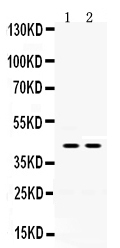
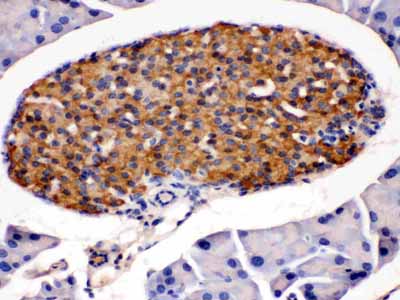
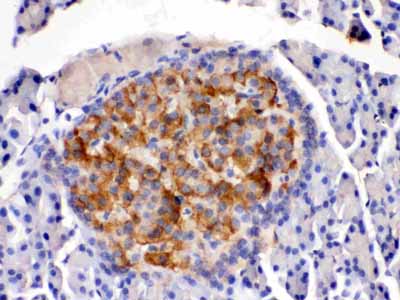
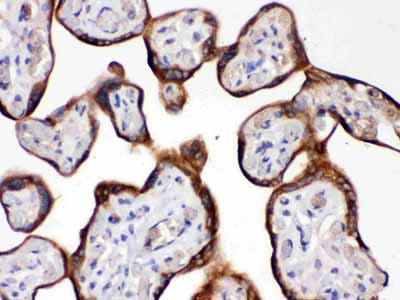
| Description | Rabbit IgG polyclonal antibody for Corticosteroid 11-beta-dehydrogenase isozyme 2(HSD11B2) detection. Tested with WB, IHC-P in Human;Mouse;Rat. |
| Reconstitution | Add 0.2ml of distilled water will yield a concentration of 500ug/ml. |
| Gene ID | 3291 |
|---|---|
| Other Names | Corticosteroid 11-beta-dehydrogenase isozyme 2, 1.1.1.-, 11-beta-hydroxysteroid dehydrogenase type 2, 11-DH2, 11-beta-HSD2, 11-beta-hydroxysteroid dehydrogenase type II, 11-HSD type II, 11-beta-HSD type II, NAD-dependent 11-beta-hydroxysteroid dehydrogenase, 11-beta-HSD, Short chain dehydrogenase/reductase family 9C member 3, HSD11B2, HSD11K {ECO:0000303|PubMed:8530071}, SDR9C3 |
| Calculated MW | 44127 Da |
| Application Details | Immunohistochemistry(Paraffin-embedded Section), 0.5-1 µg/ml, Human, Mouse, Rat, By Heat Western blot, 0.1-0.5 µg/ml, Human, Rat |
| Subcellular Localization | Microsome . Endoplasmic reticulum . |
| Tissue Specificity | Expressed in kidney, pancreas, prostate, ovary, small intestine and colon. At midgestation, expressed at high levels in placenta and in fetal kidney and, at much lower levels, in fetal lung and testis (PubMed:8530071). . |
| Source | Eukaryota |
| Protein Name | Corticosteroid 11-beta-dehydrogenase isozyme 2 |
| Contents | Each vial contains 5mg BSA, 0.9mg NaCl, 0.2mg Na2HPO4, 0.05mg NaN3. |
| Immunogen | A synthetic peptide corresponding to a sequence at the C-terminus of human HSD11B2 (277-309aa EKRKQLLLANLPQELLQAYGKDYIEHLHGQFLH), different from the related mouse sequence by five amino acids, and from the related rat sequence by three amino acids. |
| Purification | Immunogen affinity purified. |
| Cross Reactivity | No cross reactivity with other proteins |
| Storage | At -20˚C for one year. After r˚Constitution, at 4˚C for one month. It˚Can also be aliquotted and stored frozen at -20˚C for a longer time.Avoid repeated freezing and thawing. |
For Research Use Only. Not For Use In Diagnostic Procedures.
| Name | HSD11B2 (HGNC:5209) |
|---|---|
| Function | Catalyzes the conversion of biologically active 11beta- hydroxyglucocorticoids (11beta-hydroxysteroid) such as cortisol, to inactive 11-ketoglucocorticoids (11-oxosteroid) such as cortisone, in the presence of NAD(+) (PubMed:10497248, PubMed:12788846, PubMed:17314322, PubMed:22796344, PubMed:23685396, PubMed:27927697, PubMed:30902677, PubMed:33387577, PubMed:7859916, PubMed:8538347). Functions as a dehydrogenase (oxidase), thereby decreasing the concentration of active glucocorticoids, thus protecting the nonselective mineralocorticoid receptor from occupation by glucocorticoids (PubMed:10497248, PubMed:12788846, PubMed:17314322, PubMed:33387577, PubMed:7859916). Plays an important role in maintaining glucocorticoids balance during preimplantation and protects the fetus from excessive maternal corticosterone exposure (By similarity). Catalyzes the oxidation of 11beta-hydroxytestosterone (11beta,17beta-dihydroxyandrost-4-ene-3-one) to 11-ketotestosterone (17beta-hydroxyandrost-4-ene-3,11-dione), a major bioactive androgen (PubMed:22796344, PubMed:27927697). Catalyzes the conversion of 11beta- hydroxyandrostenedione (11beta-hydroxyandrost-4-ene-3,17-dione) to 11- ketoandrostenedione (androst-4-ene-3,11,17-trione), which can be further metabolized to 11-ketotestosterone (PubMed:23685396, PubMed:27927697). Converts 7-beta-25-dihydroxycholesterol to 7-oxo-25- hydroxycholesterol in vitro (PubMed:30902677). 7-beta-25- dihydroxycholesterol (not 7-oxo-25-hydroxycholesterol) acts as a ligand for the G protein-coupled receptor (GPCR) Epstein-Barr virus-induced gene 2 (EBI2) and may thereby regulate immune cell migration (PubMed:30902677). May protect ovulating oocytes and fertilizing spermatozoa from the adverse effects of cortisol (By similarity). Catalyzes the conversion of 7-beta-hydroxycholesterol into 7- ketocholesterol (7-oxocholesterol), a precursor of 7-keto,27- hydroxycholesterol, which activates smoothened (SMO) and the smoothened signaling pathway (By similarity). |
| Cellular Location | Microsome. Endoplasmic reticulum |
| Tissue Location | Expressed in kidney, placenta, pancreas, prostate, ovary, small intestine and colon, and in lower levels in the spleen and testis (PubMed:7859916). At midgestation, expressed at high levels in placenta and in fetal kidney and, at much lower levels, in fetal lung and testis (PubMed:8530071). |
Provided below are standard protocols that you may find useful for product applications.
BACKGROUND
Corticosteroid 11-β-dehydrogenase isozyme 2, also known as 11-β-hydroxysteroid dehydrogenase 2, is an enzyme that in humans is encoded by the HSD11B2 gene. There are at least two isozymes of the corticosteroid 11-beta-dehydrogenase, a microsomal enzyme complex responsible for the interconversion of cortisol and cortisone. The type I isozyme has both 11-beta-dehydrogenase (cortisol to cortisone) and 11-oxoreductase (cortisone to cortisol) activities. The type II isozyme, encoded by this gene, has only 11-beta-dehydrogenase activity. In aldosterone-selective epithelial tissues such as the kidney, the type II isozyme catalyzes the glucocorticoid cortisol to the inactive metabolite cortisone, thus preventing illicit activation of the mineralocorticoid receptor. In tissues that do not express the mineralocorticoid receptor, such as the placenta and testis, it protects cells from the growth-inhibiting and/or pro-apoptotic effects of cortisol, particularly during embryonic development. Mutations in this gene cause the syndrome of apparent mineralocorticoid excess and hypertension.

终于等到您。ABCEPTA(百远生物)抗体产品。
点击下方“我要评价 ”按钮提交您的反馈信息,您的反馈和评价是我们最宝贵的财富之一,
我们将在1-3个工作日内处理您的反馈信息。
如有疑问,联系:0512-88856768 tech-china@abcepta.com.


