


 癌症的基本特征包括细胞增殖、血管生成、迁移、凋亡逃避机制和细胞永生等。找到癌症发生过程中这些通路的关键标记物和对应的抗体用于检测至关重要。
 为您推荐一个泛素化位点预测神器——泛素化分析工具,可以为您的蛋白的泛素化位点作出预测和评分。
 细胞自噬受体图形绘图工具为你的蛋白的细胞受体结合位点作出预测和评分,识别结合到自噬通路中的蛋白是非常重要的,便于让我们理解自噬在正常生理、病理过程中的作用,如发育、细胞分化、神经退化性疾病、压力条件下、感染和癌症。
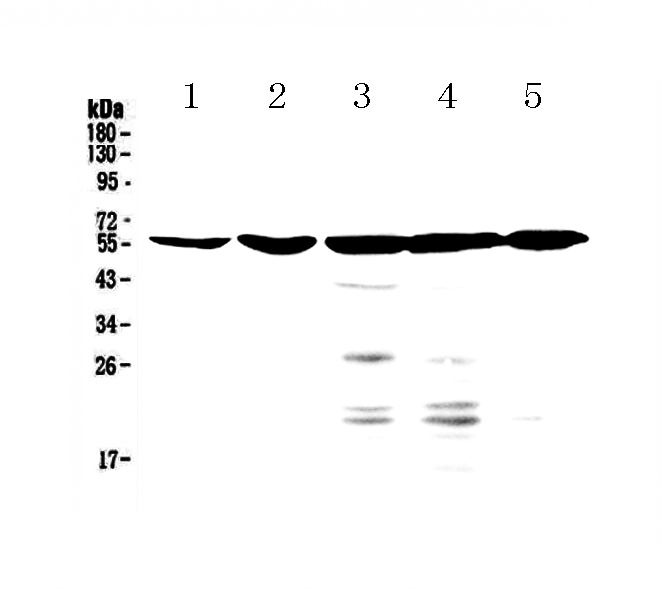
Anti-NR1H4 Picoband Antibody
- 产品详情
- 实验流程
- 背景知识
Application 
| WB |
|---|---|
| Primary Accession | Q96RI1 |
| Host | Rabbit |
| Reactivity | Human, Mouse |
| Clonality | Polyclonal |
| Format | Lyophilized |
| Description | Rabbit IgG polyclonal antibody for Bile acid receptor(NR1H4) detection. Tested with WB in Human;Mouse. |
| Reconstitution | Add 0.2ml of distilled water will yield a concentration of 500ug/ml. |
| Gene ID | 9971 |
|---|---|
| Other Names | Bile acid receptor, Farnesoid X-activated receptor, Farnesol receptor HRR-1, Nuclear receptor subfamily 1 group H member 4, Retinoid X receptor-interacting protein 14, RXR-interacting protein 14, NR1H4, BAR, FXR, HRR1, RIP14 |
| Calculated MW | 55914 Da |
| Application Details | Western blot, 0.1-0.5 µg/ml, Human, Mouse |
| Subcellular Localization | Nucleus . |
| Tissue Specificity | Liver and hepatocyte-related cells express mainly FXRalpha1-type isoforms with isoform 3 and isoform 4 in approximative equal proportions. In intestine and kidney mainly FXRalpha2-type isoforms are expressed with isoform 1 and isoform 2 in approximative equal proportions. Expressed in pancreatic beta cells and macrophages. . |
| Source | Eukaryota |
| Contents | Each vial contains 5mg BSA, 0.9mg NaCl, 0.2mg Na2HPO4, 0.05mg NaN3. |
| Immunogen | A synthetic peptide corresponding to a sequence at the C-terminus of human NR1H4 (442-486aa QHFACLLGRLTELRTFNHHHAEMLMSWRVNDHKFTPLLCEIWDVQ), identical to the related mouse and rat sequences. |
| Purification | Immunogen affinity purified. |
| Cross Reactivity | No cross reactivity with other proteins. |
| Storage | At -20˚C for one year. After r˚Constitution, at 4˚C for one month. It˚Can also be aliquotted and stored frozen at -20˚C for a longer time. Avoid repeated freezing and thawing. |
For Research Use Only. Not For Use In Diagnostic Procedures.
| Name | NR1H4 |
|---|---|
| Synonyms | BAR, FXR, HRR1, RIP14 |
| Function | Ligand-activated transcription factor. Receptor for bile acids (BAs) such as chenodeoxycholic acid (CDCA), lithocholic acid, deoxycholic acid (DCA) and allocholic acid (ACA). Plays a essential role in BA homeostasis through the regulation of genes involved in BA synthesis, conjugation and enterohepatic circulation. Also regulates lipid and glucose homeostasis and is involved innate immune response (PubMed:10334992, PubMed:10334993, PubMed:21383957, PubMed:22820415). The FXR-RXR heterodimer binds predominantly to farnesoid X receptor response elements (FXREs) containing two inverted repeats of the consensus sequence 5'-AGGTCA-3' in which the monomers are spaced by 1 nucleotide (IR-1) but also to tandem repeat DR1 sites with lower affinity, and can be activated by either FXR or RXR-specific ligands. It is proposed that monomeric nuclear receptors such as NR5A2/LRH-1 bound to coregulatory nuclear responsive element (NRE) halfsites located in close proximity to FXREs modulate transcriptional activity (By similarity). In the liver activates transcription of the corepressor NR0B2 thereby indirectly inhibiting CYP7A1 and CYP8B1 (involved in BA synthesis) implicating at least in part histone demethylase KDM1A resulting in epigenomic repression, and SLC10A1/NTCP (involved in hepatic uptake of conjugated BAs). Activates transcription of the repressor MAFG (involved in regulation of BA synthesis) (By similarity). Activates transcription of SLC27A5/BACS and BAAT (involved in BA conjugation), ABCB11/BSEP (involved in bile salt export) by directly recruiting histone methyltransferase CARM1, and ABCC2/MRP2 (involved in secretion of conjugated BAs) and ABCB4 (involved in secretion of phosphatidylcholine in the small intestine) (PubMed:12754200, PubMed:15471871, PubMed:17895379). Activates transcription of SLC27A5/BACS and BAAT (involved in BA conjugation), ABCB11/BSEP (involved in bile salt export) by directly recruiting histone methyltransferase CARM1, and ABCC2/MRP2 (involved in secretion of conjugated BAs) and ABCB4 (involved in secretion of phosphatidylcholine in the small intestine) (PubMed:10514450, PubMed:15239098, PubMed:16269519). In the intestine activates FGF19 expression and secretion leading to hepatic CYP7A1 repression (PubMed:12815072, PubMed:19085950). The function also involves the coordinated induction of hepatic KLB/beta-klotho expression (By similarity). Regulates transcription of liver UGT2B4 and SULT2A1 involved in BA detoxification; binding to the UGT2B4 promoter seems to imply a monomeric transactivation independent of RXRA (PubMed:12806625, PubMed:16946559). Modulates lipid homeostasis by activating liver NR0B2/SHP-mediated repression of SREBF1 (involved in de novo lipogenesis), expression of PLTP (involved in HDL formation), SCARB1 (involved in HDL hepatic uptake), APOE, APOC1, APOC4, PPARA (involved in beta-oxidation of fatty acids), VLDLR and SDC1 (involved in the hepatic uptake of LDL and IDL remnants), and inhibiting expression of MTTP (involved in VLDL assembly (PubMed:12554753, PubMed:12660231, PubMed:15337761). Increases expression of APOC2 (promoting lipoprotein lipase activity implicated in triglyceride clearance) (PubMed:11579204). Transrepresses APOA1 involving a monomeric competition with NR2A1 for binding to a DR1 element (PubMed:11927623, PubMed:21804189). Also reduces triglyceride clearance by inhibiting expression of ANGPTL3 and APOC3 (both involved in inhibition of lipoprotein lipase) (PubMed:12891557). Involved in glucose homeostasis by modulating hepatic gluconeogenesis through activation of NR0B2/SHP- mediated repression of respective genes. Modulates glycogen synthesis (inducing phosphorylation of glycogen synthase kinase-3) (By similarity). Modulates glucose-stimulated insulin secretion and is involved in insulin resistance (PubMed:20447400). Involved in intestinal innate immunity. Plays a role in protecting the distal small intestine against bacterial overgrowth and preservation of the epithelial barrier (By similarity). Down-regulates inflammatory cytokine expression in several types of immune cells including macrophages and mononuclear cells (PubMed:21242261). Mediates trans- repression of TLR4-induced cytokine expression; the function seems to require its sumoylation and prevents N-CoR nuclear receptor corepressor clearance from target genes such as IL1B and NOS2 (PubMed:19864602). Involved in the TLR9-mediated protective mechanism in intestinal inflammation. Plays an anti-inflammatory role in liver inflammation; proposed to inhibit pro-inflammatory (but not antiapoptotic) NF-kappa-B signaling) (By similarity). |
| Cellular Location | Nucleus. [Isoform 2]: Nucleus [Isoform 4]: Nucleus |
| Tissue Location | Liver and hepatocyte-related cells express mainly FXRalpha1-type isoforms with isoform 3 and isoform 4 in approximately equal proportions. In intestine and kidney mainly FXRalpha2-type isoforms are expressed with isoform 1 and isoform 2 in approximately equal proportions. Expressed in pancreatic beta cells and macrophages |
Provided below are standard protocols that you may find useful for product applications.
BACKGROUND
The bile acid receptor (BAR), also known as farnesoid X receptor (FXR) or NR1H4 (nuclear receptor subfamily 1, group H, member 4) is a nuclear receptor that is encoded by the NR1H4 gene in humans. This gene encodes a ligand-activated transcription factor that shares structural features in common with nuclear hormone receptor family members. This protein functions as a receptor for bile acids, and when bound to bile acids, binds to DNA and regulates the expression of genes involved in bile acid synthesis and transport.

终于等到您。ABCEPTA(百远生物)抗体产品。
点击下方“我要评价 ”按钮提交您的反馈信息,您的反馈和评价是我们最宝贵的财富之一,
我们将在1-3个工作日内处理您的反馈信息。
如有疑问,联系:0512-88856768 tech-china@abcepta.com.


