


 癌症的基本特征包括细胞增殖、血管生成、迁移、凋亡逃避机制和细胞永生等。找到癌症发生过程中这些通路的关键标记物和对应的抗体用于检测至关重要。
 为您推荐一个泛素化位点预测神器——泛素化分析工具,可以为您的蛋白的泛素化位点作出预测和评分。
 细胞自噬受体图形绘图工具为你的蛋白的细胞受体结合位点作出预测和评分,识别结合到自噬通路中的蛋白是非常重要的,便于让我们理解自噬在正常生理、病理过程中的作用,如发育、细胞分化、神经退化性疾病、压力条件下、感染和癌症。
Anti-Six3 Picoband Antibody
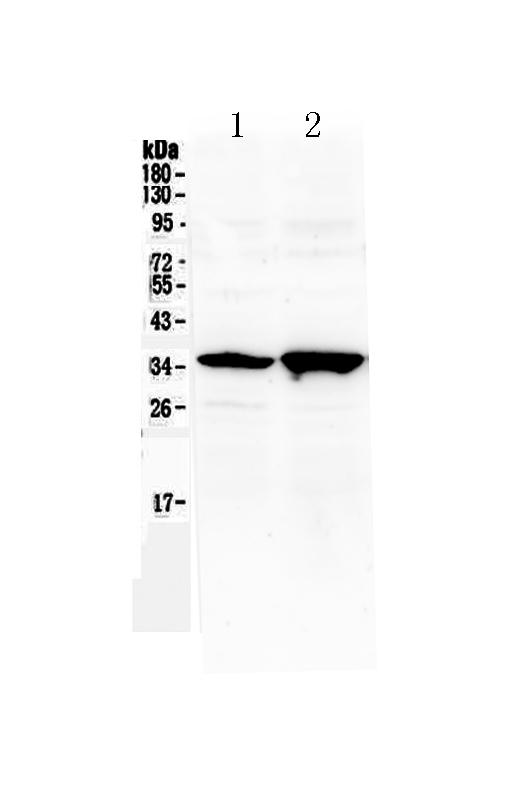
- 产品详情
- 实验流程
- 背景知识
Application 
| WB |
|---|---|
| Primary Accession | O95343 |
| Host | Rabbit |
| Reactivity | Human, Mouse, Rat |
| Clonality | Polyclonal |
| Format | Lyophilized |
| Description | Rabbit IgG polyclonal antibody for Homeobox protein SIX3(SIX3) detection. Tested with WB in Human;Mouse;Rat. |
| Reconstitution | Add 0.2ml of distilled water will yield a concentration of 500ug/ml. |
| Gene ID | 6496 |
|---|---|
| Other Names | Homeobox protein SIX3, Sine oculis homeobox homolog 3, SIX3 |
| Calculated MW | 35487 Da |
| Application Details | Western blot, 0.1-0.5 µg/ml, Mouse, Rat, Human |
| Subcellular Localization | Nucleus . |
| Source | Eukaryota |
| Contents | Each vial contains 5mg BSA, 0.9mg NaCl, 0.2mg Na2HPO4, 0.05mg NaN3. |
| Immunogen | A synthetic peptide corresponding to a sequence at the N-terminus of human Six3 (1-32aa MVFRSPLDLYSSHFLLPNFADSHHRSILLASS), different from the related mouse sequence by two amino acids. |
| Purification | Immunogen affinity purified. |
| Cross Reactivity | No cross reactivity with other proteins. |
| Storage | At -20˚C for one year. After r˚Constitution, at 4˚C for one month. It˚Can also be aliquotted and stored frozen at -20˚C for a longer time. Avoid repeated freezing and thawing. |
For Research Use Only. Not For Use In Diagnostic Procedures.
| Name | SIX3 |
|---|---|
| Function | Transcriptional regulator which can act as both a transcriptional repressor and activator by binding a ATTA homeodomain core recognition sequence on these target genes. During forebrain development represses WNT1 expression allowing zona limitans intrathalamica formation and thereby ensuring proper anterio-posterior patterning of the diencephalon and formation of the rostral diencephalon. Acts as a direct upstream activator of SHH expression in the rostral diencephalon ventral midline and that in turn SHH maintains its expression. In addition, Six3 activity is required for the formation of the telencephalon. During postnatal stages of brain development is necessary for ependymal cell maturation by promoting the maturation of radial glia into ependymal cells through regulation of neuroblast proliferation and migration. Acts on the proliferation and differentiation of neural progenitor cells through activating transcription of CCND1 and CCND2. During early lens formation plays a role in lens induction and specification by activating directly PAX6 in the presumptive lens ectoderm. In turn PAX6 activates SIX3 resulting in activation of PDGFRA and CCND1 promoting cell proliferation. Also is required for the neuroretina development by directly suppressing WNT8B expression in the anterior neural plate territory. Its action during retina development and lens morphogenesis is TLE5 and TLE4-dependent manner. Furthermore, during eye development regulates several genes expression. Before and during early lens development represses the CRYGF promoter by binding a SIX repressor element. Directly activates RHO transcription, or cooperates with CRX or NRL. Six3 also functions in the formation of the proximodistal axis of the optic cup, and promotes the formation of optic vesicles-like structures. During pituitary development, acts in parallel or alternatively with HESX1 to control cell proliferation through Wnt/beta-catenin pathway (By similarity). Plays a role in eye development by suppressing WNT1 expression and in dorsal-ventral patterning by repressing BMP signaling pathway. |
| Cellular Location | Nucleus {ECO:0000250|UniProtKB:Q62233, ECO:0000255|PROSITE-ProRule:PRU00108} |
Provided below are standard protocols that you may find useful for product applications.
BACKGROUND
Homeobox protein SIX3 is a protein that in humans is encoded by the SIX3 gene. This gene encodes a member of the sine oculishomeobox transcription factor family. The encoded protein plays a role in eye development. Mutations in SIX3 are the cause of a severe brain malformation, called holoprosencephaly type 2 (HPE2). In HPE2, the brain fails to separate into two hemispheres during early embryonic development, leading to eye and brain malformations, which result in serious facial abnormalities. A mutant zebrafish knockout model has been developed, in which the anterior part of the head was missing due to the atypical increase of Wnt1 activity. When injected with SIX3, these zebrafish embryos were able to successfully develop a normal forebrain. When SIX3 was turned off in mice, resulting in a lack of retina formation due to excessive expression of Wnt8b in the region where the forebrain normally develops. Both of these studies demonstrate the importance of SIX3 activity in brain and eye development.

终于等到您。ABCEPTA(百远生物)抗体产品。
点击下方“我要评价 ”按钮提交您的反馈信息,您的反馈和评价是我们最宝贵的财富之一,
我们将在1-3个工作日内处理您的反馈信息。
如有疑问,联系:0512-88856768 tech-china@abcepta.com.


