


 癌症的基本特征包括细胞增殖、血管生成、迁移、凋亡逃避机制和细胞永生等。找到癌症发生过程中这些通路的关键标记物和对应的抗体用于检测至关重要。
 为您推荐一个泛素化位点预测神器——泛素化分析工具,可以为您的蛋白的泛素化位点作出预测和评分。
 细胞自噬受体图形绘图工具为你的蛋白的细胞受体结合位点作出预测和评分,识别结合到自噬通路中的蛋白是非常重要的,便于让我们理解自噬在正常生理、病理过程中的作用,如发育、细胞分化、神经退化性疾病、压力条件下、感染和癌症。
Anti-Caspase-6 Picoband Antibody
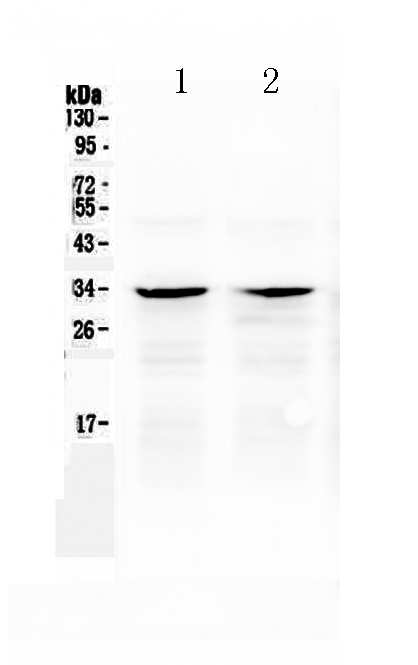
- 产品详情
- 实验流程
- 背景知识
Application 
| WB |
|---|---|
| Primary Accession | P55212 |
| Host | Rabbit |
| Reactivity | Human, Mouse, Rat |
| Clonality | Polyclonal |
| Format | Lyophilized |
| Description | Rabbit IgG polyclonal antibody for Caspase-6(CASP6) detection. Tested with WB in Human;Mouse;Rat. |
| Reconstitution | Add 0.2ml of distilled water will yield a concentration of 500ug/ml. |
| Gene ID | 839 |
|---|---|
| Other Names | Caspase-6, CASP-6, 3.4.22.59, Apoptotic protease Mch-2, Caspase-6 subunit p18, Caspase-6 subunit p11, CASP6, MCH2 |
| Calculated MW | 33310 Da |
| Application Details | Western blot, 0.1-0.5 µg/ml, Mouse, Rat, Human |
| Subcellular Localization | Cytoplasm. |
| Source | Eukaryota |
| Contents | Each vial contains 5mg BSA, 0.9mg NaCl, 0.2mg Na2HPO4, 0.05mg NaN3. |
| Immunogen | E. coli-derived human Caspase-6 recombinant protein (Position: A194-N293). Human Caspase-6 shares 95.9% and 93.9% amino acid (aa) sequence identity with mouse and rat Caspase-6, respectively. |
| Purification | Immunogen affinity purified. |
| Cross Reactivity | No cross reactivity with other proteins. |
| Storage | At -20˚C for one year. After r˚Constitution, at 4˚C for one month. It˚Can also be aliquotted and stored frozen at -20˚C for a longer time. Avoid repeated freezing and thawing. |
For Research Use Only. Not For Use In Diagnostic Procedures.
| Name | CASP6 (HGNC:1507) |
|---|---|
| Function | Cysteine protease that plays essential roles in programmed cell death, axonal degeneration, development and innate immunity (PubMed:19133298, PubMed:22858542, PubMed:27032039, PubMed:28864531, PubMed:30420425, PubMed:32298652, PubMed:8663580). Acts as a non- canonical executioner caspase during apoptosis: localizes in the nucleus and cleaves the nuclear structural protein NUMA1 and lamin A/LMNA thereby inducing nuclear shrinkage and fragmentation (PubMed:11953316, PubMed:17401638, PubMed:8663580, PubMed:9463409). Lamin-A/LMNA cleavage is required for chromatin condensation and nuclear disassembly during apoptotic execution (PubMed:11953316). Acts as a regulator of liver damage by promoting hepatocyte apoptosis: in absence of phosphorylation by AMP-activated protein kinase (AMPK), catalyzes cleavage of BID, leading to cytochrome c release, thereby participating in nonalcoholic steatohepatitis (PubMed:32029622). Cleaves PARK7/DJ-1 in cells undergoing apoptosis (By similarity). Involved in intrinsic apoptosis by mediating cleavage of RIPK1 (PubMed:22858542). Furthermore, cleaves many transcription factors such as NF-kappa-B and cAMP response element-binding protein/CREBBP (PubMed:10559921, PubMed:14657026). Cleaves phospholipid scramblase proteins XKR4 and XKR9 (By similarity). In addition to apoptosis, involved in different forms of programmed cell death (PubMed:32298652). Plays an essential role in defense against viruses by acting as a central mediator of the ZBP1-mediated pyroptosis, apoptosis, and necroptosis (PANoptosis), independently of its cysteine protease activity (PubMed:32298652). PANoptosis is a unique inflammatory programmed cell death, which provides a molecular scaffold that allows the interactions and activation of machinery required for inflammasome/pyroptosis, apoptosis and necroptosis (PubMed:32298652). Mechanistically, interacts with RIPK3 and enhances the interaction between RIPK3 and ZBP1, leading to ZBP1-mediated inflammasome activation and cell death (PubMed:32298652). Plays an essential role in axon degeneration during axon pruning which is the remodeling of axons during neurogenesis but not apoptosis (By similarity). Regulates B-cell programs both during early development and after antigen stimulation (By similarity). |
| Cellular Location | Cytoplasm. Nucleus |
Provided below are standard protocols that you may find useful for product applications.
BACKGROUND
Caspase 6 is an enzyme that in humans is encoded by the CASP6 gene. This gene encodes a protein that is a member of the cysteine-aspartic acid protease (caspase) family. Using radiation hybrid mapping, the CASP6 gene is localized to human chromosome 4q25-q26. It functions as a downstream enzyme in the caspase activation cascade. And CASP6 can cleave lamin A to its signature apoptotic fragment.

终于等到您。ABCEPTA(百远生物)抗体产品。
点击下方“我要评价 ”按钮提交您的反馈信息,您的反馈和评价是我们最宝贵的财富之一,
我们将在1-3个工作日内处理您的反馈信息。
如有疑问,联系:0512-88856768 tech-china@abcepta.com.


