


 癌症的基本特征包括细胞增殖、血管生成、迁移、凋亡逃避机制和细胞永生等。找到癌症发生过程中这些通路的关键标记物和对应的抗体用于检测至关重要。
 为您推荐一个泛素化位点预测神器——泛素化分析工具,可以为您的蛋白的泛素化位点作出预测和评分。
 细胞自噬受体图形绘图工具为你的蛋白的细胞受体结合位点作出预测和评分,识别结合到自噬通路中的蛋白是非常重要的,便于让我们理解自噬在正常生理、病理过程中的作用,如发育、细胞分化、神经退化性疾病、压力条件下、感染和癌症。
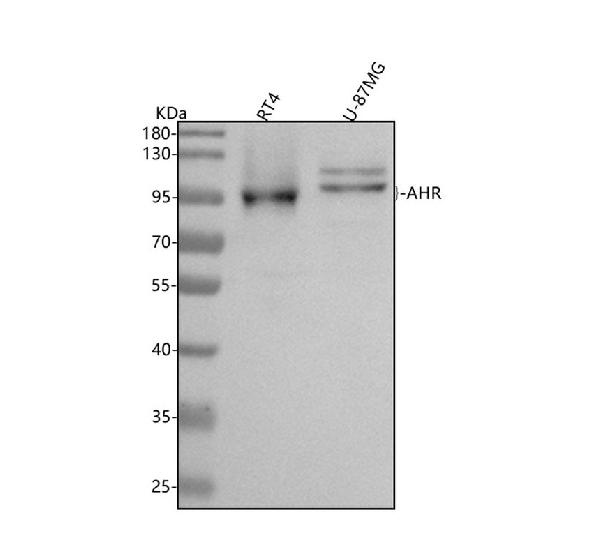
Anti-AhR Rabbit Monoclonal Antibody
- 产品详情
- 实验流程
Application 
| WB, IF, ICC |
|---|---|
| Primary Accession | P35869 |
| Host | Rabbit |
| Isotype | Rabbit IgG |
| Reactivity | Human |
| Clonality | Monoclonal |
| Format | Liquid |
| Description | Anti-AhR Rabbit Monoclonal Antibody . Tested in WB, ICC/IF applications. This antibody reacts with Human. |
| Gene ID | 196 |
|---|---|
| Other Names | Aryl hydrocarbon receptor, Ah receptor, AhR, Class E basic helix-loop-helix protein 76, bHLHe76, AHR {ECO:0000303|PubMed:8393992, ECO:0000312|HGNC:HGNC:348} |
| Calculated MW | 96147 Da |
| Application Details | WB 1:500-1:2000 ICC/IF 1:50-1:200 |
| Subcellular Localization | Cytoplasm. Nucleus. Initially cytoplasmic; upon binding with ligand and interaction with a HSP90, it translocates to the nucleus. |
| Tissue Specificity | Expressed in all tissues tested including blood, brain, heart, kidney, liver, lung, pancreas and skeletal muscle.. |
| Source | Eukaryota |
| Contents | Rabbit IgG in phosphate buffered saline, pH 7.4, 150mM NaCl, 0.02% sodium azide and 50% glycerol, 0.4-0.5mg/ml BSA. |
| Clone Names | Clone: AOHI-1 |
| Immunogen | A synthesized peptide derived from human AhR |
| Purification | Affinity-chromatography |
| Storage | Store at -20°C for one year. For short term storage and frequent use, store at 4°C for up to one month. Avoid repeated freeze-thaw cycles. |
For Research Use Only. Not For Use In Diagnostic Procedures.
| Name | AHR {ECO:0000303|PubMed:8393992, ECO:0000312|HGNC:HGNC:348} |
|---|---|
| Function | Ligand-activated transcription factor that enables cells to adapt to changing conditions by sensing compounds from the environment, diet, microbiome and cellular metabolism, and which plays important roles in development, immunity and cancer (PubMed:23275542, PubMed:30373764, PubMed:32818467, PubMed:7961644). Upon ligand binding, translocates into the nucleus, where it heterodimerizes with ARNT and induces transcription by binding to xenobiotic response elements (XRE) (PubMed:23275542, PubMed:30373764, PubMed:7961644). Regulates a variety of biological processes, including angiogenesis, hematopoiesis, drug and lipid metabolism, cell motility and immune modulation (PubMed:12213388). Xenobiotics can act as ligands: upon xenobiotic- binding, activates the expression of multiple phase I and II xenobiotic chemical metabolizing enzyme genes (such as the CYP1A1 gene) (PubMed:7961644, PubMed:33193710). Mediates biochemical and toxic effects of halogenated aromatic hydrocarbons (PubMed:34521881, PubMed:7961644). Next to xenobiotics, natural ligands derived from plants, microbiota, and endogenous metabolism are potent AHR agonists (PubMed:18076143). Tryptophan (Trp) derivatives constitute an important class of endogenous AHR ligands (PubMed:32818467, PubMed:32866000). Acts as a negative regulator of anti-tumor immunity: indoles and kynurenic acid generated by Trp catabolism act as ligand and activate AHR, thereby promoting AHR-driven cancer cell motility and suppressing adaptive immunity (PubMed:32818467). Regulates the circadian clock by inhibiting the basal and circadian expression of the core circadian component PER1 (PubMed:28602820). Inhibits PER1 by repressing the CLOCK-BMAL1 heterodimer mediated transcriptional activation of PER1 (PubMed:28602820). The heterodimer ARNT:AHR binds to the dioxin response element (DRE) of target gene promoters and activates their transcription (PubMed:28602820). |
| Cellular Location | Cytoplasm. Nucleus. Note=Initially cytoplasmic; upon binding with ligand and interaction with a HSP90, it translocates to the nucleus. |
| Tissue Location | Expressed in all tissues tested including blood, brain, heart, kidney, liver, lung, pancreas and skeletal muscle Expressed in retinal photoreceptors (PubMed:29726989) |
Research Areas
Application Protocols
Provided below are standard protocols that you may find useful for product applications.

终于等到您。ABCEPTA(百远生物)抗体产品。
点击下方“我要评价 ”按钮提交您的反馈信息,您的反馈和评价是我们最宝贵的财富之一,
我们将在1-3个工作日内处理您的反馈信息。
如有疑问,联系:0512-88856768 tech-china@abcepta.com.


