


 癌症的基本特征包括细胞增殖、血管生成、迁移、凋亡逃避机制和细胞永生等。找到癌症发生过程中这些通路的关键标记物和对应的抗体用于检测至关重要。
 为您推荐一个泛素化位点预测神器——泛素化分析工具,可以为您的蛋白的泛素化位点作出预测和评分。
 细胞自噬受体图形绘图工具为你的蛋白的细胞受体结合位点作出预测和评分,识别结合到自噬通路中的蛋白是非常重要的,便于让我们理解自噬在正常生理、病理过程中的作用,如发育、细胞分化、神经退化性疾病、压力条件下、感染和癌症。
Anti-SIRT6 Rabbit Monoclonal Antibody
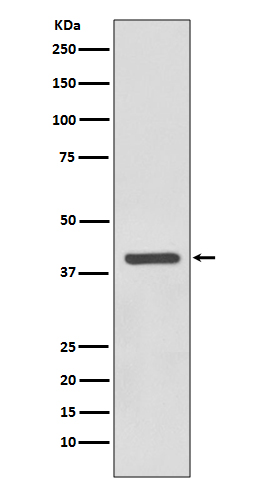
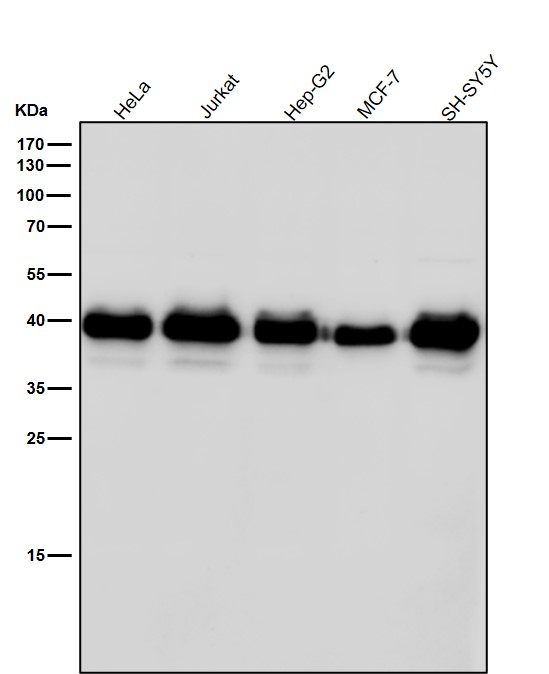
- 产品详情
- 实验流程
Application 
| WB |
|---|---|
| Primary Accession | Q8N6T7 |
| Host | Rabbit |
| Isotype | Rabbit IgG |
| Reactivity | Human |
| Clonality | Monoclonal |
| Format | Liquid |
| Description | Anti-SIRT6 Rabbit Monoclonal Antibody . Tested in WB application. This antibody reacts with Human. |
| Gene ID | 51548 |
|---|---|
| Other Names | NAD-dependent protein deacylase sirtuin-6, 2.3.1.-, NAD-dependent protein deacetylase sirtuin-6, 2.3.1.286 {ECO:0000255|PROSITE-ProRule:PRU00236, ECO:0000269|PubMed:18337721, ECO:0000269|PubMed:23892288, ECO:0000269|PubMed:24052263, ECO:0000269|PubMed:27043296, ECO:0000269|PubMed:27322069}, Protein mono-ADP-ribosyltransferase sirtuin-6, 2.4.2.-, Regulatory protein SIR2 homolog 6, hSIRT6, SIR2-like protein 6, SIRT6 {ECO:0000303|PubMed:10873683, ECO:0000312|HGNC:HGNC:14934} |
| Calculated MW | 39119 Da |
| Application Details | WB 1:1000-1:2000 |
| Subcellular Localization | Nucleus, nucleoplasm. Predominantly nuclear. Associated with telomeric heterochromatin regions. |
| Source | Eukaryota |
| Contents | Rabbit IgG in phosphate buffered saline, pH 7.4, 150mM NaCl, 0.02% sodium azide and 50% glycerol, 0.4-0.5mg/ml BSA. |
| Clone Names | Clone: HBA-19 |
| Immunogen | A synthesized peptide derived from human SIRT6 |
| Purification | Affinity-chromatography |
| Storage | Store at -20°C for one year. For short term storage and frequent use, store at 4°C for up to one month. Avoid repeated freeze-thaw cycles. |
For Research Use Only. Not For Use In Diagnostic Procedures.
| Name | SIRT6 {ECO:0000303|PubMed:10873683, ECO:0000312|HGNC:HGNC:14934} |
|---|---|
| Function | NAD-dependent protein deacetylase, deacylase and mono-ADP- ribosyltransferase that plays an essential role in DNA damage repair, telomere maintenance, metabolic homeostasis, inflammation, tumorigenesis and aging (PubMed:18337721, PubMed:19135889, PubMed:19625767, PubMed:21362626, PubMed:21680843, PubMed:23217706, PubMed:23552949, PubMed:23653361, PubMed:24052263, PubMed:27180906, PubMed:27322069, PubMed:29555651, PubMed:30374165). Displays protein- lysine deacetylase or defatty-acylase (demyristoylase and depalmitoylase) activity, depending on the context (PubMed:23552949, PubMed:24052263, PubMed:27322069). Acts as a key histone deacetylase by catalyzing deacetylation of histone H3 at 'Lys-9', 'Lys-18' and 'Lys- 56' (H3K9ac, H3K18ac and H3K56ac, respectively), suppressing target gene expression of several transcription factors, including NF-kappa-B (PubMed:19625767, PubMed:21362626, PubMed:23892288, PubMed:23911928, PubMed:24012758, PubMed:26456828, PubMed:26898756, PubMed:27043296, PubMed:27180906, PubMed:30374165, PubMed:33067423). Acts as an inhibitor of transcription elongation by mediating deacetylation of H3K9ac and H3K56ac, preventing release of NELFE from chromatin and causing transcriptional pausing (By similarity). Involved in DNA repair by promoting double-strand break (DSB) repair: acts as a DSB sensor by recognizing and binding DSB sites, leading to (1) recruitment of DNA repair proteins, such as SMARCA5/SNF2H, and (2) deacetylation of histone H3K9ac and H3K56ac (PubMed:23911928, PubMed:31995034, PubMed:32538779). SIRT6 participation to DSB repair is probably involved in extension of life span (By similarity). Also promotes DNA repair by deacetylating non-histone proteins, such as DDB2 and p53/TP53 (PubMed:29474172, PubMed:32789493). Specifically deacetylates H3K18ac at pericentric heterochromatin, thereby maintaining pericentric heterochromatin silencing at centromeres and protecting against genomic instability and cellular senescence (PubMed:27043296). Involved in telomere maintenance by catalyzing deacetylation of histone H3 in telomeric chromatin, regulating telomere position effect and telomere movement in response to DNA damage (PubMed:18337721, PubMed:19625767, PubMed:21847107). Required for embryonic stem cell differentiation by mediating histone deacetylation of H3K9ac (PubMed:25915124, PubMed:29555651). Plays a major role in metabolism by regulating processes such as glycolysis, gluconeogenesis, insulin secretion and lipid metabolism (PubMed:24012758, PubMed:26787900). Inhibits glycolysis via histone deacetylase activity and by acting as a corepressor of the transcription factor HIF1A, thereby controlling the expression of multiple glycolytic genes (By similarity). Has tumor suppressor activity by repressing glycolysis, thereby inhibiting the Warburg effect (PubMed:23217706). Also regulates glycolysis and tumorigenesis by mediating deacetylation and nuclear export of non- histone proteins, such as isoform M2 of PKM (PKM2) (PubMed:26787900). Acts as a negative regulator of gluconeogenesis by mediating deacetylation of non-histone proteins, such as FOXO1 and KAT2A/GCN5 (PubMed:23142079, PubMed:25009184). Promotes beta-oxidation of fatty acids during fasting by catalyzing deacetylation of NCOA2, inducing coactivation of PPARA (By similarity). Acts as a regulator of lipid catabolism in brown adipocytes, both by catalyzing deacetylation of histones and non-histone proteins, such as FOXO1 (By similarity). Also acts as a regulator of circadian rhythms, both by regulating expression of clock-controlled genes involved in lipid and carbohydrate metabolism, and by catalyzing deacetylation of PER2 (By similarity). The defatty-acylase activity is specifically involved in regulation of protein secretion (PubMed:23552949, PubMed:24052263, PubMed:27322069, PubMed:28406396). Has high activity toward long-chain fatty acyl groups and mediates protein-lysine demyristoylation and depalmitoylation of target proteins, such as RRAS2 and TNF, thereby regulating their secretion (PubMed:23552949, PubMed:28406396). Also acts as a mono-ADP- ribosyltransferase by mediating mono-ADP-ribosylation of PARP1, TRIM28/KAP1 or SMARCC2/BAF170 (PubMed:21680843, PubMed:22753495, PubMed:27322069, PubMed:27568560). Mono-ADP-ribosyltransferase activity is involved in DNA repair, cellular senescence, repression of LINE-1 retrotransposon elements and regulation of transcription (PubMed:21680843, PubMed:22753495, PubMed:27568560). |
| Cellular Location | Nucleus. Chromosome. Chromosome, telomere. Endoplasmic reticulum. Note=Predominantly nuclear (PubMed:18337721). Associated with pericentric heterochromatin and telomeric heterochromatin regions (PubMed:18337721, PubMed:27043296) Localizes to DNA damage sites: directly recognizes and binds double- strand breaks (DSBs) sites via a tunnel-like structure that has high affinity for DSBs (PubMed:21680843, PubMed:23911928, PubMed:27568560, PubMed:31995034, PubMed:32538779). A fraction localizes to the endoplasmic reticulum (PubMed:23552949). |
Research Areas
Application Protocols
Provided below are standard protocols that you may find useful for product applications.

终于等到您。ABCEPTA(百远生物)抗体产品。
点击下方“我要评价 ”按钮提交您的反馈信息,您的反馈和评价是我们最宝贵的财富之一,
我们将在1-3个工作日内处理您的反馈信息。
如有疑问,联系:0512-88856768 tech-china@abcepta.com.


