


 癌症的基本特征包括细胞增殖、血管生成、迁移、凋亡逃避机制和细胞永生等。找到癌症发生过程中这些通路的关键标记物和对应的抗体用于检测至关重要。
 为您推荐一个泛素化位点预测神器——泛素化分析工具,可以为您的蛋白的泛素化位点作出预测和评分。
 细胞自噬受体图形绘图工具为你的蛋白的细胞受体结合位点作出预测和评分,识别结合到自噬通路中的蛋白是非常重要的,便于让我们理解自噬在正常生理、病理过程中的作用,如发育、细胞分化、神经退化性疾病、压力条件下、感染和癌症。
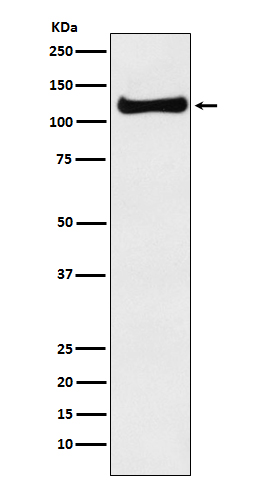
Anti-USP10 Monoclonal Antibody
- 产品详情
- 实验流程
Application 
| WB, IHC, IF, ICC, IP |
|---|---|
| Primary Accession | Q14694 |
| Host | Rabbit |
| Isotype | Rabbit IgG |
| Reactivity | Human |
| Clonality | Monoclonal |
| Format | Liquid |
| Description | Anti-USP10 Monoclonal Antibody . Tested in WB, IHC, ICC/IF, IP applications. This antibody reacts with Human. |
| Gene ID | 9100 |
|---|---|
| Other Names | Ubiquitin carboxyl-terminal hydrolase 10, 3.4.19.12, Deubiquitinating enzyme 10, Ubiquitin thioesterase 10, Ubiquitin-specific-processing protease 10, USP10 {ECO:0000303|PubMed:11439350, ECO:0000312|HGNC:HGNC:12608} |
| Calculated MW | 87134 Da |
| Application Details | WB 1:500-1:2000 IHC 1:50-1:200 ICC/IF 1:50-1:200 IP 1:50 |
| Source | Eukaryota |
| Contents | Rabbit IgG in phosphate buffered saline, pH 7.4, 150mM NaCl, 0.02% sodium azide and 50% glycerol, 0.4-0.5mg/ml BSA. |
| Clone Names | Clone: ADCB-21 |
| Immunogen | A synthesized peptide derived from human USP10 Hydrolase that can remove conjugated ubiquitin from target proteins such as p53/TP53, SNX3 and CFTR. Acts as an essential regulator of p53/TP53 stability: in unstressed cells, specifically deubiquitinates p53/TP53 in the cytoplasm, leading to counteract MDM2 action and stabilize p53/TP53. |
| Purification | Affinity-chromatography |
| Storage | Store at -20°C for one year. For short term storage and frequent use, store at 4°C for up to one month. Avoid repeated freeze-thaw cycles. |
For Research Use Only. Not For Use In Diagnostic Procedures.
| Name | USP10 {ECO:0000303|PubMed:11439350, ECO:0000312|HGNC:HGNC:12608} |
|---|---|
| Function | Hydrolase that can remove conjugated ubiquitin from target proteins such as p53/TP53, RPS2/us5, RPS3/us3, RPS10/eS10, BECN1, SNX3 and CFTR (PubMed:11439350, PubMed:18632802, PubMed:31981475). Acts as an essential regulator of p53/TP53 stability: in unstressed cells, specifically deubiquitinates p53/TP53 in the cytoplasm, leading to counteract MDM2 action and stabilize p53/TP53 (PubMed:20096447). Following DNA damage, translocates to the nucleus and deubiquitinates p53/TP53, leading to regulate the p53/TP53-dependent DNA damage response (PubMed:20096447). Component of a regulatory loop that controls autophagy and p53/TP53 levels: mediates deubiquitination of BECN1, a key regulator of autophagy, leading to stabilize the PIK3C3/VPS34-containing complexes (PubMed:21962518). In turn, PIK3C3/VPS34-containing complexes regulate USP10 stability, suggesting the existence of a regulatory system by which PIK3C3/VPS34-containing complexes regulate p53/TP53 protein levels via USP10 and USP13 (PubMed:21962518). Does not deubiquitinate MDM2 (PubMed:20096447). Plays a key role in 40S ribosome subunit recycling when a ribosome has stalled during translation: acts both by inhibiting formation of stress granules, which store stalled translation pre-initiation complexes, and mediating deubiquitination of 40S ribosome subunits (PubMed:27022092, PubMed:31981475, PubMed:34348161, PubMed:34469731). Acts as a negative regulator of stress granules formation by lowering G3BP1 and G3BP2 valence, thereby preventing G3BP1 and G3BP2 ability to undergo liquid- liquid phase separation (LLPS) and assembly of stress granules (PubMed:11439350, PubMed:27022092, PubMed:32302570). Promotes 40S ribosome subunit recycling following ribosome dissociation in response to ribosome stalling by mediating deubiquitination of 40S ribosomal proteins RPS2/us5, RPS3/us3 and RPS10/eS10, thereby preventing their degradation by the proteasome (PubMed:31981475, PubMed:34348161, PubMed:34469731). Part of a ribosome quality control that takes place when ribosomes have stalled during translation initiation (iRQC): USP10 acts by removing monoubiquitination of RPS2/us5 and RPS3/us3, promoting 40S ribosomal subunit recycling (PubMed:34469731). Deubiquitinates CFTR in early endosomes, enhancing its endocytic recycling (PubMed:19398555). Involved in a TANK-dependent negative feedback response to attenuate NF-kappa-B activation via deubiquitinating IKBKG or TRAF6 in response to interleukin-1-beta (IL1B) stimulation or upon DNA damage (PubMed:25861989). Deubiquitinates TBX21 leading to its stabilization (PubMed:24845384). Plays a negative role in the RLR signaling pathway upon RNA virus infection by blocking the RIGI- mediated MAVS activation. Mechanistically, removes the unanchored 'Lys- 63'-linked polyubiquitin chains of MAVS to inhibit its aggregation, essential for its activation (PubMed:37582970). |
| Cellular Location | Cytoplasm. Nucleus. Early endosome. Note=Cytoplasmic in normal conditions (PubMed:20096447). After DNA damage, translocates to the nucleus following phosphorylation by ATM (PubMed:20096447) |
| Tissue Location | Widely expressed.. |
Research Areas
Application Protocols
Provided below are standard protocols that you may find useful for product applications.

终于等到您。ABCEPTA(百远生物)抗体产品。
点击下方“我要评价 ”按钮提交您的反馈信息,您的反馈和评价是我们最宝贵的财富之一,
我们将在1-3个工作日内处理您的反馈信息。
如有疑问,联系:0512-88856768 tech-china@abcepta.com.


