


 癌症的基本特征包括细胞增殖、血管生成、迁移、凋亡逃避机制和细胞永生等。找到癌症发生过程中这些通路的关键标记物和对应的抗体用于检测至关重要。
 为您推荐一个泛素化位点预测神器——泛素化分析工具,可以为您的蛋白的泛素化位点作出预测和评分。
 细胞自噬受体图形绘图工具为你的蛋白的细胞受体结合位点作出预测和评分,识别结合到自噬通路中的蛋白是非常重要的,便于让我们理解自噬在正常生理、病理过程中的作用,如发育、细胞分化、神经退化性疾病、压力条件下、感染和癌症。
Anti-LIN28 LIN28A Monoclonal Antibody
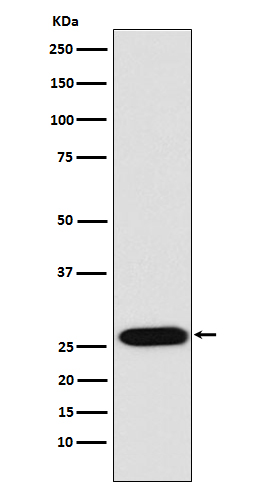
- 产品详情
- 实验流程
Application 
| WB, IHC, IF, ICC, IP, FC |
|---|---|
| Primary Accession | Q9H9Z2 |
| Host | Rabbit |
| Isotype | Rabbit IgG |
| Reactivity | Human |
| Clonality | Monoclonal |
| Format | Liquid |
| Description | Anti-LIN28 LIN28A Monoclonal Antibody . Tested in WB, IHC, ICC/IF, IP, Flow Cytometry applications. This antibody reacts with Human. |
| Gene ID | 79727 |
|---|---|
| Other Names | Protein lin-28 homolog A, Lin-28A, Zinc finger CCHC domain-containing protein 1, LIN28A, CSDD1, LIN28, ZCCHC1 |
| Calculated MW | 22743 Da |
| Application Details | WB 1:1000-1:5000 IHC 1:50-1:200 ICC/IF 1:100-1:500 IP 1:50 FC 1:50 |
| Source | Eukaryota |
| Contents | Rabbit IgG in phosphate buffered saline, pH 7.4, 150mM NaCl, 0.02% sodium azide and 50% glycerol, 0.4-0.5mg/ml BSA. |
| Clone Names | Clone: AFFE-12 |
| Immunogen | A synthesized peptide derived from human LIN28 Involved in the timing of developmental events and choice of stage specific cell fates. Acts as a suppressor of microRNA (miRNA) biogenesis by specifically binding the precursor let-7 (pre-let-7), a miRNA precursor. Acts by binding pre-let-7 and recruiting ZCCHC11/TUT4 uridylyltransferase, leading to the terminal uridylation of pre-let-7. |
| Purification | Affinity-chromatography |
| Storage | Store at -20°C for one year. For short term storage and frequent use, store at 4°C for up to one month. Avoid repeated freeze-thaw cycles. |
For Research Use Only. Not For Use In Diagnostic Procedures.
| Name | LIN28A |
|---|---|
| Synonyms | CSDD1, LIN28, ZCCHC1 |
| Function | RNA-binding protein that inhibits processing of pre-let-7 miRNAs and regulates translation of mRNAs that control developmental timing, pluripotency and metabolism (PubMed:21247876). Seems to recognize a common structural G-quartet (G4) feature in its miRNA and mRNA targets (Probable). 'Translational enhancer' that drives specific mRNAs to polysomes and increases the efficiency of protein synthesis. Its association with the translational machinery and target mRNAs results in an increased number of initiation events per molecule of mRNA and, indirectly, in mRNA stabilization. Binds IGF2 mRNA, MYOD1 mRNA, ARBP/36B4 ribosomal protein mRNA and its own mRNA. Essential for skeletal muscle differentiation program through the translational up- regulation of IGF2 expression. Suppressor of microRNA (miRNA) biogenesis, including that of let-7, miR107, miR-143 and miR-200c. Specifically binds the miRNA precursors (pre-miRNAs), recognizing an 5'-GGAG-3' motif found in pre-miRNA terminal loop, and recruits TUT4 and TUT7 uridylyltransferases (PubMed:18951094, PubMed:19703396, PubMed:22118463, PubMed:22898984). This results in the terminal uridylation of target pre-miRNAs (PubMed:18951094, PubMed:19703396, PubMed:22118463, PubMed:22898984). Uridylated pre-miRNAs fail to be processed by Dicer and undergo degradation. The repression of let-7 expression is required for normal development and contributes to maintain the pluripotent state by preventing let-7-mediated differentiation of embryonic stem cells (PubMed:18951094, PubMed:19703396, PubMed:22118463, PubMed:22898984). Localized to the periendoplasmic reticulum area, binds to a large number of spliced mRNAs and inhibits the translation of mRNAs destined for the ER, reducing the synthesis of transmembrane proteins, ER or Golgi lumen proteins, and secretory proteins. Binds to and enhances the translation of mRNAs for several metabolic enzymes, such as PFKP, PDHA1 or SDHA, increasing glycolysis and oxidative phosphorylation. Which, with the let-7 repression may enhance tissue repair in adult tissue (By similarity). |
| Cellular Location | Cytoplasm. Rough endoplasmic reticulum {ECO:0000250|UniProtKB:Q8K3Y3}. Cytoplasm, P-body. Cytoplasm, Stress granule. Nucleus, nucleolus {ECO:0000250|UniProtKB:Q8K3Y3}. Note=Predominantly cytoplasmic (PubMed:22118463). In the cytoplasm, localizes to peri-endoplasmic reticulum regions and detected in the microsomal fraction derived from rough endoplasmic reticulum (RER) following subcellular fractionation May be bound to the cytosolic surface of RER on which ER-associated mRNAs are translated (By similarity). Shuttle from the nucleus to the cytoplasm requires RNA-binding (PubMed:17617744). Nucleolar localization is observed in 10-15% of the nuclei in differentiated myotubes (By similarity). {ECO:0000250|UniProtKB:Q8K3Y3, ECO:0000269|PubMed:17617744, ECO:0000269|PubMed:22118463} |
| Tissue Location | Expressed in embryonic stem cells, placenta and testis. Tends to be up-regulated in HER2-overexpressing breast tumors |
Research Areas
Application Protocols
Provided below are standard protocols that you may find useful for product applications.

终于等到您。ABCEPTA(百远生物)抗体产品。
点击下方“我要评价 ”按钮提交您的反馈信息,您的反馈和评价是我们最宝贵的财富之一,
我们将在1-3个工作日内处理您的反馈信息。
如有疑问,联系:0512-88856768 tech-china@abcepta.com.


