


 癌症的基本特征包括细胞增殖、血管生成、迁移、凋亡逃避机制和细胞永生等。找到癌症发生过程中这些通路的关键标记物和对应的抗体用于检测至关重要。
 为您推荐一个泛素化位点预测神器——泛素化分析工具,可以为您的蛋白的泛素化位点作出预测和评分。
 细胞自噬受体图形绘图工具为你的蛋白的细胞受体结合位点作出预测和评分,识别结合到自噬通路中的蛋白是非常重要的,便于让我们理解自噬在正常生理、病理过程中的作用,如发育、细胞分化、神经退化性疾病、压力条件下、感染和癌症。
Anti-METTL3 Rabbit Monoclonal Antibody
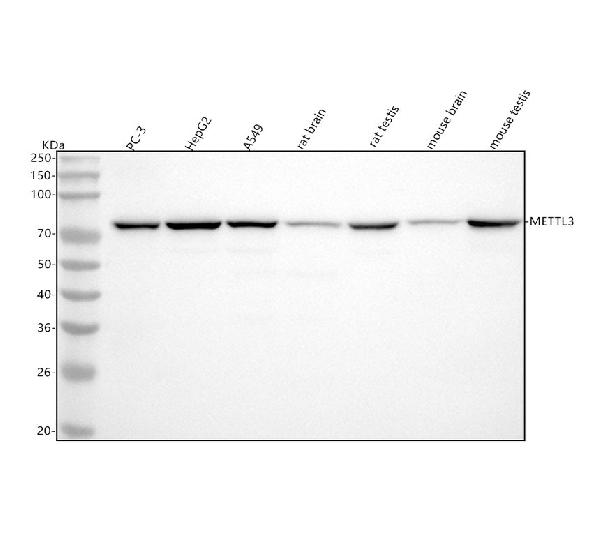
- 产品详情
- 实验流程
Application 
| WB, IHC, IF, ICC, IP, FC |
|---|---|
| Primary Accession | Q86U44 |
| Host | Rabbit |
| Isotype | IgG |
| Reactivity | Rat, Human, Mouse |
| Clonality | Monoclonal |
| Format | Liquid |
| Description | Anti-METTL3 Rabbit Monoclonal Antibody . Tested in WB, IHC, ICC/IF, IP, Flow Cytometry applications. This antibody reacts with Human, Mouse, Rat. |
| Gene ID | 56339 |
|---|---|
| Other Names | N6-adenosine-methyltransferase catalytic subunit, 2.1.1.348, Methyltransferase-like protein 3, hMETTL3, N6-adenosine-methyltransferase 70 kDa subunit, MT-A70, METTL3 (HGNC:17563), MTA70 |
| Calculated MW | 64474 Da |
| Application Details | WB 1:500-1:2000 IHC 1:50-1:200 ICC/IF 1:50-1:200 IP 1:50 FC 1:50 |
| Source | Eukaryota |
| Contents | Rabbit IgG in phosphate buffered saline, pH 7.4, 150mM NaCl, 0.02% sodium azide and 50% glycerol, 0.4-0.5mg/ml BSA. |
| Clone Names | Clone: 21M06 |
| Immunogen | A synthesized peptide derived from human METTL3 |
| Purification | Affinity-chromatography |
| Storage | Store at -20°C for one year. For short term storage and frequent use, store at 4°C for up to one month. Avoid repeated freeze-thaw cycles. |
For Research Use Only. Not For Use In Diagnostic Procedures.
| Name | METTL3 (HGNC:17563) |
|---|---|
| Synonyms | MTA70 |
| Function | The METTL3-METTL14 heterodimer forms a N6-methyltransferase complex that methylates adenosine residues at the N(6) position of some RNAs and regulates various processes such as the circadian clock, differentiation of embryonic and hematopoietic stem cells, cortical neurogenesis, response to DNA damage, differentiation of T-cells and primary miRNA processing (PubMed:22575960, PubMed:24284625, PubMed:25719671, PubMed:25799998, PubMed:26321680, PubMed:26593424, PubMed:27281194, PubMed:27373337, PubMed:27627798, PubMed:28297716, PubMed:29348140, PubMed:29506078, PubMed:30428350, PubMed:9409616). In the heterodimer formed with METTL14, METTL3 constitutes the catalytic core (PubMed:27281194, PubMed:27373337, PubMed:27627798). N6- methyladenosine (m6A), which takes place at the 5'-[AG]GAC-3' consensus sites of some mRNAs, plays a role in mRNA stability, processing, translation efficiency and editing (PubMed:22575960, PubMed:24284625, PubMed:25719671, PubMed:25799998, PubMed:26321680, PubMed:26593424, PubMed:28297716, PubMed:9409616). M6A acts as a key regulator of mRNA stability: methylation is completed upon the release of mRNA into the nucleoplasm and promotes mRNA destabilization and degradation (PubMed:28637692). In embryonic stem cells (ESCs), m6A methylation of mRNAs encoding key naive pluripotency-promoting transcripts results in transcript destabilization, promoting differentiation of ESCs (By similarity). M6A regulates the length of the circadian clock: acts as an early pace-setter in the circadian loop by putting mRNA production on a fast-track for facilitating nuclear processing, thereby providing an early point of control in setting the dynamics of the feedback loop (By similarity). M6A also regulates circadian regulation of hepatic lipid metabolism (PubMed:30428350). M6A regulates spermatogonial differentiation and meiosis and is essential for male fertility and spermatogenesis (By similarity). Also required for oogenesis (By similarity). Involved in the response to DNA damage: in response to ultraviolet irradiation, METTL3 rapidly catalyzes the formation of m6A on poly(A) transcripts at DNA damage sites, leading to the recruitment of POLK to DNA damage sites (PubMed:28297716). M6A is also required for T-cell homeostasis and differentiation: m6A methylation of transcripts of SOCS family members (SOCS1, SOCS3 and CISH) in naive T-cells promotes mRNA destabilization and degradation, promoting T-cell differentiation (By similarity). Inhibits the type I interferon response by mediating m6A methylation of IFNB (PubMed:30559377). M6A also takes place in other RNA molecules, such as primary miRNA (pri- miRNAs) (PubMed:25799998). Mediates m6A methylation of Xist RNA, thereby participating in random X inactivation: m6A methylation of Xist leads to target YTHDC1 reader on Xist and promote transcription repression activity of Xist (PubMed:27602518). M6A also regulates cortical neurogenesis: m6A methylation of transcripts related to transcription factors, neural stem cells, the cell cycle and neuronal differentiation during brain development promotes their destabilization and decay, promoting differentiation of radial glial cells (By similarity). METTL3 mediates methylation of pri-miRNAs, marking them for recognition and processing by DGCR8 (PubMed:25799998). Acts as a positive regulator of mRNA translation independently of the methyltransferase activity: promotes translation by interacting with the translation initiation machinery in the cytoplasm (PubMed:27117702). Its overexpression in a number of cancer cells suggests that it may participate in cancer cell proliferation by promoting mRNA translation (PubMed:27117702). During human coronavirus SARS-CoV-2 infection, adds m6A modifications in SARS-CoV-2 RNA leading to decreased RIGI binding and subsequently dampening the sensing and activation of innate immune responses (PubMed:33961823). |
| Cellular Location | Nucleus. Nucleus speckle. Cytoplasm. Note=Colocalizes with speckles in interphase nuclei, suggesting that it may be associated with nuclear pre-mRNA splicing components (PubMed:9409616). In response to ultraviolet irradiation, colocalizes to DNA damage sites however, it probably does not bind DNA but localizes in the vicinity of DNA damage sites (PubMed:28297716). |
| Tissue Location | Widely expressed at low level. Expressed in spleen, thymus, prostate, testis, ovary, small intestine, colon and peripheral blood leukocytes. |
Research Areas
Application Protocols
Provided below are standard protocols that you may find useful for product applications.

终于等到您。ABCEPTA(百远生物)抗体产品。
点击下方“我要评价 ”按钮提交您的反馈信息,您的反馈和评价是我们最宝贵的财富之一,
我们将在1-3个工作日内处理您的反馈信息。
如有疑问,联系:0512-88856768 tech-china@abcepta.com.


