


 癌症的基本特征包括细胞增殖、血管生成、迁移、凋亡逃避机制和细胞永生等。找到癌症发生过程中这些通路的关键标记物和对应的抗体用于检测至关重要。
 为您推荐一个泛素化位点预测神器——泛素化分析工具,可以为您的蛋白的泛素化位点作出预测和评分。
 细胞自噬受体图形绘图工具为你的蛋白的细胞受体结合位点作出预测和评分,识别结合到自噬通路中的蛋白是非常重要的,便于让我们理解自噬在正常生理、病理过程中的作用,如发育、细胞分化、神经退化性疾病、压力条件下、感染和癌症。
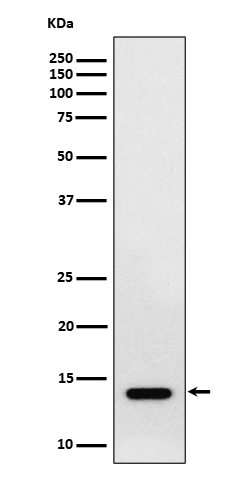
Anti-RNF7 Rabbit Monoclonal Antibody
- 产品详情
- 实验流程
Application 
| WB, IHC, IF, ICC |
|---|---|
| Primary Accession | Q9UBF6 |
| Host | Rabbit |
| Isotype | IgG |
| Reactivity | Rat, Human, Mouse |
| Clonality | Monoclonal |
| Format | Liquid |
| Description | Anti-RNF7 Rabbit Monoclonal Antibody . Tested in WB, IHC, ICC/IF applications. This antibody reacts with Human, Mouse, Rat. |
| Gene ID | 9616 |
|---|---|
| Other Names | RING-box protein 2, Rbx2, CKII beta-binding protein 1, CKBBP1, RING finger protein 7, Regulator of cullins 2, Sensitive to apoptosis gene protein, RNF7, RBX2, ROC2, SAG |
| Calculated MW | 12683 Da |
| Application Details | WB 1:500-1:2000 IHC 1:50-1:200 ICC/IF 1:50-1:200 |
| Source | Eukaryota |
| Contents | Rabbit IgG in phosphate buffered saline, pH 7.4, 150mM NaCl, 0.02% sodium azide and 50% glycerol, 0.4-0.5mg/ml BSA. |
| Clone Names | Clone: 30R91 |
| Immunogen | A synthesized peptide derived from human RNF7 |
| Purification | Affinity-chromatography |
| Storage | Store at -20°C for one year. For short term storage and frequent use, store at 4°C for up to one month. Avoid repeated freeze-thaw cycles. |
For Research Use Only. Not For Use In Diagnostic Procedures.
| Name | RNF7 (HGNC:10070) |
|---|---|
| Function | Catalytic component of multiple cullin-5-RING E3 ubiquitin- protein ligase complexes (ECS complexes), which mediate the ubiquitination and subsequent proteasomal degradation of target proteins (PubMed:21980433, PubMed:33268465, PubMed:38418882, PubMed:38574733, PubMed:35512830, PubMed:40440427, PubMed:40963025). It is thereby involved in various biological processes, such as cell cycle progression, signal transduction and transcription (PubMed:21980433, PubMed:33268465, PubMed:38418882, PubMed:38574733). The functional specificity of the E3 ubiquitin-protein ligase ECS complexes depend on the variable SOCS box-containing substrate recognition component (PubMed:21980433, PubMed:33268465). Within ECS complexes, RNF7/RBX2 recruits the E2 ubiquitination enzyme to the complex via its RING-type and brings it into close proximity to the substrate (PubMed:34518685). Catalytic subunit of various SOCS-containing ECS complexes, such as the ECS(SOCS7) complex, that regulate reelin signaling by mediating ubiquitination and degradation of DAB1 (By similarity). The ECS(SOCS2) complex mediates the ubiquitination and subsequent proteasomal degradation of phosphorylated EPOR and GHR (PubMed:21980433, PubMed:25505247). Promotes ubiquitination and degradation of NF1, thereby regulating Ras protein signal transduction (By similarity). As part of the ECS(ASB9) complex, catalyzes ubiquitination and degradation of CKB (PubMed:33268465). The ECS(SPSB3) complex catalyzes ubiquitination of nuclear CGAS (PubMed:38418882). As part of the ECS(RAB40C) complex, mediates ANKRD28 ubiquitination and degradation, thereby inhibiting protein phosphatase 6 (PP6) complex activity and focal adhesion assembly during cell migration (PubMed:35512830). The ECS(ASB7) complex acts a negative regulator of H3K9me3 histone mark by mediating ubiquitination and degradation of SUV39H1 (PubMed:40440427). As part of some ECS complex, catalyzes 'Lys-11'-linked ubiquitination and degradation of BTRC (PubMed:27910872). ECS complexes and ARIH2 collaborate in tandem to mediate ubiquitination of target proteins; ARIH2 mediating addition of the first ubiquitin on CRLs targets (PubMed:34518685, PubMed:38418882). As part of the ECS(LRRC58) complex, mediates CDO1 ubiquitination and degradation, regulating cysteine catabolism (PubMed:40963025). Specifically catalyzes the neddylation of CUL5 via its interaction with UBE2F (PubMed:19250909). Does not catalyze neddylation of other cullins (CUL1, CUL2, CUL3, CUL4A or CUL4B) (PubMed:19250909). May play a role in protecting cells from apoptosis induced by redox agents (PubMed:10082581). |
| Cellular Location | Cytoplasm. Nucleus |
| Tissue Location | Expressed in heart, liver, skeletal muscle and pancreas. At very low levels expressed in brain, placenta and lung |
Research Areas
Application Protocols
Provided below are standard protocols that you may find useful for product applications.

终于等到您。ABCEPTA(百远生物)抗体产品。
点击下方“我要评价 ”按钮提交您的反馈信息,您的反馈和评价是我们最宝贵的财富之一,
我们将在1-3个工作日内处理您的反馈信息。
如有疑问,联系:0512-88856768 tech-china@abcepta.com.


