


 癌症的基本特征包括细胞增殖、血管生成、迁移、凋亡逃避机制和细胞永生等。找到癌症发生过程中这些通路的关键标记物和对应的抗体用于检测至关重要。
 为您推荐一个泛素化位点预测神器——泛素化分析工具,可以为您的蛋白的泛素化位点作出预测和评分。
 细胞自噬受体图形绘图工具为你的蛋白的细胞受体结合位点作出预测和评分,识别结合到自噬通路中的蛋白是非常重要的,便于让我们理解自噬在正常生理、病理过程中的作用,如发育、细胞分化、神经退化性疾病、压力条件下、感染和癌症。
Anti-Ikaros/IKZF1 Antibody Picoband™ (monoclonal, 5F12H7)
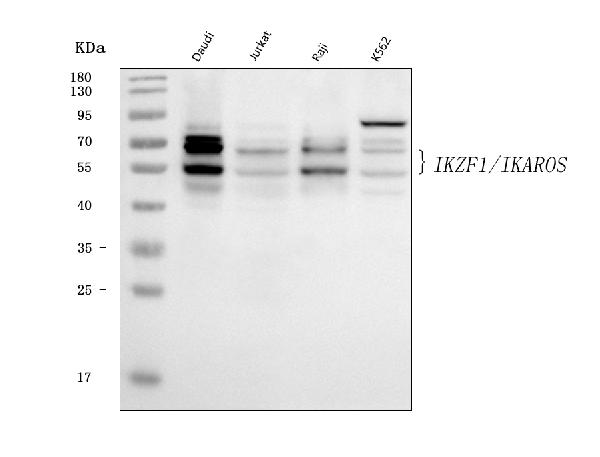
- 产品详情
- 实验流程
- 背景知识
Application 
| WB |
|---|---|
| Primary Accession | Q13422 |
| Host | Mouse |
| Isotype | IgG1 |
| Reactivity | Human |
| Clonality | Monoclonal |
| Format | Lyophilized |
| Description | Anti-Ikaros/IKZF1 Antibody Picoband™ (monoclonal, 5F12H7) . Tested in WB applications. This antibody reacts with Human. |
| Reconstitution | Adding 0.2 ml of distilled water will yield a concentration of 500 µg/ml. |
| Gene ID | 10320 |
|---|---|
| Other Names | DNA-binding protein Ikaros, Ikaros family zinc finger protein 1, Lymphoid transcription factor LyF-1, IKZF1, IK1, IKAROS, LYF1, ZNFN1A1 |
| Calculated MW | 57528 Da |
| Application Details | Western blot, 0.25-0.5 µg/ml, Human |
| Source | Eukaryota |
| Contents | Each vial contains 4 mg Trehalose, 0.9 mg NaCl and 0.2 mg Na2HPO4. |
| Clone Names | Clone: 5F12H7 |
| Immunogen | A synthetic peptide corresponding to a sequence at the C-terminus of human Ikaros, different from the related mouse sequence by five amino acids. |
| Purification | Immunogen affinity purified. |
| Storage | At -20°C for one year from date of receipt. After reconstitution, at 4°C for one month. It can also be aliquotted and stored frozen at -20°C for six months. Avoid repeated freezing and thawing. |
For Research Use Only. Not For Use In Diagnostic Procedures.
| Name | IKZF1 |
|---|---|
| Synonyms | IK1, IKAROS, LYF1, ZNFN1A1 |
| Function | Transcription regulator of hematopoietic cell differentiation (PubMed:17934067). Binds gamma-satellite DNA (PubMed:17135265, PubMed:19141594). Plays a role in the development of lymphocytes, B- and T-cells. Binds and activates the enhancer (delta-A element) of the CD3-delta gene. Repressor of the TDT (fikzfterminal deoxynucleotidyltransferase) gene during thymocyte differentiation. Regulates transcription through association with both HDAC-dependent and HDAC-independent complexes. Targets the 2 chromatin-remodeling complexes, NuRD and BAF (SWI/SNF), in a single complex (PYR complex), to the beta-globin locus in adult erythrocytes (PubMed:10204490). Increases normal apoptosis in adult erythroid cells (By similarity). Confers early temporal competence to retinal progenitor cells (RPCs) (By similarity). Function is isoform-specific and is modulated by dominant-negative inactive isoforms (PubMed:17135265, PubMed:17934067). Recognized by CRBN and is targeted for degradation by DCX (DDB1-CUL4-X- box) E3 protein ligase complex (PubMed:41565821). |
| Cellular Location | Nucleus. Note=In resting lymphocytes, distributed diffusely throughout the nucleus. Localizes to pericentromeric heterochromatin in proliferating cells. This localization requires DNA binding which is regulated by phosphorylation / dephosphorylation events. [Isoform Ik6]: Cytoplasm. |
| Tissue Location | Abundantly expressed in thymus, spleen and peripheral blood Leukocytes and lymph nodes. Lower expression in bone marrow and small intestine. |
Provided below are standard protocols that you may find useful for product applications.
BACKGROUND
DNA-binding protein Ikaros is a protein that in humans is encoded by the IKZF1 gene. This gene encodes a transcription factor that belongs to the family of zinc-finger DNA-binding proteins associated with chromatin remodeling. The expression of this protein is restricted to the fetal and adult hemo-lymphopoietic system, and it functions as a regulator of lymphocyte differentiation. Several alternatively spliced transcript variants encoding different isoforms have been described for this gene. Most isoforms share a common C-terminal domain, which contains two zinc finger motifs that are required for hetero- or homo-dimerization, and for interactions with other proteins. The isoforms, however, differ in the number of N-terminal zinc finger motifs that bind DNA and in nuclear localization signal presence, resulting in members with and without DNA-binding properties. Only a few isoforms contain the requisite three or more N-terminal zinc motifs that confer high affinity binding to a specific core DNA sequence element in the promoters of target genes. The non-DNA-binding isoforms are largely found in the cytoplasm, and are thought to function as dominant-negative factors.

终于等到您。ABCEPTA(百远生物)抗体产品。
点击下方“我要评价 ”按钮提交您的反馈信息,您的反馈和评价是我们最宝贵的财富之一,
我们将在1-3个工作日内处理您的反馈信息。
如有疑问,联系:0512-88856768 tech-china@abcepta.com.


