


 癌症的基本特征包括细胞增殖、血管生成、迁移、凋亡逃避机制和细胞永生等。找到癌症发生过程中这些通路的关键标记物和对应的抗体用于检测至关重要。
 为您推荐一个泛素化位点预测神器——泛素化分析工具,可以为您的蛋白的泛素化位点作出预测和评分。
 细胞自噬受体图形绘图工具为你的蛋白的细胞受体结合位点作出预测和评分,识别结合到自噬通路中的蛋白是非常重要的,便于让我们理解自噬在正常生理、病理过程中的作用,如发育、细胞分化、神经退化性疾病、压力条件下、感染和癌症。
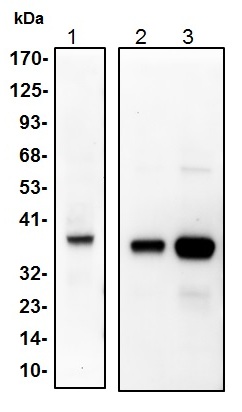
AKR1C3 Polyclonal Antibody
Rabbit Polyclonal Antibody
- 产品详情
- 实验流程
- 背景知识
Application 
| WB, DB |
|---|---|
| Primary Accession | P42330 |
| Reactivity | Human, Mouse, Rat |
| Host | Rabbit |
| Clonality | Polyclonal |
| Isotype | Rabbit IgG |
| Calculated MW | 36853 Da |
| Gene ID | 8644 |
|---|---|
| Positive Control | Western blot |
| Application & Usage | Western blot: 1-4 µg/ml, Dot blot: 1-4 µg/ml |
| Alias Symbol | AKR1C3 |
| Other Names | Aldo-keto reductase family 1, member C3, DD3, DDX, HA1753, HAKRB, HAKRe, hluPGFS, HSD17B5 |
| Appearance | Colourless liquid |
| Formulation | 100 µg (0.5 mg/ml) of antibody in PBS pH 7.2, 0.01 % BSA, 0.03 % ProClin® and 50 % glycerol. |
| Reconstitution & Storage | -20 °C |
| Background Descriptions | |
| Precautions | AKR1C3 Polyclonal Antibody is for research use only and not for use in diagnostic or therapeutic procedures. |
For Research Use Only. Not For Use In Diagnostic Procedures.
| Name | AKR1C3 |
|---|---|
| Function | Cytosolic aldo-keto reductase that catalyzes NADPH-dependent reduction of ketosteroids to hydroxysteroids. Displays broad substrate specificity with distinct positional and stereochemistry, primarily generating 17beta-hydroxysteroids, but also 3alpha- and 20alpha- hydroxysteroids (PubMed:10998348, PubMed:11165022, PubMed:20036328, PubMed:9415401, PubMed:9927279, PubMed:10998348, PubMed:9927279). Produces potent androgens via classical and 'backdoor'/alternative pathways. In the classical androgen metabolic pathway (biosynthesis of 5alpha-dihydrotestosterone (5alpha-DHT) via testosterone), catalyzes the reduction of delta4-androstenedione to form testosterone (PubMed:10998348, PubMed:11165022, PubMed:20036328, PubMed:9415401, PubMed:9927279). In the 'backdoor' androgen metabolic pathway (biosynthesis of 5alpha-dihydrotestosterone (5alpha-DHT) via pregnanes), reduces androsterone to 5alpha-androstane-3alpha,17beta- diol preceding 5alpha-DHT secretion (PubMed:10557352, PubMed:10998348, PubMed:9415401). Reduces 5alpha-DHT to less potent androgen 5alpha- androstane-3alpha,17beta-diol, likely regulating ligand availability for androgen receptors (PubMed:10557352, PubMed:10998348, PubMed:11165022, PubMed:14672942, PubMed:7650035, PubMed:9415401). May contribute to the metabolism of adrenal-derived androgen precursors. Reduces 11-keto-4-androstene-3,17-dione (11KA4) and 11-keto-5alpha- androstane-3,17-dione (11K-Adione) into potent androgens 11- ketotestosterone (11KT) and 11-ketodihydrotestosterone (11KDHT), respectively (PubMed:31926269). In estrogen metabolism, catalyzes the conversion of estrone to potent estrogen 17beta-estradiol (PubMed:10998348, PubMed:11165022, PubMed:20036328). Acts as a prostaglandin (PG) F2alpha synthase. Displays 11-ketoreductase and 9,11-endoperoxide reductase activities and reduces PGD2 to 11beta- PGF2alpha and PGH2 to PGF2alpha (PubMed:10622721, PubMed:11165022, PubMed:15047184, PubMed:19010934, PubMed:20036328, PubMed:7650035, PubMed:9415401, PubMed:9927279). Also displays retinaldehyde reductase activity toward 9-cis-retinal (PubMed:21851338). In vitro can efficiently catalyze bidirectional conversion between ketosteroids and hydroxysteroids using NADPH/NADP(+) or NADH/NAD(+) as cofactors. In vivo however, the reductase activity prevails since the major reducing cofactor NADPH inhibits NAD(+)-dependent oxidase activity (PubMed:11165022, PubMed:14672942). In addition, it is able to reduce in vitro various carbonyl compounds like menadione, phenanthrenequinone and nitrobenzaldehyde (By similarity). |
| Cellular Location | Cytoplasm. |
| Tissue Location | Expressed in many tissues including adrenal gland, brain, kidney, liver, lung, mammary gland, placenta, small intestine, colon, spleen, prostate and testis. High expression in prostate and mammary gland. In the prostate, higher levels in epithelial cells than in stromal cells. In the brain, expressed in medulla, spinal cord, frontotemporal lobes, thalamus, subthalamic nuclei and amygdala. Weaker expression in the hippocampus, substantia nigra and caudate |
Provided below are standard protocols that you may find useful for product applications.
BACKGROUND
Aldo-keto reductase family 1 member C3 in humans is encoded by the AKR1C3 gene. This enzyme catalyzes the reduction of prostaglandin (PG) D2, PGH2 and phenanthrenequinone (PQ), and the oxidation of 9alpha, 11beta-PGF2 to PGD2. It may play an important role in the pathogenesis of allergic diseases such as asthma, and may also have a role in controlling cell growth and/or differentiation.

终于等到您。ABCEPTA(百远生物)抗体产品。
点击下方“我要评价 ”按钮提交您的反馈信息,您的反馈和评价是我们最宝贵的财富之一,
我们将在1-3个工作日内处理您的反馈信息。
如有疑问,联系:0512-88856768 tech-china@abcepta.com.


