


 癌症的基本特征包括细胞增殖、血管生成、迁移、凋亡逃避机制和细胞永生等。找到癌症发生过程中这些通路的关键标记物和对应的抗体用于检测至关重要。
 为您推荐一个泛素化位点预测神器——泛素化分析工具,可以为您的蛋白的泛素化位点作出预测和评分。
 细胞自噬受体图形绘图工具为你的蛋白的细胞受体结合位点作出预测和评分,识别结合到自噬通路中的蛋白是非常重要的,便于让我们理解自噬在正常生理、病理过程中的作用,如发育、细胞分化、神经退化性疾病、压力条件下、感染和癌症。
Anti-RPA70 Antibody (8C3-D12-H10)
Mouse Monoclonal Antibody
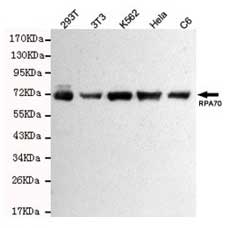
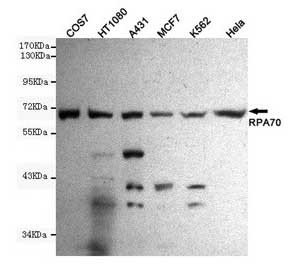
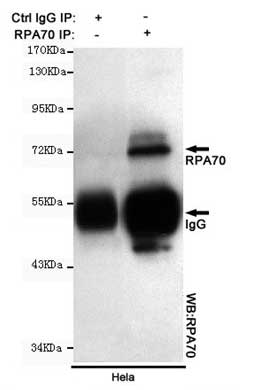
- 产品详情
- 实验流程
- 背景知识
Application 
| WB, IF, IP |
|---|---|
| Primary Accession | P27694 |
| Reactivity | Human, Mouse, Rat, Monkey |
| Host | Mouse |
| Clonality | Monoclonal |
| Isotype | Mouse IgG2a |
| Clone Names | 8C3-D12-H10 |
| Calculated MW | 68138 Da |
| Gene ID | 6117 |
|---|---|
| Application & Usage | WB: Hela, 293T, C6, 3T3 and K562 cell lysates; WB: Hela, A431, MCF7, COS7, HT1080 and K562 cell lysates; IP: HeLa cell lysates; IF: HeLa cells |
| Other Names | Replication protein A 70 kDa DNA-binding subunit, RP-A p70, Replication factor A protein 1, RF-A protein 1, Single-stranded DNA-binding protein, RPA1 |
| Target/Specificity | RPA70 |
| Antibody Form | Liquid |
| Appearance | Colorless liquid |
| Formulation | In PBS (pH 7.4) containing with 0.02% sodium azide and 50% |
| Handling | The antibody solution should be gently mixed before use. |
| Reconstitution & Storage | -20 °C |
| Background Descriptions | |
| Precautions | Anti-RPA70 Antibody (8C3-D12-H10) is for research use only and not for use in diagnostic or therapeutic procedures. |
For Research Use Only. Not For Use In Diagnostic Procedures.
| Name | RPA1 |
|---|---|
| Synonyms | REPA1, RPA70 |
| Function | As part of the heterotrimeric replication protein A complex (RPA/RP-A), binds and stabilizes single-stranded DNA intermediates that form during DNA replication or upon DNA stress. It prevents their reannealing and in parallel, recruits and activates different proteins and complexes involved in DNA metabolism (PubMed:17596542, PubMed:27723717, PubMed:27723720). Thereby, it plays an essential role both in DNA replication and the cellular response to DNA damage (PubMed:9430682). In the cellular response to DNA damage, the RPA complex controls DNA repair and DNA damage checkpoint activation. Through recruitment of ATRIP activates the ATR kinase a master regulator of the DNA damage response (PubMed:24332808). It is required for the recruitment of the DNA double-strand break repair factors RAD51 and RAD52 to chromatin in response to DNA damage (PubMed:17765923). Also recruits to sites of DNA damage proteins like XPA and XPG that are involved in nucleotide excision repair and is required for this mechanism of DNA repair (PubMed:7697716). Also plays a role in base excision repair (BER) probably through interaction with UNG (PubMed:9765279). Also recruits SMARCAL1/HARP, which is involved in replication fork restart, to sites of DNA damage. Plays a role in telomere maintenance (PubMed:17959650, PubMed:34767620). As part of the alternative replication protein A complex, aRPA, binds single-stranded DNA and probably plays a role in DNA repair. Compared to the RPA2- containing, canonical RPA complex, may not support chromosomal DNA replication and cell cycle progression through S-phase. The aRPA may not promote efficient priming by DNA polymerase alpha but could support DNA synthesis by polymerase delta in presence of PCNA and replication factor C (RFC), the dual incision/excision reaction of nucleotide excision repair and RAD51-dependent strand exchange (PubMed:19996105). RPA stimulates 5'-3' helicase activity of the BRIP1/FANCJ (PubMed:17596542). |
| Cellular Location | Nucleus. Nucleus, PML body. Note=Enriched in PML bodies in cells displaying alternative lengthening of their telomeres |
Provided below are standard protocols that you may find useful for product applications.
BACKGROUND
Replication protein A 70 kDa DNA-binding subunit plays an essential role both in DNA replication and the cellular response to DNA damage. In the cellular response to DNA damage, the RPA complex controls DNA repair and DNA damage checkpoint activation. Through recruitment of ATRIP activates the ATR kinase a master regulator of the DNA damage response. It is required for the recruitment of the DNA double-strand break repair factors RAD51 and RAD52 to chromatin in response to DNA damage.

终于等到您。ABCEPTA(百远生物)抗体产品。
点击下方“我要评价 ”按钮提交您的反馈信息,您的反馈和评价是我们最宝贵的财富之一,
我们将在1-3个工作日内处理您的反馈信息。
如有疑问,联系:0512-88856768 tech-china@abcepta.com.


