


 癌症的基本特征包括细胞增殖、血管生成、迁移、凋亡逃避机制和细胞永生等。找到癌症发生过程中这些通路的关键标记物和对应的抗体用于检测至关重要。
 为您推荐一个泛素化位点预测神器——泛素化分析工具,可以为您的蛋白的泛素化位点作出预测和评分。
 细胞自噬受体图形绘图工具为你的蛋白的细胞受体结合位点作出预测和评分,识别结合到自噬通路中的蛋白是非常重要的,便于让我们理解自噬在正常生理、病理过程中的作用,如发育、细胞分化、神经退化性疾病、压力条件下、感染和癌症。
Parathyroid Hormone (PTH) (N-Terminal) Antibody - With BSA and Azide
Mouse Monoclonal Antibody [Clone SPM604 ]
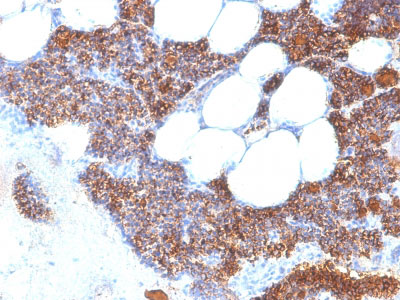
- 产品详情
- 实验流程
- 背景知识
Application 
| IHC, IF, FC |
|---|---|
| Primary Accession | P01270 |
| Other Accession | 5741, 37045 |
| Reactivity | Human |
| Host | Mouse |
| Clonality | Monoclonal |
| Isotype | Mouse / IgG2b, kappa |
| Clone Names | SPM604 |
| Calculated MW | 12861 Da |
| Gene ID | 5741 |
|---|---|
| Other Names | Parathyroid hormone, PTH, Parathormone, Parathyrin, PTH |
| Application Note | IHC~~1:100~500 IF~~1:50~200 FC~~1:10~50 |
| Storage | Store at 2 to 8°C.Antibody is stable for 24 months. |
| Precautions | Parathyroid Hormone (PTH) (N-Terminal) Antibody - With BSA and Azide is for research use only and not for use in diagnostic or therapeutic procedures. |
For Research Use Only. Not For Use In Diagnostic Procedures.
| Name | PTH {ECO:0000303|PubMed:35932760, ECO:0000312|HGNC:HGNC:9606} |
|---|---|
| Function | Peptide hormone secreted by parathyroid chief cells that acts as a primary endocrine regulator of extracellular calcium and phosphate homeostasis, acting primarily on bone and kidney to maintain serum calcium levels within a narrow range (PubMed:11604398, PubMed:35932760). Acts by binding and activating the G protein-coupled receptor PTH1R, engaging the receptor to activate G(s)-mediated cAMP/PKA signaling and G(q)-mediated PLC/PKC signaling (PubMed:18375760, PubMed:35932760). In bone, acts indirectly on osteoclasts by binding PTH1R on cells of the osteoblast/osteocyte lineage, where it increases expression of TNFSF11/RANKL and decreases expression of TNFRSF11B/OPG, thereby raising the RANKL/OPG ratio and stimulating osteoclast differentiation and bone resorption (PubMed:9797718, PubMed:11454517). Stimulates also [1-14C]-2-deoxy-D- glucose (2DG) transport and glycogen synthesis in osteoblastic cells (PubMed:21076856). In distal renal tubule cells, stimulates active Ca(2+) reabsorption via the adenylyl cyclase-cAMP-protein kinase A (PKA) pathway leading to the phosphorylation and activation of the calcium selective cation channel TRPV5 (PubMed:19423690). Acting on PTH1R in proximal renal tubule cells, decreases reabsorption of filtered phosphate by reducing apical abundance of SLC34A1, through a mechanism involving PTH1R-activated PKC-mediated phosphorylation of the scaffold NHERF1, causing dissociation of the NHERF1-SLC34A1 complex and subsequent clathrin-mediated endocytosis and lysosomal degradation of the cotransporter (By similarity). Activates also transcription of CYP27B1 (25-hydroxyvitamin D3 1-alpha-hydroxylase) through a cAMP/PKA/SIK2-SIK3/CRTC2 axis, thereby increasing renal synthesis of the active vitamin D metabolite 1,25-dihydroxyvitamin D(3) (By similarity). |
| Cellular Location | Secreted |
Provided below are standard protocols that you may find useful for product applications.
BACKGROUND
Epitope of this MAb maps in the N-terminus of PTH, a hormone produced by the parathyroid gland that regulates the concentration of calcium and phosphorus in extracellular fluid. This hormone elevates blood Ca2+ levels by dissolving the salts in bone and preventing their renal excretion.ĀIt is produced in the parathyroid gland as an 84 amino acid single chain polypeptide. It can also be secreted as N-terminal truncated fragments or C-terminal fragments after intracellular degradation, as in case of hypercalcemia. Defects in this gene are a cause of familial isolated hypoparathyroidism (FIH); also called autosomal dominant hypoparathyroidism or autosomal dominant hypocalcemia. FIH is characterized by hypocalcemia and hyperphosphatemia due to inadequate secretion of parathyroid hormone. Symptoms are seizures, tetany and cramps. FIH exist both as autosomal dominant and recessive forms of hypoparathyroidism.
REFERENCES
Watson, P.H. and Hanley, D.A. 1993. Parathyroid hormone: regulation of synthesis and secretion. Clin. Invest. Med. 16: 58-77. |

终于等到您。ABCEPTA(百远生物)抗体产品。
点击下方“我要评价 ”按钮提交您的反馈信息,您的反馈和评价是我们最宝贵的财富之一,
我们将在1-3个工作日内处理您的反馈信息。
如有疑问,联系:0512-88856768 tech-china@abcepta.com.


