


 癌症的基本特征包括细胞增殖、血管生成、迁移、凋亡逃避机制和细胞永生等。找到癌症发生过程中这些通路的关键标记物和对应的抗体用于检测至关重要。
 为您推荐一个泛素化位点预测神器——泛素化分析工具,可以为您的蛋白的泛素化位点作出预测和评分。
 细胞自噬受体图形绘图工具为你的蛋白的细胞受体结合位点作出预测和评分,识别结合到自噬通路中的蛋白是非常重要的,便于让我们理解自噬在正常生理、病理过程中的作用,如发育、细胞分化、神经退化性疾病、压力条件下、感染和癌症。
Cdc20 (Cell Division Cycle Protein 20) Antibody - With BSA and Azide
Mouse Monoclonal Antibody [Clone CDC20/1102 ]
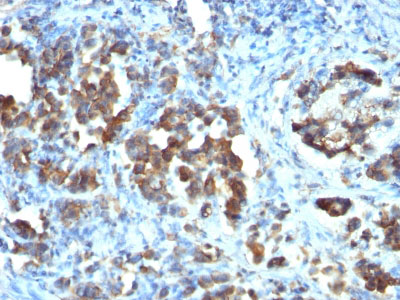
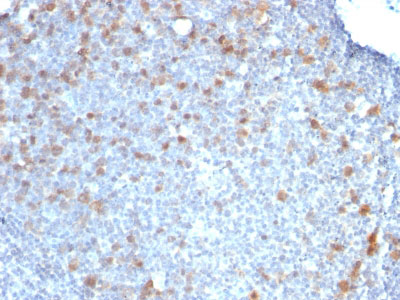
- 产品详情
- 实验流程
- 背景知识
Application 
| IHC, IF, FC |
|---|---|
| Primary Accession | Q12834 |
| Other Accession | 991, 524947 |
| Reactivity | Human |
| Host | Mouse |
| Clonality | Monoclonal |
| Isotype | Mouse / IgG1, kappa |
| Clone Names | CDC20/1102 |
| Calculated MW | 54723 Da |
| Gene ID | 991 |
|---|---|
| Other Names | Cell division cycle protein 20 homolog, p55CDC, CDC20 |
| Application Note | IHC~~1:100~500 IF~~1:50~200 FC~~1:10~50 |
| Storage | Store at 2 to 8°C.Antibody is stable for 24 months. |
| Precautions | Cdc20 (Cell Division Cycle Protein 20) Antibody - With BSA and Azide is for research use only and not for use in diagnostic or therapeutic procedures. |
For Research Use Only. Not For Use In Diagnostic Procedures.
| Name | CDC20 |
|---|---|
| Function | Substrate-specific adapter and activator of the anaphase promoting complex/cyclosome (APC/C) that confers substrate specificity by binding to substrates and targeting them to the APC/C for ubiquitination and degradation (PubMed:9734353, PubMed:27030811, PubMed:29343641, PubMed:27120157, PubMed:27509861). Essential for activating APC/C in the metaphase/anaphase transition of the cell cycle, targeting the degradation of cyclin B and securin (PubMed:27120157, PubMed:27509861, PubMed:32666501). Recognizes and binds the destruction box (D box), KEB box and ABBA motifs on protein substrates (PubMed:29343641, PubMed:27509861). The CDC20-APC/C complex positively regulates the formation of synaptic vesicle clustering at active zone to the presynaptic membrane in postmitotic neurons (By similarity). CDC20-APC/C-induced degradation of NEUROD2 induces presynaptic differentiation (By similarity). The CDC20-APC/C complex promotes proper dilation formation and radial migration by degrading CCDC41 (By similarity). Component of the mitotic checkpoint complex (MCC), which inhibits APC/C and delays chromosome segregation until all chromosomes are properly attached to the mitotic spindle (PubMed:27509861). The MCC, which consists of CDC20, MAD2L1/MAD2, BUB1B/BUBR1 and BUB3, is a key player of the spindle assembly checkpoint (PubMed:27509861). The MCC-bound APC/C complex is inactive and this delays the metaphase/anaphase transition (PubMed:9811605, PubMed:9637688, PubMed:27509861). When the spindle assembly checkpoint is silenced, the MCC-APC/C complex recruits the E2 enzyme UBCH10 and triggers the auto-ubiquitination of CDC20 in the MCC, thereby reactivating APC/C for transition into anaphase (PubMed:27509861). |
| Cellular Location | Cytoplasm, cytoskeleton, microtubule organizing center, centrosome. Chromosome, centromere, kinetochore. Cytoplasm, cytoskeleton, spindle pole |
Provided below are standard protocols that you may find useful for product applications.
BACKGROUND
Cyclins, regulatory subunits, which associate with kinases, control many of the important steps in cell cycle progression. The Cdc2 protein kinase (p34Cdc2) exhibits protein kinase activity in vitro and exists in a complex with both cyclin B and a protein homologous to p13SUC1. Cdc2 kinase is the active subunit of the M phase promoting factor (MPF) and the M phase-specific Histone H1 kinase. The p34Cdc2/cyclin B complex is required for the G2 to M transition. An additional cell cycle-dependent protein kinase, termed p55cdc, exhibits a high degree of homology with the S. cerevisiae proteins Cdc20 and Cdc4. The p55cdc transcript is readily detectable in a variety of cultured cell lines in growth phase, but disappears when cell growth is chemically arrested.
REFERENCES
Sironi L et al. 2001. EMBO J. 20(22):6371-82.

终于等到您。ABCEPTA(百远生物)抗体产品。
点击下方“我要评价 ”按钮提交您的反馈信息,您的反馈和评价是我们最宝贵的财富之一,
我们将在1-3个工作日内处理您的反馈信息。
如有疑问,联系:0512-88856768 tech-china@abcepta.com.


