


 癌症的基本特征包括细胞增殖、血管生成、迁移、凋亡逃避机制和细胞永生等。找到癌症发生过程中这些通路的关键标记物和对应的抗体用于检测至关重要。
 为您推荐一个泛素化位点预测神器——泛素化分析工具,可以为您的蛋白的泛素化位点作出预测和评分。
 细胞自噬受体图形绘图工具为你的蛋白的细胞受体结合位点作出预测和评分,识别结合到自噬通路中的蛋白是非常重要的,便于让我们理解自噬在正常生理、病理过程中的作用,如发育、细胞分化、神经退化性疾病、压力条件下、感染和癌症。
Accn2 antibody - N-terminal region
Rabbit Polyclonal Antibody
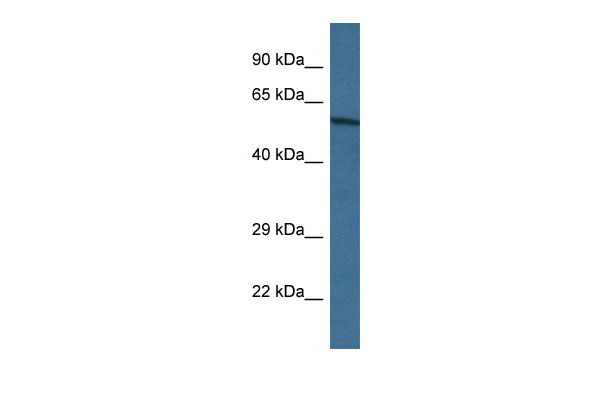
- 产品详情
- 实验流程
Application 
| WB |
|---|---|
| Primary Accession | Q6NXK8 |
| Other Accession | NM_009597, NP_033727 |
| Reactivity | Human, Mouse, Rat, Rabbit, Dog, Horse, Bovine |
| Predicted | Human, Mouse, Rat, Rabbit, Bovine |
| Host | Rabbit |
| Clonality | Polyclonal |
| Calculated MW | 59668 Da |
| Gene ID | 11419 |
|---|---|
| Alias Symbol | AI843610, ASIC, ASIC1, ASIC1a, B530003N02Rik, BNaC2, Accn2 |
| Other Names | Acid-sensing ion channel 1, ASIC1, Acid-sensing ion channel, Amiloride-sensitive cation channel 2, neuronal, Brain sodium channel 2, BNaC2, Asic1, Accn2, Asic, Bnac2 |
| Format | Liquid. Purified antibody supplied in 1x PBS buffer with 0.09% (w/v) sodium azide and 2% sucrose. |
| Reconstitution & Storage | Add 50 ul of distilled water. Final anti-Accn2 antibody concentration is 1 mg/ml in PBS buffer with 2% sucrose. For longer periods of storage, store at 20°C. Avoid repeat freeze-thaw cycles. |
| Precautions | Accn2 antibody - N-terminal region is for research use only and not for use in diagnostic or therapeutic procedures. |
For Research Use Only. Not For Use In Diagnostic Procedures.
| Name | Asic1 {ECO:0000312|MGI:MGI:1194915} |
|---|---|
| Function | Forms voltage-independent, pH-gated trimeric sodium channels that act as postsynaptic excitatory receptors in the nervous system, playing a crucial role in regulating synaptic plasticity, learning, and memory (PubMed:11988176, PubMed:12843249, PubMed:15369669, PubMed:17060608). Upon extracellular pH drop this channel elicits transient, fast activating, and completely desensitizing inward currents (PubMed:15369669). Displays high selectivity for sodium ions but can also permit the permeation of other cations (PubMed:15369669). Regulates more or less directly intracellular calcium concentration and CaMKII phosphorylation, and thereby the density of dendritic spines (PubMed:15369669, PubMed:17060608). Modulates neuronal activity in the circuits underlying innate fear (PubMed:17662962). |
| Cellular Location | Cell membrane; Multi-pass membrane protein {ECO:0000250|UniProtKB:P78348} Postsynaptic cell membrane. Cell projection, dendrite. Note=Isolated in synaptosomes from the dendritic synapses of neurons. |
| Tissue Location | Expressed in brain areas receiving strong excitatory corticofugal input. In hippocampus, expressed in the hilus of the dentate gyrus. In the cerebral cortex expressed in anterior and posterior cingulate cortex, sensory and motor cortices. In the sensory cortex strongest expression is detected in the whisker barrel field. In sensorimotor and cingulate cortex expression is elevated in layer III Also expressed in basal ganglia, striatum, ventral pallidum, olfactory tubercle, and nucleus accumbens. Weakly expressed in thalamus with the exception of the habenula and the medial septal nuclei. In olfactory bulb, preferentially expressed in the glomerular layer, within glomeruli. Expressed in cerebellum in the molecular and granule cell layers. Strongly expressed in amygdala complex, particularly in the lateral and basolateral nuclei. Isoform 1 is more abundant in brain compared to isoform 2 (at protein level). Expressed in the nodose ganglion and dorsal root ganglion. Expressed in dendritic spine cells |
Research Areas
Application Protocols
Provided below are standard protocols that you may find useful for product applications.

终于等到您。ABCEPTA(百远生物)抗体产品。
点击下方“我要评价 ”按钮提交您的反馈信息,您的反馈和评价是我们最宝贵的财富之一,
我们将在1-3个工作日内处理您的反馈信息。
如有疑问,联系:0512-88856768 tech-china@abcepta.com.


