


 癌症的基本特征包括细胞增殖、血管生成、迁移、凋亡逃避机制和细胞永生等。找到癌症发生过程中这些通路的关键标记物和对应的抗体用于检测至关重要。
 为您推荐一个泛素化位点预测神器——泛素化分析工具,可以为您的蛋白的泛素化位点作出预测和评分。
 细胞自噬受体图形绘图工具为你的蛋白的细胞受体结合位点作出预测和评分,识别结合到自噬通路中的蛋白是非常重要的,便于让我们理解自噬在正常生理、病理过程中的作用,如发育、细胞分化、神经退化性疾病、压力条件下、感染和癌症。
Rorc antibody - N-terminal region
Rabbit Polyclonal Antibody
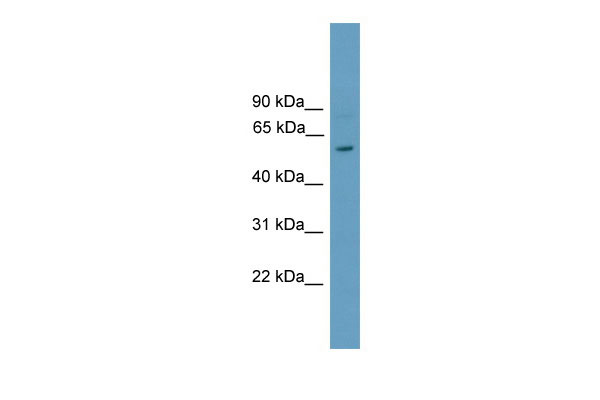
- 产品详情
- 实验流程
Application 
| WB, IHC |
|---|---|
| Primary Accession | P51450 |
| Other Accession | NM_011281, NP_035411 |
| Reactivity | Human, Mouse, Rat, Pig, Dog |
| Predicted | Mouse, Rat |
| Host | Rabbit |
| Clonality | Polyclonal |
| Calculated MW | 58117 Da |
| Gene ID | 19885 |
|---|---|
| Alias Symbol | Nr1f3, RORgamma, TOR, Thor |
| Other Names | Nuclear receptor ROR-gamma, Nuclear receptor RZR-gamma, Nuclear receptor subfamily 1 group F member 3, RAR-related orphan receptor C, Retinoid-related orphan receptor-gamma, Thymus orphan receptor, TOR, Rorc, Nr1f3, Rorg, Thor |
| Format | Liquid. Purified antibody supplied in 1x PBS buffer with 0.09% (w/v) sodium azide and 2% sucrose. |
| Reconstitution & Storage | Add 50 ul of distilled water. Final anti-Rorc antibody concentration is 1 mg/ml in PBS buffer with 2% sucrose. For longer periods of storage, store at 20°C. Avoid repeat freeze-thaw cycles. |
| Precautions | Rorc antibody - N-terminal region is for research use only and not for use in diagnostic or therapeutic procedures. |
For Research Use Only. Not For Use In Diagnostic Procedures.
| Name | Rorc |
|---|---|
| Synonyms | Nr1f3, Rorg, Thor |
| Function | Nuclear receptor that binds DNA as a monomer to ROR response elements (RORE) containing a single core motif half-site 5'-AGGTCA-3' preceded by a short A-T-rich sequence. Key regulator of cellular differentiation, immunity, peripheral circadian rhythm as well as lipid, steroid, xenobiotics and glucose metabolism. Considered to have intrinsic transcriptional activity, have some natural ligands like oxysterols that act as agonists (25-hydroxycholesterol) or inverse agonists (7-oxygenated sterols), enhancing or repressing the transcriptional activity, respectively. Recruits distinct combinations of cofactors to target gene regulatory regions to modulate their transcriptional expression, depending on the tissue, time and promoter contexts (PubMed:17666523, PubMed:19381306, PubMed:19965867, PubMed:21853531, PubMed:22789990, PubMed:23723244). Regulates the circadian expression of clock genes such as CRY1, BMAL1 and NR1D1 in peripheral tissues and in a tissue-selective manner (PubMed:22753030). Competes with NR1D1 for binding to their shared DNA response element on some clock genes such as BMAL1, CRY1 and NR1D1 itself, resulting in NR1D1-mediated repression or RORC-mediated activation of the expression, leading to the circadian pattern of clock genes expression. Therefore influences the period length and stability of the clock (PubMed:22753030). Involved in the regulation of the rhythmic expression of genes involved in glucose and lipid metabolism, including PLIN2 and AVPR1A. Negative regulator of adipocyte differentiation through the regulation of early phase genes expression, such as MMP3. Controls adipogenesis as well as adipocyte size and modulates insulin sensitivity in obesity. In liver, has specific and redundant functions with RORA as positive or negative modulator of expression of genes encoding phase I and Phase II proteins involved in the metabolism of lipids, steroids and xenobiotics, such as SULT1E1 (PubMed:21853531). Also plays a role in the regulation of hepatocyte glucose metabolism through the regulation of G6PC1 and PCK1. Regulates the rhythmic expression of PROX1 and promotes its nuclear localization. Plays an indispensable role in the induction of IFN-gamma dependent anti- mycobacterial systemic immunity (By similarity). |
| Cellular Location | Nucleus {ECO:0000255|PROSITE-ProRule:PRU00407, ECO:0000269|PubMed:18368049, ECO:0000269|PubMed:21853531, ECO:0000269|PubMed:22753030} |
| Tissue Location | Expressed in immature Vgamma2 gamma-delta T-cells (at protein level) (PubMed:23562159). Expressed in the liver (PubMed:17666523, PubMed:22753030). Expressed in the heart (PubMed:17666523). Expressed in the kidney, jejunum, and brown adipose tissue (PubMed:22753030). [Isoform 2]: Expressed in the thymus, primarily in immature thymocytes, including Vgamma2 gamma-delta T-cells (at protein levels) (PubMed:10602018, PubMed:9881970). Also expressed in a subset of mature T(H)17 cells (PubMed:18164222). Not expressed in the spleen or bone marrow (PubMed:9881970). |
Research Areas
Application Protocols
Provided below are standard protocols that you may find useful for product applications.

终于等到您。ABCEPTA(百远生物)抗体产品。
点击下方“我要评价 ”按钮提交您的反馈信息,您的反馈和评价是我们最宝贵的财富之一,
我们将在1-3个工作日内处理您的反馈信息。
如有疑问,联系:0512-88856768 tech-china@abcepta.com.


