


 癌症的基本特征包括细胞增殖、血管生成、迁移、凋亡逃避机制和细胞永生等。找到癌症发生过程中这些通路的关键标记物和对应的抗体用于检测至关重要。
 为您推荐一个泛素化位点预测神器——泛素化分析工具,可以为您的蛋白的泛素化位点作出预测和评分。
 细胞自噬受体图形绘图工具为你的蛋白的细胞受体结合位点作出预测和评分,识别结合到自噬通路中的蛋白是非常重要的,便于让我们理解自噬在正常生理、病理过程中的作用,如发育、细胞分化、神经退化性疾病、压力条件下、感染和癌症。
SIX4 antibody - N-terminal region
Rabbit Polyclonal Antibody
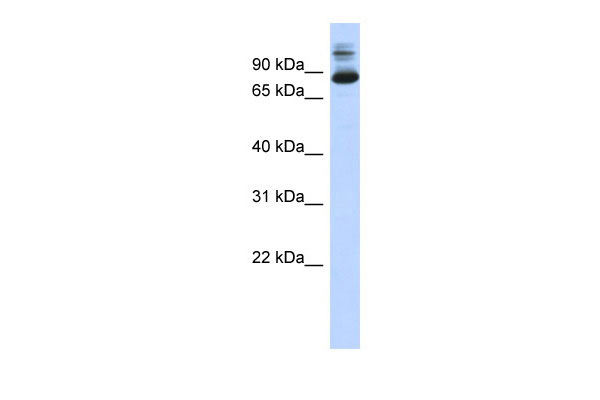
- 产品详情
- 实验流程
Application 
| WB |
|---|---|
| Primary Accession | Q9UIU6 |
| Other Accession | NM_017420, NP_059116 |
| Reactivity | Human, Mouse, Rat, Dog, Horse |
| Predicted | Human, Mouse, Rat, Pig |
| Host | Rabbit |
| Clonality | Polyclonal |
| Calculated MW | 82933 Da |
| Gene ID | 51804 |
|---|---|
| Alias Symbol | AREC3, MGC119450, MGC119452, MGC119453 |
| Other Names | Homeobox protein SIX4, Sine oculis homeobox homolog 4, SIX4 |
| Format | Liquid. Purified antibody supplied in 1x PBS buffer with 0.09% (w/v) sodium azide and 2% sucrose. |
| Reconstitution & Storage | Add 50 ul of distilled water. Final anti-SIX4 antibody concentration is 1 mg/ml in PBS buffer with 2% sucrose. For longer periods of storage, store at 20°C. Avoid repeat freeze-thaw cycles. |
| Precautions | SIX4 antibody - N-terminal region is for research use only and not for use in diagnostic or therapeutic procedures. |
For Research Use Only. Not For Use In Diagnostic Procedures.
| Name | SIX4 |
|---|---|
| Function | Transcriptional regulator which can act as both a transcriptional repressor and activator by binding a DNA sequence on these target genes and is involved in processes like cell differentiation, cell migration and cell survival. Transactivates gene expression by binding a 5'-[CAT]A[CT][CT][CTG]GA[GAT]-3' motif present in the Trex site and a 5'-TCA[AG][AG]TTNC-3' motif present in the MEF3 site of the muscle-specific genes enhancer. Acts cooperatively with EYA proteins to transactivate their target genes through interaction and nuclear translocation of EYA protein. Acts synergistically with SIX1 to regulate target genes involved in formation of various organs, including muscle, kidney, gonad, ganglia, olfactory epithelium and cranial skeleton. Plays a role in several important steps of muscle development. Controls the genesis of hypaxial myogenic progenitors in the dermomyotome by transactivating PAX3 and the delamination and migration of the hypaxial precursors from the ventral lip to the limb buds through the transactivation of PAX3, MET and LBX1. Controls myoblast determination by transactivating MYF5, MYOD1 and MYF6. Controls somitic differentiation in myocyte through MYOG transactivation. Plays a role in synaptogenesis and sarcomere organization by participating in myofiber specialization during embryogenesis by activating fast muscle program in the primary myotome resulting in an up-regulation of fast muscle genes, including ATP2A1, MYL1 and TNNT3. Simultaneously, is also able to activate inhibitors of slow muscle genes, such as SOX6, HRASLS, and HDAC4, thereby restricting the activation of the slow muscle genes. During muscle regeneration, negatively regulates differentiation of muscle satellite cells through down-regulation of MYOG expression. During kidney development regulates the early stages of metanephros development and ureteric bud formation through regulation of GDNF, SALL1, PAX8 and PAX2 expression. Plays a role in gonad development by regulating both testis determination and size determination. In gonadal sex determination, transactivates ZFPM2 by binding a MEF3 consensus sequence, resulting in SRY up-regulation. In gonadal size determination, transactivates NR5A1 by binding a MEF3 consensus sequence resulting in gonadal precursor cell formation regulation. During olfactory development mediates the specification and patterning of olfactory placode through fibroblast growth factor and BMP4 signaling pathways and also regulates epithelial cell proliferation during placode formation. Promotes survival of sensory neurons during early trigeminal gangliogenesis. In the developing dorsal root ganglia, up-regulates SLC12A2 transcription. Regulates early thymus/parathyroid organogenesis through regulation of GCM2 and FOXN1 expression. Forms gustatory papillae during development of the tongue. Also plays a role during embryonic cranial skeleton morphogenesis. |
| Cellular Location | Nucleus {ECO:0000250|UniProtKB:Q61321}. Cytoplasm {ECO:0000250|UniProtKB:Q61321} |
Research Areas
Application Protocols
Provided below are standard protocols that you may find useful for product applications.
REFERENCES
Gallardo,M.E., (1999) Genomics 61 (1), 82-91 Reconstitution and Storage:For short term use, store at 2-8C up to 1 week. For long term storage, store at -20C in small aliquots to prevent freeze-thaw cycles.

终于等到您。ABCEPTA(百远生物)抗体产品。
点击下方“我要评价 ”按钮提交您的反馈信息,您的反馈和评价是我们最宝贵的财富之一,
我们将在1-3个工作日内处理您的反馈信息。
如有疑问,联系:0512-88856768 tech-china@abcepta.com.


