


 癌症的基本特征包括细胞增殖、血管生成、迁移、凋亡逃避机制和细胞永生等。找到癌症发生过程中这些通路的关键标记物和对应的抗体用于检测至关重要。
 为您推荐一个泛素化位点预测神器——泛素化分析工具,可以为您的蛋白的泛素化位点作出预测和评分。
 细胞自噬受体图形绘图工具为你的蛋白的细胞受体结合位点作出预测和评分,识别结合到自噬通路中的蛋白是非常重要的,便于让我们理解自噬在正常生理、病理过程中的作用,如发育、细胞分化、神经退化性疾病、压力条件下、感染和癌症。
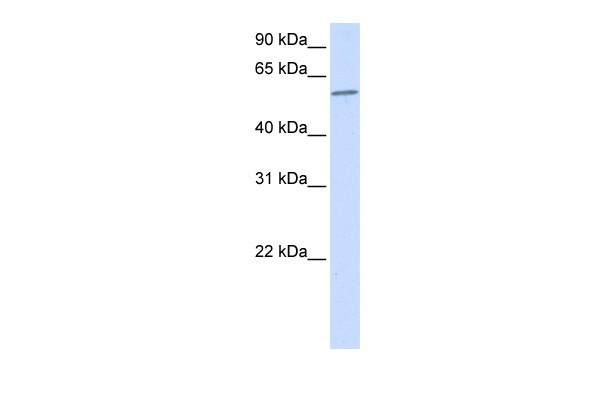
PPP3CA antibody - N-terminal region
Rabbit Polyclonal Antibody
- 产品详情
- 实验流程
Application 
| WB |
|---|---|
| Primary Accession | P63329 |
| Other Accession | NM_000944, NP_000935 |
| Reactivity | Human, Mouse, Rat, Rabbit, Zebrafish, Pig, Dog, Horse, Bovine |
| Predicted | Human, Mouse, Rat, Pig, Chicken, Dog, Horse |
| Host | Rabbit |
| Clonality | Polyclonal |
| Calculated MW | 58644 Da |
| Gene ID | 24674 |
|---|---|
| Alias Symbol | CALN, CALNA, CALNA1, CCN1, CNA1, PPP2B |
| Other Names | Serine/threonine-protein phosphatase 2B catalytic subunit alpha isoform, 3.1.3.16, CAM-PRP catalytic subunit, Calmodulin-dependent calcineurin A subunit alpha isoform, Ppp3ca, Calna |
| Format | Liquid. Purified antibody supplied in 1x PBS buffer with 0.09% (w/v) sodium azide and 2% sucrose. |
| Reconstitution & Storage | Add 50 ul of distilled water. Final anti-PPP3CA antibody concentration is 1 mg/ml in PBS buffer with 2% sucrose. For longer periods of storage, store at 20°C. Avoid repeat freeze-thaw cycles. |
| Precautions | PPP3CA antibody - N-terminal region is for research use only and not for use in diagnostic or therapeutic procedures. |
For Research Use Only. Not For Use In Diagnostic Procedures.
| Name | Ppp3ca {ECO:0000312|RGD:3382} |
|---|---|
| Synonyms | Calna |
| Function | Calcium-dependent, calmodulin-stimulated protein phosphatase which plays an essential role in the transduction of intracellular Ca(2+)-mediated signals (PubMed:1322410, PubMed:24018048). Many of the substrates contain a PxIxIT motif and/or a LxVP motif (By similarity). In response to increased Ca(2+) levels, dephosphorylates and activates phosphatase SSH1 which results in cofilin dephosphorylation (By similarity). In response to increased Ca(2+) levels following mitochondrial depolarization, dephosphorylates DNM1L inducing DNM1L translocation to the mitochondrion (By similarity). Positively regulates the CACNA1B/CAV2.2-mediated Ca(2+) release probability at hippocampal neuronal soma and synaptic terminals (PubMed:23699505). Dephosphorylates heat shock protein HSPB1 (By similarity). Dephosphorylates and activates transcription factor NFATC1 (By similarity). Dephosphorylates and inactivates transcription factor ELK1 (By similarity). Dephosphorylates DARPP32 (By similarity). May dephosphorylate CRTC2 at 'Ser-171' resulting in CRTC2 dissociation from 14-3-3 proteins (By similarity). Required for postnatal development of the nephrogenic zone and superficial glomeruli in the kidneys, cell cycle homeostasis in the nephrogenic zone, and ultimately normal kidney function (By similarity). Plays a role in intracellular AQP2 processing and localization to the apical membrane in the kidney, may thereby be required for efficient kidney filtration (By similarity). Required for secretion of salivary enzymes amylase, peroxidase, lysozyme and sialic acid via formation of secretory vesicles in the submandibular glands (By similarity). Required for calcineurin activity and homosynaptic depotentiation in the hippocampus (By similarity). Required for normal differentiation and survival of keratinocytes and therefore required for epidermis superstructure formation (By similarity). Positively regulates osteoblastic bone formation, via promotion of osteoblast differentiation (By similarity). Positively regulates osteoclast differentiation, potentially via NFATC1 signaling (By similarity). May play a role in skeletal muscle fiber type specification, potentially via NFATC1 signaling (By similarity). Negatively regulates MAP3K14/NIK signaling via inhibition of nuclear translocation of the transcription factors RELA and RELB (By similarity). Required for antigen-specific T- cell proliferation response (By similarity). Dephosphorylates KLHL3, promoting the interaction between KLHL3 and WNK4 and subsequent degradation of WNK4 (By similarity). Negatively regulates SLC9A1 activity (By similarity). |
| Cellular Location | Cytoplasm {ECO:0000250|UniProtKB:Q08209}. Cell membrane {ECO:0000250|UniProtKB:Q08209}; Peripheral membrane protein {ECO:0000250|UniProtKB:Q08209}. Cell membrane, sarcolemma. Cytoplasm, myofibril, sarcomere, Z line. Cell projection, dendritic spine {ECO:0000250|UniProtKB:Q08209}. Note=Colocalizes with ACTN1 and MYOZ2 at the Z line in heart and skeletal muscle (PubMed:11114196). Recruited to the cell membrane by scaffold protein AKAP5 following L-type Ca(2+)- channel activation (By similarity). {ECO:0000250|UniProtKB:Q08209, ECO:0000269|PubMed:11114196} |
| Tissue Location | Expressed in neonatal cardiomyocytes (at protein level) (PubMed:11114196). Expressed in hippocampal presynaptic termini (at protein level) (PubMed:23699505). |
Research Areas
Application Protocols
Provided below are standard protocols that you may find useful for product applications.
REFERENCES
Ito A.,et al.Biochem. Biophys. Res. Commun. 163:1492-1497(1989).
Perrino B.A.,et al.J. Biol. Chem. 267:15965-15969(1992).
Chang C.,et al.Biochem. J. 288:801-805(1992).
Lubec G.,et al.Submitted (JUL-2007) to UniProtKB.
Wadzinski B.E.,et al.J. Biol. Chem. 265:21504-21508(1990).

终于等到您。ABCEPTA(百远生物)抗体产品。
点击下方“我要评价 ”按钮提交您的反馈信息,您的反馈和评价是我们最宝贵的财富之一,
我们将在1-3个工作日内处理您的反馈信息。
如有疑问,联系:0512-88856768 tech-china@abcepta.com.


