


 癌症的基本特征包括细胞增殖、血管生成、迁移、凋亡逃避机制和细胞永生等。找到癌症发生过程中这些通路的关键标记物和对应的抗体用于检测至关重要。
 为您推荐一个泛素化位点预测神器——泛素化分析工具,可以为您的蛋白的泛素化位点作出预测和评分。
 细胞自噬受体图形绘图工具为你的蛋白的细胞受体结合位点作出预测和评分,识别结合到自噬通路中的蛋白是非常重要的,便于让我们理解自噬在正常生理、病理过程中的作用,如发育、细胞分化、神经退化性疾病、压力条件下、感染和癌症。
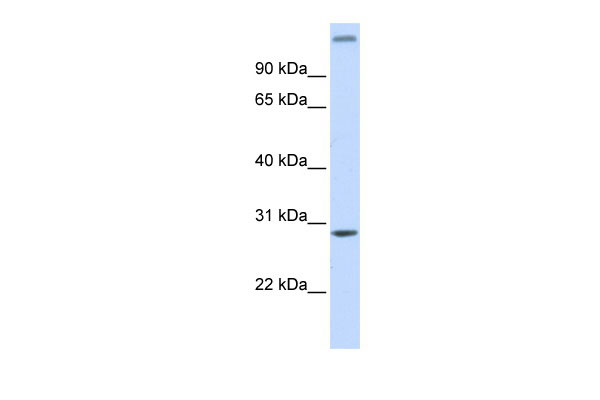
ALKBH2 antibody - middle region
Rabbit Polyclonal Antibody
- 产品详情
- 实验流程
Application 
| WB |
|---|---|
| Primary Accession | Q6NS38 |
| Other Accession | NM_001001655, NP_001001655 |
| Reactivity | Human, Mouse, Rat, Rabbit, Zebrafish, Dog, Guinea Pig, Horse, Bovine |
| Predicted | Human, Rat, Pig, Dog |
| Host | Rabbit |
| Clonality | Polyclonal |
| Calculated MW | 29322 Da |
| Gene ID | 121642 |
|---|---|
| Alias Symbol | ABH2, MGC90512, hABH2 |
| Other Names | Alpha-ketoglutarate-dependent dioxygenase alkB homolog 2, 1.14.11.33, Alkylated DNA repair protein alkB homolog 2, DNA oxidative demethylase ALKBH2, Oxy DC1, ALKBH2, ABH2 |
| Format | Liquid. Purified antibody supplied in 1x PBS buffer with 0.09% (w/v) sodium azide and 2% sucrose. |
| Reconstitution & Storage | Add 50 ul of distilled water. Final anti-ALKBH2 antibody concentration is 1 mg/ml in PBS buffer with 2% sucrose. For longer periods of storage, store at 20°C. Avoid repeat freeze-thaw cycles. |
| Precautions | ALKBH2 antibody - middle region is for research use only and not for use in diagnostic or therapeutic procedures. |
For Research Use Only. Not For Use In Diagnostic Procedures.
| Name | ALKBH2 |
|---|---|
| Synonyms | ABH2 {ECO:0000303|PubMed:16174769} |
| Function | Dioxygenase that repairs alkylated nucleic acid bases by direct reversal oxidative dealkylation. Can process both double- stranded (ds) and single-stranded (ss) DNA substrates, with a strong preference for dsDNA (PubMed:12486230, PubMed:12594517, PubMed:16174769, PubMed:20714506, PubMed:23972994, PubMed:25797601). Uses molecular oxygen, 2-oxoglutarate and iron as cofactors to oxidize the alkyl groups that are subsequently released as aldehydes, regenerating the undamaged bases. Probes the base pair stability, locates a weakened base pair and flips the damaged base to accommodate the lesion in its active site for efficient catalysis (PubMed:18432238, PubMed:22659876). Repairs monoalkylated bases, specifically N1- methyladenine and N3-methylcytosine, as well as higher order alkyl adducts such as bases modified with exocyclic bridged adducts known as etheno adducts including 1,N6-ethenoadenine, 3,N4-ethenocytosine and 1,N2-ethenoguanine (PubMed:12486230, PubMed:12594517, PubMed:16174769, PubMed:20714506, PubMed:23972994, PubMed:25797601, PubMed:26408825). Acts as a gatekeeper of genomic integrity under alkylation stress. Efficiently repairs alkylated lesions in ribosomal DNA (rDNA). These lesions can cause ss- and dsDNA strand breaks that severely impair rDNA transcription (PubMed:23972994). In a response mechanism to DNA damage, associates with PCNA at replication forks to repair alkylated adducts prior to replication (PubMed:19736315, PubMed:26408825). |
| Cellular Location | Nucleus. Nucleus, nucleolus. Nucleus, nucleoplasm. Note=Relocates to the replication foci during S-phase. |
| Tissue Location | Detected in colon, small intestine, ovary, testis, prostate, skeletal muscle, heart, liver and urinary bladder |
Research Areas
Application Protocols
Provided below are standard protocols that you may find useful for product applications.
REFERENCES
Lin Y.,et al.Submitted (SEP-2004) to the EMBL/GenBank/DDBJ databases.
Tsujikawa K.,et al.J. Cell. Mol. Med. 11:1105-1116(2007).
Scherer S.E.,et al.Nature 440:346-351(2006).
Duncan T.,et al.Proc. Natl. Acad. Sci. U.S.A. 99:16660-16665(2002).
Aas P.A.,et al.Nature 421:859-863(2003).

终于等到您。ABCEPTA(百远生物)抗体产品。
点击下方“我要评价 ”按钮提交您的反馈信息,您的反馈和评价是我们最宝贵的财富之一,
我们将在1-3个工作日内处理您的反馈信息。
如有疑问,联系:0512-88856768 tech-china@abcepta.com.


