


 癌症的基本特征包括细胞增殖、血管生成、迁移、凋亡逃避机制和细胞永生等。找到癌症发生过程中这些通路的关键标记物和对应的抗体用于检测至关重要。
 为您推荐一个泛素化位点预测神器——泛素化分析工具,可以为您的蛋白的泛素化位点作出预测和评分。
 细胞自噬受体图形绘图工具为你的蛋白的细胞受体结合位点作出预测和评分,识别结合到自噬通路中的蛋白是非常重要的,便于让我们理解自噬在正常生理、病理过程中的作用,如发育、细胞分化、神经退化性疾病、压力条件下、感染和癌症。
Bckdk antibody - N-terminal region
Rabbit Polyclonal Antibody
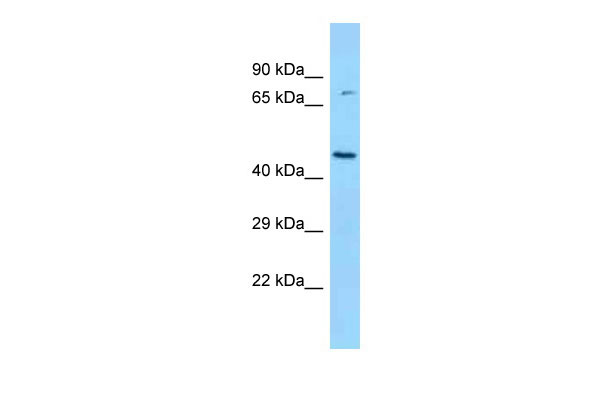
- 产品详情
- 实验流程
Application 
| WB |
|---|---|
| Primary Accession | Q00972 |
| Other Accession | NM_019244, NP_062117 |
| Reactivity | Human, Mouse, Rat, Rabbit, Dog, Guinea Pig, Bovine |
| Predicted | Human, Mouse, Pig, Dog |
| Host | Rabbit |
| Clonality | Polyclonal |
| Calculated MW | 46474 Da |
| Gene ID | 29603 |
|---|---|
| Other Names | [3-methyl-2-oxobutanoate dehydrogenase [lipoamide]] kinase, mitochondrial, 2.7.11.4, Branched-chain alpha-ketoacid dehydrogenase kinase, BCKD-kinase, BCKDHKIN, Bckdk |
| Format | Liquid. Purified antibody supplied in 1x PBS buffer with 0.09% (w/v) sodium azide and 2% sucrose. |
| Reconstitution & Storage | Add 50 ul of distilled water. Final anti-Bckdk antibody concentration is 1 mg/ml in PBS buffer with 2% sucrose. For longer periods of storage, store at 20°C. Avoid repeat freeze-thaw cycles. |
| Precautions | Bckdk antibody - N-terminal region is for research use only and not for use in diagnostic or therapeutic procedures. |
For Research Use Only. Not For Use In Diagnostic Procedures.
| Name | Bckdk |
|---|---|
| Function | Serine/threonine-protein kinase component of macronutrients metabolism. Forms a functional kinase and phosphatase pair with PPM1K, serving as a metabolic regulatory node that coordinates branched-chain amino acids (BCAAs) with glucose and lipid metabolism via two distinct phosphoprotein targets: mitochondrial BCKDHA subunit of the branched- chain alpha-ketoacid dehydrogenase (BCKDH) complex and cytosolic ACLY, a lipogenic enzyme of Krebs cycle (Probable) (PubMed:1377677, PubMed:7649998). Phosphorylates and inactivates mitochondrial BCKDH complex a multisubunit complex consisting of three multimeric components each involved in different steps of BCAA catabolism: E1 composed of BCKDHA and BCKDHB, E2 core composed of DBT monomers, and E3 composed of DLD monomers. Associates with the E2 component of BCKDH complex and phosphorylates BCKDHA on Ser-333, leading to conformational changes that interrupt substrate channeling between E1 and E2 and inactivates the BCKDH complex (Probable) (PubMed:1377677, PubMed:7649998). phosphorylates ACLY on Ser-455 in response to changes in cellular carbohydrate abundance such as occurs during fasting to feeding metabolic transition. Refeeding stimulates MLXIPL/ChREBP transcription factor, leading to increased BCKDK to PPM1K expression ratio, phosphorylation and activation of ACLY that ultimately results in the generation of malonyl-CoA and oxaloacetate immediate substrates of de novo lipogenesis and glucogenesis, respectively (Probable). Recognizes phosphosites having SxxE/D canonical motif (By similarity). |
| Cellular Location | Mitochondrion matrix. Mitochondrion. Note=Detected in the cytosolic compartment of liver cells. |
| Tissue Location | Expressed in heart and liver. |
Research Areas
Application Protocols
Provided below are standard protocols that you may find useful for product applications.
REFERENCES
Popov K.M.,et al.J. Biol. Chem. 267:13127-13130(1992).
Harris R.A.,et al.Adv. Enzyme Regul. 32:267-284(1992).
Davie J.R.,et al.J. Biol. Chem. 270:19861-19867(1995).

终于等到您。ABCEPTA(百远生物)抗体产品。
点击下方“我要评价 ”按钮提交您的反馈信息,您的反馈和评价是我们最宝贵的财富之一,
我们将在1-3个工作日内处理您的反馈信息。
如有疑问,联系:0512-88856768 tech-china@abcepta.com.


