


 癌症的基本特征包括细胞增殖、血管生成、迁移、凋亡逃避机制和细胞永生等。找到癌症发生过程中这些通路的关键标记物和对应的抗体用于检测至关重要。
 为您推荐一个泛素化位点预测神器——泛素化分析工具,可以为您的蛋白的泛素化位点作出预测和评分。
 细胞自噬受体图形绘图工具为你的蛋白的细胞受体结合位点作出预测和评分,识别结合到自噬通路中的蛋白是非常重要的,便于让我们理解自噬在正常生理、病理过程中的作用,如发育、细胞分化、神经退化性疾病、压力条件下、感染和癌症。
9030625A04Rik antibody - C-terminal region
Rabbit Polyclonal Antibody
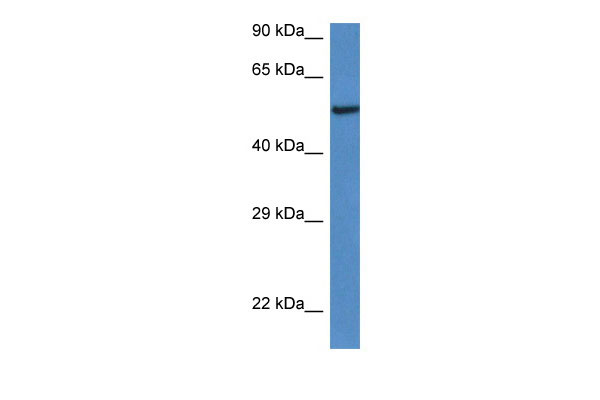
- 产品详情
- 实验流程
Application 
| WB |
|---|---|
| Primary Accession | Q8BZT9 |
| Other Accession | NM_172488, NP_766076 |
| Reactivity | Human, Mouse, Rat, Rabbit, Zebrafish, Pig, Dog, Guinea Pig, Horse, Bovine |
| Predicted | Human, Mouse, Rat, Rabbit, Zebrafish, Pig, Dog, Guinea Pig, Horse, Bovine |
| Host | Rabbit |
| Clonality | Polyclonal |
| Calculated MW | 47514 Da |
| Gene ID | 210808 |
|---|---|
| Alias Symbol | Lacc1, 9030625A04Rik |
| Other Names | Laccase domain-containing protein 1, Lacc1 |
| Format | Liquid. Purified antibody supplied in 1x PBS buffer with 0.09% (w/v) sodium azide and 2% sucrose. |
| Reconstitution & Storage | Add 50 ul of distilled water. Final anti-9030625A04Rik antibody concentration is 1 mg/ml in PBS buffer with 2% sucrose. For longer periods of storage, store at 20°C. Avoid repeat freeze-thaw cycles. |
| Precautions | 9030625A04Rik antibody - C-terminal region is for research use only and not for use in diagnostic or therapeutic procedures. |
For Research Use Only. Not For Use In Diagnostic Procedures.
| Name | Lacc1 {ECO:0000312|MGI:MGI:2445077} |
|---|---|
| Function | Purine nucleoside enzyme that catalyzes the phosphorolysis of adenosine, guanosine and inosine nucleosides, yielding D-ribose 1- phosphate and the respective free bases, adenine, guanine and hypoxanthine (By similarity). Also catalyzes the phosphorolysis of S- methyl-5'-thioadenosine into adenine and S-methyl-5-thio-alpha-D-ribose 1-phosphate (By similarity). Also has adenosine deaminase activity (By similarity). Acts as a regulator of innate immunity in macrophages by modulating the purine nucleotide metabolism, thereby regulating the metabolic function and bioenergetic state of macrophages (PubMed:27478939, PubMed:31978345). Enables a purine nucleotide cycle between adenosine and inosine monophosphate and adenylosuccinate that prevents cytoplasmic acidification and balances the cytoplasmic- mitochondrial redox interface (PubMed:31978345). The purine nucleotide cycle consumes aspartate and releases fumarate in a manner involving fatty acid oxidation and ATP-citrate lyase activity (PubMed:31978345). Participates in pattern recognition receptor-induced cytokines in macrophages: associates with the NOD2-signaling complex and promotes optimal NOD2-induced signaling, cytokine secretion and bacterial clearance (By similarity). Localizes to the endoplasmic reticulum upon PRR stimulation of macrophages and associates with endoplasmic reticulum-stress sensors, promoting the endoplasmic reticulum unfolded protein response (UPR) (By similarity). Does not show laccase activity (By similarity). Component of L-arginine metabolism in activated macrophages supporting anti-inflammatory and antibacterial macrophage effector functions. Cleaves L-citrulline, a product of L-arginine metabolized via NOS2, to yield isocyanate, a reactive carbonyl species- like cytotoxin, and L-ornithine, a precursor in polyamine biosynthesis. Through L-ornithine controls cellular polyamine pools likely triggering polyamine-mediated proinflammatory cytokine suppression and autophagy stimulation (PubMed:35978195). Directly interacts with components of autophagy machinery to regulate macrophage metabolism and bacterial phagocytosis. Acts downstream of the energy sensor AMP-activated protein kinase (AMPK) to promote autophagy associated to lipid droplets generation providing fatty acids for mitochondrial respiration (By similarity). |
| Cellular Location | Cytoplasm. Nucleus. Endoplasmic reticulum {ECO:0000250|UniProtKB:Q8IV20}. Peroxisome {ECO:0000250|UniProtKB:Q8IV20}. Note=Upon stimulation of the pattern- recognition receptor (PRR) NOD2, localizes to the endoplasmic reticulum. {ECO:0000250|UniProtKB:Q8IV20} |
| Tissue Location | Predominantly expressed in myeloid cells (PubMed:30510070). Highly expressed in primary macrophages and dendritic cells sorted from the peritoneum or spleen, respectively (at protein level) (PubMed:30510070). |
Research Areas
Application Protocols
Provided below are standard protocols that you may find useful for product applications.
REFERENCES
Carninci P.,et al.Science 309:1559-1563(2005).

终于等到您。ABCEPTA(百远生物)抗体产品。
点击下方“我要评价 ”按钮提交您的反馈信息,您的反馈和评价是我们最宝贵的财富之一,
我们将在1-3个工作日内处理您的反馈信息。
如有疑问,联系:0512-88856768 tech-china@abcepta.com.


