


 癌症的基本特征包括细胞增殖、血管生成、迁移、凋亡逃避机制和细胞永生等。找到癌症发生过程中这些通路的关键标记物和对应的抗体用于检测至关重要。
 为您推荐一个泛素化位点预测神器——泛素化分析工具,可以为您的蛋白的泛素化位点作出预测和评分。
 细胞自噬受体图形绘图工具为你的蛋白的细胞受体结合位点作出预测和评分,识别结合到自噬通路中的蛋白是非常重要的,便于让我们理解自噬在正常生理、病理过程中的作用,如发育、细胞分化、神经退化性疾病、压力条件下、感染和癌症。
LPGAT1 Antibody - middle region
Rabbit Polyclonal Antibody
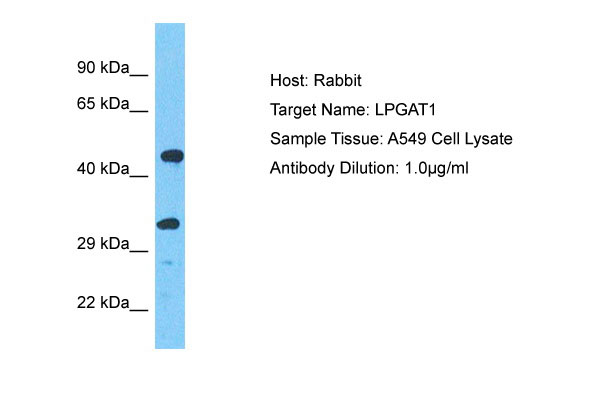
- 产品详情
- 实验流程
Application 
| WB |
|---|---|
| Primary Accession | Q92604 |
| Other Accession | XP_005273421 |
| Reactivity | Human |
| Host | Rabbit |
| Clonality | Polyclonal |
| Calculated MW | 43089 Da |
| Gene ID | 9926 |
|---|---|
| Alias Symbol | LPGAT1, FAM34A, KIAA0205, |
| Other Names | Acyl-CoA:lysophosphatidylglycerol acyltransferase 1, 2.3.1.-, LPGAT1, FAM34A, KIAA0205 |
| Format | Liquid. Purified antibody supplied in 1x PBS buffer with 0.09% (w/v) sodium azide and 2% sucrose. |
| Reconstitution & Storage | Add 50 &mu, l of distilled water. Final Anti-LPGAT1 antibody concentration is 1 mg/ml in PBS buffer with 2% sucrose. For longer periods of storage, store at -20°C. Avoid repeat freeze-thaw cycles. |
| Precautions | LPGAT1 Antibody - middle region is for research use only and not for use in diagnostic or therapeutic procedures. |
For Research Use Only. Not For Use In Diagnostic Procedures.
| Name | LPGAT1 (HGNC:28985) |
|---|---|
| Function | Lysophospholipid acyltransferase involved in fatty acyl chain remodeling of glycerophospholipids in the endoplasmic reticulum membrane (By similarity). Selectively catalyzes the transfer and esterification of saturated long-chain fatty acids from acyl-CoA to the sn-1 position of 1-lyso-2-acyl phosphatidylethanolamines (1-lyso-PE, LPE), with a preference for stearoyl CoA over palmitoyl CoA as acyl donor (PubMed:36049524). Acts in concert with an unknown phospholipase A1 to convert palmitate phosphatidylethanolamine (PE) species into stearate ones. Provides substrates to the PE methylation pathway, controlling stearate/palmitate composition of PE and phosphatidylcholine (PC) species with an overall impact on de novo hepatic lipid synthesis, body fat content and life span (By similarity). Can acylate lysophosphatidylglycerols (LPG) using various saturated fatty acyl-CoAs as acyl donors (PubMed:15485873). Can also acylate monoacylglycerols with a preference for 2-monoacylglycerols over 1-monoacylglycerols (By similarity). Has no activity toward lysophosphatidic acids (LPA) (By similarity). |
| Cellular Location | Endoplasmic reticulum membrane; Multi-pass membrane protein |
| Tissue Location | Highly expressed in liver and placenta. Also expressed in peripheral blood, lung, kidney and brain. Detected at lower levels in colon. High expression is detected in brain and testis |
Research Areas
Application Protocols
Provided below are standard protocols that you may find useful for product applications.
REFERENCES
Yang Y.,et al.J. Biol. Chem. 279:55866-55874(2004).
Ji D.,et al.Submitted (FEB-2004) to the EMBL/GenBank/DDBJ databases.
Nagase T.,et al.DNA Res. 3:321-329(1996).
Mural R.J.,et al.Submitted (SEP-2005) to the EMBL/GenBank/DDBJ databases.

终于等到您。ABCEPTA(百远生物)抗体产品。
点击下方“我要评价 ”按钮提交您的反馈信息,您的反馈和评价是我们最宝贵的财富之一,
我们将在1-3个工作日内处理您的反馈信息。
如有疑问,联系:0512-88856768 tech-china@abcepta.com.


