


 癌症的基本特征包括细胞增殖、血管生成、迁移、凋亡逃避机制和细胞永生等。找到癌症发生过程中这些通路的关键标记物和对应的抗体用于检测至关重要。
 为您推荐一个泛素化位点预测神器——泛素化分析工具,可以为您的蛋白的泛素化位点作出预测和评分。
 细胞自噬受体图形绘图工具为你的蛋白的细胞受体结合位点作出预测和评分,识别结合到自噬通路中的蛋白是非常重要的,便于让我们理解自噬在正常生理、病理过程中的作用,如发育、细胞分化、神经退化性疾病、压力条件下、感染和癌症。
YTHDF2 Antibody - C-terminal region
Rabbit Polyclonal Antibody
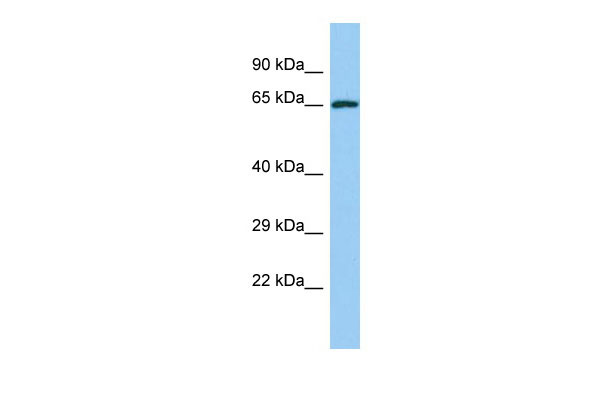
- 产品详情
- 实验流程
Application 
| WB |
|---|---|
| Primary Accession | Q9Y5A9 |
| Other Accession | NM_016258, NP_057342 |
| Reactivity | Human, Mouse, Rat, Rabbit, Dog, Horse, Bovine |
| Predicted | Human, Mouse, Rat, Rabbit, Dog, Horse, Bovine |
| Host | Rabbit |
| Clonality | Polyclonal |
| Calculated MW | 62334 Da |
| Gene ID | 51441 |
|---|---|
| Alias Symbol | HGRG8, NY-REN-2 |
| Other Names | YTH domain-containing family protein 2, CLL-associated antigen KW-14, High-glucose-regulated protein 8, Renal carcinoma antigen NY-REN-2, YTHDF2, HGRG8 |
| Format | Liquid. Purified antibody supplied in 1x PBS buffer with 0.09% (w/v) sodium azide and 2% sucrose. |
| Reconstitution & Storage | Add 50 ul of distilled water. Final anti-YTHDF2 antibody concentration is 1 mg/ml in PBS buffer with 2% sucrose. For longer periods of storage, store at 20°C. Avoid repeat freeze-thaw cycles. |
| Precautions | YTHDF2 Antibody - C-terminal region is for research use only and not for use in diagnostic or therapeutic procedures. |
For Research Use Only. Not For Use In Diagnostic Procedures.
| Name | YTHDF2 {ECO:0000303|PubMed:24284625, ECO:0000312|HGNC:HGNC:31675} |
|---|---|
| Function | Specifically recognizes and binds N6-methyladenosine (m6A)- containing RNAs, and regulates their stability (PubMed:24284625, PubMed:26046440, PubMed:26318451, PubMed:32492408). M6A is a modification present at internal sites of mRNAs and some non-coding RNAs and plays a role in mRNA stability and processing (PubMed:22575960, PubMed:24284625, PubMed:25412658, PubMed:25412661, PubMed:32492408). Acts as a regulator of mRNA stability by promoting degradation of m6A-containing mRNAs via interaction with the CCR4-NOT and ribonuclease P/MRP complexes, depending on the context (PubMed:24284625, PubMed:26046440, PubMed:27558897, PubMed:30930054, PubMed:32492408). The YTHDF paralogs (YTHDF1, YTHDF2 and YTHDF3) share m6A-containing mRNAs targets and act redundantly to mediate mRNA degradation and cellular differentiation (PubMed:28106072, PubMed:32492408). M6A-containing mRNAs containing a binding site for RIDA/HRSP12 (5'-GGUUC-3') are preferentially degraded by endoribonucleolytic cleavage: cooperative binding of RIDA/HRSP12 and YTHDF2 to transcripts leads to recruitment of the ribonuclease P/MRP complex (PubMed:30930054). Other m6A-containing mRNAs undergo deadenylation via direct interaction between YTHDF2 and CNOT1, leading to recruitment of the CCR4-NOT and subsequent deadenylation of m6A- containing mRNAs (PubMed:27558897). Required maternally to regulate oocyte maturation: probably acts by binding to m6A-containing mRNAs, thereby regulating maternal transcript dosage during oocyte maturation, which is essential for the competence of oocytes to sustain early zygotic development (By similarity). Also required during spermatogenesis: regulates spermagonial adhesion by promoting degradation of m6A-containing transcripts coding for matrix metallopeptidases (By similarity). Also involved in hematopoietic stem cells specification by binding to m6A-containing mRNAs, leading to promote their degradation (PubMed:30065315). Also acts as a regulator of neural development by promoting m6A-dependent degradation of neural development-related mRNA targets (By similarity). Inhibits neural specification of induced pluripotent stem cells by binding to methylated neural-specific mRNAs and promoting their degradation, thereby restraining neural differentiation (PubMed:32169943). Regulates circadian regulation of hepatic lipid metabolism: acts by promoting m6A-dependent degradation of PPARA transcripts (PubMed:30428350). Regulates the innate immune response to infection by inhibiting the type I interferon response: acts by binding to m6A-containing IFNB transcripts and promoting their degradation (PubMed:30559377). May also act as a promoter of cap-independent mRNA translation following heat shock stress: upon stress, relocalizes to the nucleus and specifically binds mRNAs with some m6A methylation mark at their 5'-UTR, protecting demethylation of mRNAs by FTO, thereby promoting cap-independent mRNA translation (PubMed:26458103). Regulates mitotic entry by promoting the phase-specific m6A-dependent degradation of WEE1 transcripts (PubMed:32267835). Promotes formation of phase-separated membraneless compartments, such as P-bodies or stress granules, by undergoing liquid-liquid phase separation upon binding to mRNAs containing multiple m6A-modified residues: polymethylated mRNAs act as a multivalent scaffold for the binding of YTHDF proteins, juxtaposing their disordered regions and thereby leading to phase separation (PubMed:31292544, PubMed:31388144, PubMed:31642031, PubMed:32451507). The resulting mRNA-YTHDF complexes then partition into different endogenous phase-separated membraneless compartments, such as P-bodies, stress granules or neuronal RNA granules (PubMed:31292544). May also recognize and bind RNAs modified by C5-methylcytosine (m5C) and act as a regulator of rRNA processing (PubMed:31815440). |
| Cellular Location | Cytoplasm, cytosol. Cytoplasm, P-body. Cytoplasm, Stress granule. Nucleus. Note=Localizes to the cytosol and relocates to the nucleus following heat shock stress (PubMed:26458103) Can partition into different structures: into P-bodies in unstressed cells, and into stress granules during stress (PubMed:31292544) |
| Tissue Location | Highly expressed in induced pluripotent stem cells (iPSCs) and down-regulated during neural differentiation |
Research Areas
Application Protocols
Provided below are standard protocols that you may find useful for product applications.
REFERENCES
Scanlan M.J.,et al.Int. J. Cancer 83:456-464(1999).
Roberts T.P.,et al.Submitted (OCT-1999) to the EMBL/GenBank/DDBJ databases.
Krackhardt A.M.,et al.Submitted (OCT-2001) to the EMBL/GenBank/DDBJ databases.
Ota T.,et al.Nat. Genet. 36:40-45(2004).
Gregory S.G.,et al.Nature 441:315-321(2006).

终于等到您。ABCEPTA(百远生物)抗体产品。
点击下方“我要评价 ”按钮提交您的反馈信息,您的反馈和评价是我们最宝贵的财富之一,
我们将在1-3个工作日内处理您的反馈信息。
如有疑问,联系:0512-88856768 tech-china@abcepta.com.


