


 癌症的基本特征包括细胞增殖、血管生成、迁移、凋亡逃避机制和细胞永生等。找到癌症发生过程中这些通路的关键标记物和对应的抗体用于检测至关重要。
 为您推荐一个泛素化位点预测神器——泛素化分析工具,可以为您的蛋白的泛素化位点作出预测和评分。
 细胞自噬受体图形绘图工具为你的蛋白的细胞受体结合位点作出预测和评分,识别结合到自噬通路中的蛋白是非常重要的,便于让我们理解自噬在正常生理、病理过程中的作用,如发育、细胞分化、神经退化性疾病、压力条件下、感染和癌症。
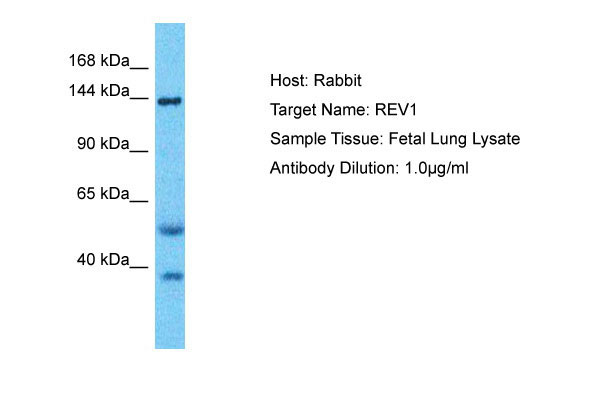
REV1 Antibody - C-terminal region
Rabbit Polyclonal Antibody
- 产品详情
- 实验流程
- 背景知识
Application 
| WB |
|---|---|
| Primary Accession | Q9UBZ9 |
| Other Accession | XP_005264024 |
| Reactivity | Human |
| Host | Rabbit |
| Clonality | Polyclonal |
| Calculated MW | 138248 Da |
| Gene ID | 51455 |
|---|---|
| Alias Symbol | REV1, REV1L, |
| Other Names | DNA repair protein REV1, 2.7.7.-, Alpha integrin-binding protein 80, AIBP80, Rev1-like terminal deoxycytidyl transferase, REV1, REV1L |
| Format | Liquid. Purified antibody supplied in 1x PBS buffer with 0.09% (w/v) sodium azide and 2% sucrose. |
| Reconstitution & Storage | Add 50 &mu, l of distilled water. Final Anti-REV1 antibody concentration is 1 mg/ml in PBS buffer with 2% sucrose. For longer periods of storage, store at -20°C. Avoid repeat freeze-thaw cycles. |
| Precautions | REV1 Antibody - C-terminal region is for research use only and not for use in diagnostic or therapeutic procedures. |
For Research Use Only. Not For Use In Diagnostic Procedures.
| Name | REV1 (HGNC:14060) |
|---|---|
| Synonyms | REV1L |
| Function | Bifunctional protein involved in the maintenance of genome stability through translesion DNA synthesis (TLS) and antibody diversification via somatic hypermutation (PubMed:16263170, PubMed:23143872). Functions as a molecular adapter protein at stalled DNA replication, coordinating polymerases recruitment, selection, and switching, in a manner independent of its deoxycytidyl transferase activity (PubMed:23143872). At the site of DNA lesion, recruits and mediates the switch between low-fidelity inserter DNA polymerases, such as POLK, that incorporate nucleotides opposite lesions and the extender DNA polymerase zeta complex which continues DNA synthesis from distorted primer termini (PubMed:23143872). In vitro, acts as a template-dependent deoxycytidyl transferase that preferentially incorporates deoxycytidine residues from dCTP to the 3'-end of a DNA primer opposite apurinic/apyrimidinic (AP) site, uracil, undamaged DNA templates (G > A > C > T) and a variety of damaged DNA templates (PubMed:10536157, PubMed:11278384, PubMed:38612916). Opposite template guanine, efficiently incorporates not only dCMP but also non- complementary dGMP and dTMP, with lower efficiency for dAMP, demonstrating low fidelity on undamaged DNA (PubMed:10536157, PubMed:11711549, PubMed:38612916). This catalytic activity has been implicated in somatic hypermutation, likely achieved by incorporation of deoxycytidine opposite abasic sites, generated at cytidines via activation-induced deoxycytidine deaminase (AID)-mediated deamination and uracil DNA glycosylase (UNG) activity, respectively (PubMed:16263170). In addition, exhibits a 5'-deoxyribose-5-phosphate lyase activity in vitro, though its necessity in vivo is not confirmed (By similarity). |
| Cellular Location | Nucleus. Note=In response to replication stress, is recruited to stalled DNA replication through recognition of monoubiquitinated PCNA, and accumulates in nuclear foci in a process facilitated by FAAP20 binding (PubMed:22266823). Nuclear foci localization likely reflects the recruitment of REV1 to DNA lesions in response to replication stress, and depends on its ubiquitin-binding motif (UBM) domains (PubMed:22266823). |
| Tissue Location | Ubiquitous. |
Provided below are standard protocols that you may find useful for product applications.
BACKGROUND
Deoxycytidyl transferase involved in DNA repair. Transfers a dCMP residue from dCTP to the 3'-end of a DNA primer in a template-dependent reaction. May assist in the first step in the bypass of abasic lesions by the insertion of a nucleotide opposite the lesion. Required for normal induction of mutations by physical and chemical agents.
REFERENCES
Lin W.,et al.Nucleic Acids Res. 27:4468-4475(1999).
Gibbs P.E.M.,et al.Proc. Natl. Acad. Sci. U.S.A. 97:4186-4191(2000).
Masuda Y.,et al.J. Biol. Chem. 276:15051-15058(2001).
Murakumo Y.,et al.J. Biol. Chem. 276:35644-35651(2001).
Ota T.,et al.Nat. Genet. 36:40-45(2004).

终于等到您。ABCEPTA(百远生物)抗体产品。
点击下方“我要评价 ”按钮提交您的反馈信息,您的反馈和评价是我们最宝贵的财富之一,
我们将在1-3个工作日内处理您的反馈信息。
如有疑问,联系:0512-88856768 tech-china@abcepta.com.


