


 癌症的基本特征包括细胞增殖、血管生成、迁移、凋亡逃避机制和细胞永生等。找到癌症发生过程中这些通路的关键标记物和对应的抗体用于检测至关重要。
 为您推荐一个泛素化位点预测神器——泛素化分析工具,可以为您的蛋白的泛素化位点作出预测和评分。
 细胞自噬受体图形绘图工具为你的蛋白的细胞受体结合位点作出预测和评分,识别结合到自噬通路中的蛋白是非常重要的,便于让我们理解自噬在正常生理、病理过程中的作用,如发育、细胞分化、神经退化性疾病、压力条件下、感染和癌症。
Anti-BRCA2 Antibody 精选
Purified Mouse Monoclonal Antibody (Mab)
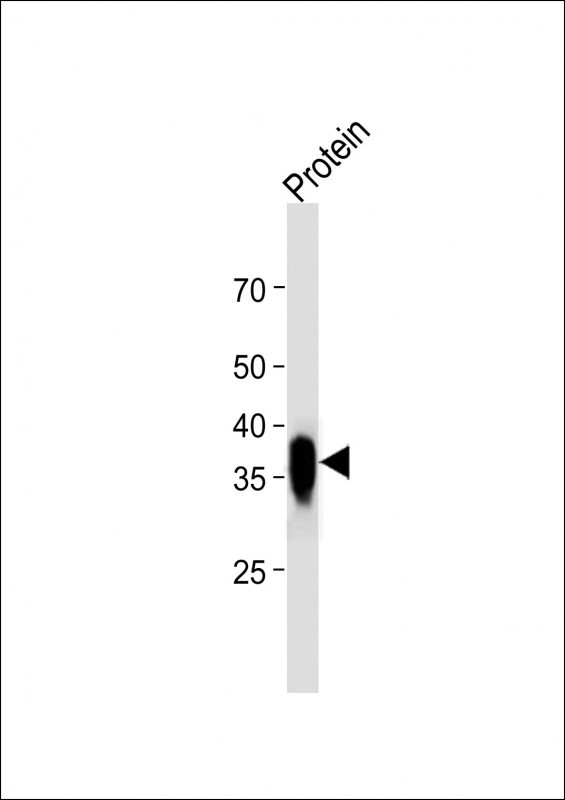
- 产品详情
- 实验流程
- 背景知识
Application 
| WB, E |
|---|---|
| Primary Accession | P51587 |
| Reactivity | Human |
| Predicted | Human |
| Host | Mouse |
| Clonality | monoclonal |
| Isotype | IgG1,κ |
| Clone Names | 1847CT631.23.58 |
| Calculated MW | 384230 Da |
| Gene ID | 675 |
|---|---|
| Other Names | Breast cancer type 2 susceptibility protein, Fanconi anemia group D1 protein, BRCA2, FACD, FANCD1 |
| Target/Specificity | This antibody is generated from a mouse immunized with a recombinant protein from human. |
| Dilution | WB~~1:2000 E~~Use at an assay dependent concentration. |
| Format | Purified monoclonal antibody supplied in PBS with 0.09% (W/V) sodium azide. This antibody is purified through a protein G column, followed by dialysis against PBS. |
| Storage | Maintain refrigerated at 2-8°C for up to 2 weeks. For long term storage store at -20°C in small aliquots to prevent freeze-thaw cycles. |
| Precautions | Anti-BRCA2 Antibody is for research use only and not for use in diagnostic or therapeutic procedures. |
For Research Use Only. Not For Use In Diagnostic Procedures.
| Name | BRCA2 {ECO:0000303|PubMed:8524414, ECO:0000312|HGNC:HGNC:1101} |
|---|---|
| Function | Tumor suppressor protein that maintains genome stability primarily by repairing damaged DNA through homologous recombination (HR) (PubMed:11239456, PubMed:12442171, PubMed:15115758, PubMed:15199141, PubMed:15671039, PubMed:15937124, PubMed:17515903, PubMed:17515904, PubMed:18317453, PubMed:19303847, PubMed:20729832, PubMed:20729858, PubMed:20729859, PubMed:21719596, PubMed:27941124, PubMed:37499663, PubMed:37515771). Facilitates the repair of double- strand breaks (DSBs) by binding and mediating the loading of the RAD51 protein onto single-stranded DNA (ssDNA), thereby promoting the activity of RAD51, which catalyzes DNA strand exchange (PubMed:11239456, PubMed:12442171, PubMed:15937124, PubMed:17515903, PubMed:17515904, PubMed:18317453, PubMed:19303847, PubMed:20729832, PubMed:20729858, PubMed:20729859, PubMed:27941124, PubMed:37499663). BRCA2 nucleates and stabilizes RAD51 on ssDNA directly and delivers RAD51 to ssDNA-double-stranded DNA (dsDNA) junctions by sliding along dsDNA backbone (PubMed:12442171, PubMed:19303847, PubMed:37499663). RAD51 targeting to ssDNA promotes removal of replication protein-A (RPA) from ssDNA and stabilization of RAD51-ssDNA filaments by blocking ATP hydrolysis (PubMed:20729859). May play a role in the extension step after strand invasion at replication-dependent DNA double-strand breaks; together with PALB2 is involved in both POLH localization at collapsed replication forks and DNA polymerization activity (PubMed:24485656). Required to prevent R-loop-associated DNA damage and thus transcription-associated genomic instability (PubMed:24896180). Silencing of BRCA2 promotes R-loop accumulation at actively transcribed genes in replicating and non-replicating cells, suggesting that BRCA2 mediates the control of R-loop associated genomic instability, independently of its known role in homologous recombination (PubMed:24896180). Also promotes RAD51 loading to telomeric regions, facilitating telomere replication and capping (PubMed:21076401). Also required for homologous recombination during meiosis by promoting the recruitment of RAD51 and DMC1 recombinases to meiotic DSB sites, enabling proper chromosome pairing and crossing over (PubMed:26976601). Also promotes homologous recombination by inactivating the FIGNL1-FIRRM complex to protect RAD51 filament from premature disassembly (PubMed:37515771). Together with NPM1, may also regulate centrosome duplication (PubMed:21084279). |
| Cellular Location | Chromosome. Chromosome, telomere. Nucleus. Cytoplasm, cytoskeleton, microtubule organizing center, centrosome Note=Colocalizes with ERCC5/XPG to nuclear foci following DNA replication stress. |
| Tissue Location | Highest levels of expression in breast and thymus, with slightly lower levels in lung, ovary and spleen |
Provided below are standard protocols that you may find useful for product applications.
BACKGROUND
Involved in double-strand break repair and/or homologous recombination. Binds RAD51 and potentiates recombinational DNA repair by promoting assembly of RAD51 onto single-stranded DNA (ssDNA). Acts by targeting RAD51 to ssDNA over double-stranded DNA, enabling RAD51 to displace replication protein-A (RPA) from ssDNA and stabilizing RAD51-ssDNA filaments by blocking ATP hydrolysis. Part of a PALB2-scaffolded HR complex containing RAD51C and which is thought to play a role in DNA repair by HR. May participate in S phase checkpoint activation. Binds selectively to ssDNA, and to ssDNA in tailed duplexes and replication fork structures. May play a role in the extension step after strand invasion at replication-dependent DNA double-strand breaks; together with PALB2 is involved in both POLH localization at collapsed replication forks and DNA polymerization activity. In concert with NPM1, regulates centrosome duplication. Interacts with the TREX-2 complex (transcription and export complex 2) subunits PCID2 and DSS1, and is required to prevent R-loop- associated DNA damage and thus transcription-associated genomic instability. Silencing of BRCA2 promotes R-loop accumulation at actively transcribed genes in replicating and non-replicating cells, suggesting that BRCA2 mediates the control of R-loop associated genomic instability, independently of its known role in homologous recombination (PubMed:24896180).
REFERENCES
Wooster R.,et al.Nature 378:789-792(1995).
Tavtigian S.V.,et al.Nat. Genet. 12:333-337(1996).
Dunham A.,et al.Nature 428:522-528(2004).
Ozcelik H.,et al.Nat. Genet. 16:17-18(1997).
Hussain S.,et al.Hum. Mol. Genet. 13:1241-1248(2004).

终于等到您。ABCEPTA(百远生物)抗体产品。
点击下方“我要评价 ”按钮提交您的反馈信息,您的反馈和评价是我们最宝贵的财富之一,
我们将在1-3个工作日内处理您的反馈信息。
如有疑问,联系:0512-88856768 tech-china@abcepta.com.


