


 癌症的基本特征包括细胞增殖、血管生成、迁移、凋亡逃避机制和细胞永生等。找到癌症发生过程中这些通路的关键标记物和对应的抗体用于检测至关重要。
 为您推荐一个泛素化位点预测神器——泛素化分析工具,可以为您的蛋白的泛素化位点作出预测和评分。
 细胞自噬受体图形绘图工具为你的蛋白的细胞受体结合位点作出预测和评分,识别结合到自噬通路中的蛋白是非常重要的,便于让我们理解自噬在正常生理、病理过程中的作用,如发育、细胞分化、神经退化性疾病、压力条件下、感染和癌症。
GAPDH Antibody
Purified Mouse Monoclonal Antibody
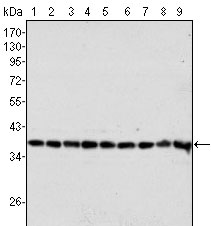
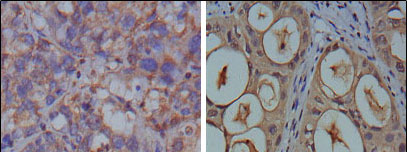
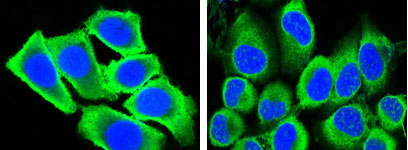
- 产品详情
- 实验流程
Application 
| WB, IHC, ICC, E |
|---|---|
| Primary Accession | P04406 |
| Reactivity | Human |
| Host | Mouse |
| Clonality | Monoclonal |
| Clone Names | 1A10 |
| Isotype | IgG1 |
| Calculated MW | 36053 Da |
| Description | Glyceraldehyde-3-phosphate dehydrogenase (GAPDH) is well known as one of the key enzymes involvedin glycolysis. It catalyzes an important energy-yielding step in carbohydrate metabolism, the reversible oxidative phosphorylation of glyceraldehyde-3-phosphate in the presence of inorganic phosphate and nicotinamide adenine dinucleotide (NAD). The enzyme exists as a tetramer of identical chains. Besides its functioning as a glycolytic enzyme in cytoplasm, recent evidence suggest that mammalian GAPDH is also involved in a great number of intracellular proceses such as membrane fusion, microtubule bundling, phosphotransferase activity, nuclear RNA export, DNA replication, and DNA repair. During the last decade a lot of findings appeared concerning the role of GAPDH in different pathologies including prostate cancer progression, programmed neuronal cell death, age-related neuronal diseases, such as Alzheimer’s and Huntington’s disease. |
| Immunogen | Purified recombinant fragment of human GAPDH expressed in E. Coli. |
| Formulation | Ascitic fluid containing 0.03% sodium azide. |
| Gene ID | 2597 |
|---|---|
| Other Names | Glyceraldehyde-3-phosphate dehydrogenase, GAPDH, 1.2.1.12, Peptidyl-cysteine S-nitrosylase GAPDH, 2.6.99.-, GAPDH, GAPD |
| Dilution | WB~~1/500 - 1/2000 IHC~~1/200 - 1/1000 ICC~~N/A E~~N/A |
| Storage | Maintain refrigerated at 2-8°C for up to 6 months. For long term storage store at -20°C in small aliquots to prevent freeze-thaw cycles. |
| Precautions | GAPDH Antibody is for research use only and not for use in diagnostic or therapeutic procedures. |
For Research Use Only. Not For Use In Diagnostic Procedures.
| Name | GAPDH {ECO:0000303|PubMed:2987855, ECO:0000312|HGNC:HGNC:4141} |
|---|---|
| Function | Catalyzes the conversion of D-glyceraldehyde 3-phosphate (G3P) into 3-phospho-D-glyceroyl phosphate in glycolysis and the reverse reaction in gluconeogenesis (PubMed:11724794, PubMed:3170585). Also shows nitrosylase activity, thereby playing a role in nuclear functions (PubMed:11724794, PubMed:3170585). Modulates the organization and assembly of the cytoskeleton (By similarity). Facilitates the CHP1- dependent microtubule and membrane associations through its ability to stimulate the binding of CHP1 to microtubules (By similarity). Component of the GAIT (gamma interferon-activated inhibitor of translation) complex which mediates interferon-gamma-induced transcript-selective translation inhibition in inflammation processes (PubMed:23071094). Upon interferon-gamma treatment assembles into the GAIT complex which binds to stem loop-containing GAIT elements in the 3'-UTR of diverse inflammatory mRNAs (such as ceruplasmin) and suppresses their translation (PubMed:23071094). Also plays a role in innate immunity by promoting TNF-induced NF-kappa-B activation and type I interferon production, via interaction with TRAF2 and TRAF3, respectively (PubMed:23332158, PubMed:27387501). Participates in nuclear events including transcription, RNA transport, DNA replication and apoptosis (By similarity). Nuclear functions are probably due to the nitrosylase activity that mediates cysteine S-nitrosylation of nuclear target proteins such as SIRT1, HDAC2 and PRKDC (By similarity). |
| Cellular Location | Cytoplasm, cytosol. Nucleus {ECO:0000250|UniProtKB:P04797}. Cytoplasm, perinuclear region. Membrane Cytoplasm, cytoskeleton {ECO:0000250|UniProtKB:P04797} Note=Translocates to the nucleus following S-nitrosylation and interaction with SIAH1, which contains a nuclear localization signal (By similarity). Postnuclear and Perinuclear regions (PubMed:12829261) {ECO:0000250|UniProtKB:P04797, ECO:0000269|PubMed:12829261} |
Research Areas
Application Protocols
Provided below are standard protocols that you may find useful for product applications.
REFERENCES
1. Allen R.W. J. Biol. Chem. 1987.262:649-653. 2. Sumner CJ. Ann Neurol 2003.54:6 47-54.

终于等到您。ABCEPTA(百远生物)抗体产品。
点击下方“我要评价 ”按钮提交您的反馈信息,您的反馈和评价是我们最宝贵的财富之一,
我们将在1-3个工作日内处理您的反馈信息。
如有疑问,联系:0512-88856768 tech-china@abcepta.com.
¥ 1,250.00
Cat# AO1033a


