


 癌症的基本特征包括细胞增殖、血管生成、迁移、凋亡逃避机制和细胞永生等。找到癌症发生过程中这些通路的关键标记物和对应的抗体用于检测至关重要。
 为您推荐一个泛素化位点预测神器——泛素化分析工具,可以为您的蛋白的泛素化位点作出预测和评分。
 细胞自噬受体图形绘图工具为你的蛋白的细胞受体结合位点作出预测和评分,识别结合到自噬通路中的蛋白是非常重要的,便于让我们理解自噬在正常生理、病理过程中的作用,如发育、细胞分化、神经退化性疾病、压力条件下、感染和癌症。
SRA Antibody
Purified Mouse Monoclonal Antibody
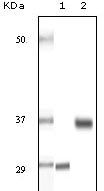
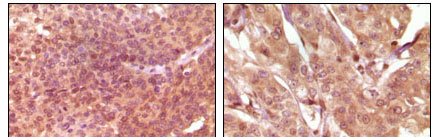
- 产品详情
- 实验流程
Application 
| WB, IHC, E |
|---|---|
| Primary Accession | Q9HD15 |
| Reactivity | Human |
| Host | Mouse |
| Clonality | Monoclonal |
| Clone Names | 7H1G1 |
| Isotype | IgG1 |
| Calculated MW | 24400 Da |
| Description | Steroid receptor RNA activator 1 (SRA), with 237-amino acid protein (about 27kDa), belongs to the growing family of functional non-coding RNAs. SRA was originally described as the first functional noncoding RNA able to specifically coactivate the activity of steroid receptors. Specifically, SRA exists as both an RNA transcript that forms a complex with steroid receptor coactivator-1 and as a stably expressed protein. Its expression is strongly up-regulated in many human tumors of the breast, uterus, and ovary, suggesting a potential role in pathogenesis. Although coactivation of steroid-dependent transcription by SRA is accompanied by a proliferative response, overexpression is not in itself sufficient to induce turmorigenesis. |
| Immunogen | Purified recombinant fragment of SRA expressed in E. Coli. |
| Formulation | Ascitic fluid containing 0.03% sodium azide. |
| Gene ID | 10011 |
|---|---|
| Other Names | Steroid receptor RNA activator 1, Steroid receptor RNA activator protein, SRAP, SRA1 (HGNC:11281) |
| Dilution | WB~~1/500 - 1/2000 IHC~~1/200 - 1/1000 E~~N/A |
| Storage | Maintain refrigerated at 2-8°C for up to 6 months. For long term storage store at -20°C in small aliquots to prevent freeze-thaw cycles. |
| Precautions | SRA Antibody is for research use only and not for use in diagnostic or therapeutic procedures. |
For Research Use Only. Not For Use In Diagnostic Procedures.
| Name | SRA1 (HGNC:11281) |
|---|---|
| Function | Functional RNA which acts as a transcriptional coactivator that selectively enhances steroid receptor-mediated transactivation ligand-independently through a mechanism involving the modulating N- terminal domain (AF-1) of steroid receptors. Also mediates transcriptional coactivation of steroid receptors ligand-dependently through the steroid-binding domain (AF-2). Enhances cellular proliferation and differentiation and promotes apoptosis in vivo. May play a role in tumorigenesis. |
| Cellular Location | Nucleus. Cytoplasm |
| Tissue Location | Highly expressed in liver and skeletal muscle and to a lesser extent in brain. Also expressed in both normal and tumorigenic breast epithelial cell lines. Significantly up-regulated in human tumors of the breast, ovary, and uterus |
Research Areas
Application Protocols
Provided below are standard protocols that you may find useful for product applications.
REFERENCES
1. Rainer B. Lanz, Steven S. Chua, Niall Barron. Mol. Cell. Biol, Oct 2003; 23: 7163 - 7176. 2. Shilpa Chooniedass-Kothari, Mohammad Kariminia Hamedani, Sandy Troup. Int J Cancer. 2006 Feb 15;118(4):1054-9 3. S. Chooniedass-Kothari, E. Emberley, M. K. Hamedani. FEBS Lett. 2004 May 21;566(1-3):43-7.

终于等到您。ABCEPTA(百远生物)抗体产品。
点击下方“我要评价 ”按钮提交您的反馈信息,您的反馈和评价是我们最宝贵的财富之一,
我们将在1-3个工作日内处理您的反馈信息。
如有疑问,联系:0512-88856768 tech-china@abcepta.com.


