


 癌症的基本特征包括细胞增殖、血管生成、迁移、凋亡逃避机制和细胞永生等。找到癌症发生过程中这些通路的关键标记物和对应的抗体用于检测至关重要。
 为您推荐一个泛素化位点预测神器——泛素化分析工具,可以为您的蛋白的泛素化位点作出预测和评分。
 细胞自噬受体图形绘图工具为你的蛋白的细胞受体结合位点作出预测和评分,识别结合到自噬通路中的蛋白是非常重要的,便于让我们理解自噬在正常生理、病理过程中的作用,如发育、细胞分化、神经退化性疾病、压力条件下、感染和癌症。
CD38 Antibody
Purified Mouse Monoclonal Antibody
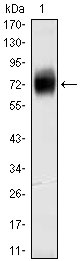
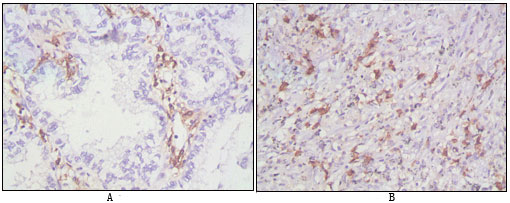
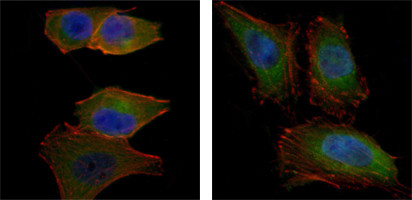
- 产品详情
- 实验流程
Application 
| WB, IHC, E |
|---|---|
| Primary Accession | P28907 |
| Reactivity | Human |
| Host | Mouse |
| Clonality | Monoclonal |
| Clone Names | 6E12D |
| Isotype | IgG1 |
| Calculated MW | 34328 Da |
| Description | CD38 is a type II integral membrane glycoprotein which is present on early B and T cell lineages and activated B and T cells but is absent from most mature resting peripheral lymphocytes. CD38 is also found on thymocytes, pre-B cells, germinal center B cells, mitogen-activated T cells, monocytes and Ig-secreting plasma cells. CD38 acts as a NAD glycohydrolase in T lym- phocytes. On hematopoietic cells CD38 induces activation, proliferation, and differentiation of mature T and B cells and mediates apoptosis of myeloid and lymphoid progenitor cells. In addition to acting as a signaling receptor, CD38 is also an enzyme capable of producing several calcium-mobilizing metabo- lites, including cyclic adenosine diphosphate ribose (cADPR). CD38 also plays a role in maintaining survival of an invariant NK T (iNKT) cell subset that preferentially contributes to the maintenance of immunological tolerance. |
| Immunogen | Purified recombinant fragment of human CD38 expressed in E. Coli. |
| Formulation | Ascitic fluid containing 0.03% sodium azide. |
| Gene ID | 952 |
|---|---|
| Other Names | ADP-ribosyl cyclase/cyclic ADP-ribose hydrolase 1, 3.2.2.6, 2'-phospho-ADP-ribosyl cyclase, 2'-phospho-ADP-ribosyl cyclase/2'-phospho-cyclic-ADP-ribose transferase, 2.4.99.20, 2'-phospho-cyclic-ADP-ribose transferase, ADP-ribosyl cyclase 1, ADPRC 1, Cyclic ADP-ribose hydrolase 1, cADPr hydrolase 1, T10, CD38, CD38 |
| Dilution | WB~~1/500 - 1/2000 IHC~~1/200 - 1/1000 E~~N/A |
| Storage | Maintain refrigerated at 2-8°C for up to 6 months. For long term storage store at -20°C in small aliquots to prevent freeze-thaw cycles. |
| Precautions | CD38 Antibody is for research use only and not for use in diagnostic or therapeutic procedures. |
For Research Use Only. Not For Use In Diagnostic Procedures.
| Name | CD38 |
|---|---|
| Function | Multifunctional transmembrane glycoprotein able to exert enzymatic activities and also to mobilize calcium, to transduce signals, to adhere to hyaluronan and to other ligands. Synthesizes cyclic ADP-ribose (cADPR), a second messenger for glucose-induced insulin secretion (PubMed:7961800, PubMed:8253715). Synthesizes the Ca(2+) mobilizer nicotinate-adenine dinucleotide phosphate, NAADP(+), from 2'-phospho-cADPR and nicotinic acid, as well as from NADP(+) and nicotinic acid. At both pH 5.0 and pH 7.4 preferentially transforms 2'- phospho-cADPR into NAADP(+), while preferentially cleaving NADP(+) to cADPR and ADPRP rather than into NADDP(+) (PubMed:16690024). Has cADPR hydrolase activity (PubMed:7961800, PubMed:8253715). Functions also as a receptor that binds the ligand CD31 on endothelial cells, promoting lymphocyte activation, proliferation, and migration across the endothelial barrier (PubMed:9551996). Involved in the regulation of crucial dendritic cell functions acquired at the mature stage, such as CCL21-driven migration, survival, and Th1-polarizing activity (PubMed:16293598). In lamina propria T lymphocytes, CD38/CD31 cognate interactions initiate a multistep signaling pathway resulting in activation of LCK anf LAT, followed by cytokine release (PubMed:11259373). |
| Cellular Location | Cell surface. Cell membrane; Single-pass type II membrane protein. Note=Localizes in membrane lipid domains. |
| Tissue Location | Expressed at high levels in pancreas, liver, kidney, brain, testis, ovary, placenta, malignant lymphoma and neuroblastoma. |
Research Areas
Application Protocols
Provided below are standard protocols that you may find useful for product applications.
REFERENCES
1. Trends Biochem Sci. 1992 Dec;17(12):495. 2. J Cell Biol. 1999 Sep 6;146(5):1161-72. 3. Exp Hematol. 2002 Jun;30(6):582-9. 4. Mol Immunol. 2006 Mar;43(7):1029-39.

终于等到您。ABCEPTA(百远生物)抗体产品。
点击下方“我要评价 ”按钮提交您的反馈信息,您的反馈和评价是我们最宝贵的财富之一,
我们将在1-3个工作日内处理您的反馈信息。
如有疑问,联系:0512-88856768 tech-china@abcepta.com.
¥ 1,250.00
Cat# AO1338a


