


 癌症的基本特征包括细胞增殖、血管生成、迁移、凋亡逃避机制和细胞永生等。找到癌症发生过程中这些通路的关键标记物和对应的抗体用于检测至关重要。
 为您推荐一个泛素化位点预测神器——泛素化分析工具,可以为您的蛋白的泛素化位点作出预测和评分。
 细胞自噬受体图形绘图工具为你的蛋白的细胞受体结合位点作出预测和评分,识别结合到自噬通路中的蛋白是非常重要的,便于让我们理解自噬在正常生理、病理过程中的作用,如发育、细胞分化、神经退化性疾病、压力条件下、感染和癌症。
KEAP1 Antibody
Purified Mouse Monoclonal Antibody

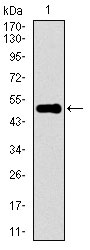
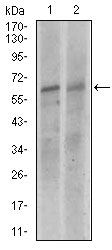
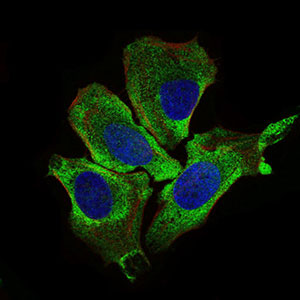
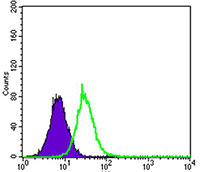
- 产品详情
- 实验流程
Application 
| WB, FC, ICC, E |
|---|---|
| Primary Accession | Q14145 |
| Reactivity | Human, Mouse |
| Host | Mouse |
| Clonality | Monoclonal |
| Clone Names | 1F10B6 |
| Isotype | IgG1 |
| Calculated MW | 69666 Da |
| Description | This gene encodes a protein containing KELCH-1 like domains, as well as a BTB/POZ domain. Kelch-like ECH-associated protein 1 interacts with NF-E2-related factor 2 in a redox-sensitive manner and the dissociation of the proteins in the cytoplasm is followed by transportation of NF-E2-related factor 2 to the nucleus. This interaction results in the expression of the catalytic subunit of gamma-glutamylcysteine synthetase. Two alternatively spliced transcript variants encoding the same isoform have been found for this gene. |
| Immunogen | Purified recombinant fragment of human KEAP1 (AA: 380-624) expressed in E. Coli. |
| Formulation | Ascitic fluid containing 0.03% sodium azide. |
| Gene ID | 9817 |
|---|---|
| Other Names | Kelch-like ECH-associated protein 1, Cytosolic inhibitor of Nrf2, INrf2, Kelch-like protein 19, KEAP1, INRF2, KIAA0132, KLHL19 |
| Dilution | WB~~1/500 - 1/2000 FC~~1/200 - 1/400 ICC~~N/A E~~1/10000 |
| Storage | Maintain refrigerated at 2-8°C for up to 6 months. For long term storage store at -20°C in small aliquots to prevent freeze-thaw cycles. |
| Precautions | KEAP1 Antibody is for research use only and not for use in diagnostic or therapeutic procedures. |
For Research Use Only. Not For Use In Diagnostic Procedures.
| Name | KEAP1 {ECO:0000303|PubMed:14585973, ECO:0000312|HGNC:HGNC:23177} |
|---|---|
| Function | Substrate-specific adapter of a BCR (BTB-CUL3-RBX1) E3 ubiquitin ligase complex that regulates the response to oxidative stress by targeting NFE2L2/NRF2 for ubiquitination (PubMed:14585973, PubMed:15379550, PubMed:15572695, PubMed:15601839, PubMed:15983046, PubMed:37339955). KEAP1 acts as a key sensor of oxidative and electrophilic stress: in normal conditions, the BCR(KEAP1) complex mediates ubiquitination and degradation of NFE2L2/NRF2, a transcription factor regulating expression of many cytoprotective genes (PubMed:15601839, PubMed:16006525). In response to oxidative stress, different electrophile metabolites trigger non-enzymatic covalent modifications of highly reactive cysteine residues in KEAP1, leading to inactivate the ubiquitin ligase activity of the BCR(KEAP1) complex, promoting NFE2L2/NRF2 nuclear accumulation and expression of phase II detoxifying enzymes (PubMed:16006525, PubMed:17127771, PubMed:18251510, PubMed:19489739, PubMed:29590092). In response to selective autophagy, KEAP1 is sequestered in inclusion bodies following its interaction with SQSTM1/p62, leading to inactivation of the BCR(KEAP1) complex and activation of NFE2L2/NRF2 (PubMed:20452972). The BCR(KEAP1) complex also mediates ubiquitination of SQSTM1/p62, increasing SQSTM1/p62 sequestering activity and degradation (PubMed:28380357). The BCR(KEAP1) complex also targets BPTF and PGAM5 for ubiquitination and degradation by the proteasome (PubMed:15379550, PubMed:17046835). |
| Cellular Location | Cytoplasm. Nucleus. Note=Mainly cytoplasmic (PubMed:15601839). In response to selective autophagy, relocalizes to inclusion bodies following interaction with SQSTM1/p62 (PubMed:20452972). |
| Tissue Location | Broadly expressed, with highest levels in skeletal muscle. |
Research Areas
Application Protocols
Provided below are standard protocols that you may find useful for product applications.
REFERENCES
1.Cell Signal. 2010 Nov;22(11):1645-54. 2.Mol Cancer Ther. 2010 Feb;9(2):336-46.

终于等到您。ABCEPTA(百远生物)抗体产品。
点击下方“我要评价 ”按钮提交您的反馈信息,您的反馈和评价是我们最宝贵的财富之一,
我们将在1-3个工作日内处理您的反馈信息。
如有疑问,联系:0512-88856768 tech-china@abcepta.com.
¥ 1,250.00
Cat# AO1778a


