


 癌症的基本特征包括细胞增殖、血管生成、迁移、凋亡逃避机制和细胞永生等。找到癌症发生过程中这些通路的关键标记物和对应的抗体用于检测至关重要。
 为您推荐一个泛素化位点预测神器——泛素化分析工具,可以为您的蛋白的泛素化位点作出预测和评分。
 细胞自噬受体图形绘图工具为你的蛋白的细胞受体结合位点作出预测和评分,识别结合到自噬通路中的蛋白是非常重要的,便于让我们理解自噬在正常生理、病理过程中的作用,如发育、细胞分化、神经退化性疾病、压力条件下、感染和癌症。
ABCC4 Antibody
Purified Mouse Monoclonal Antibody
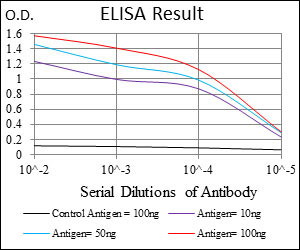
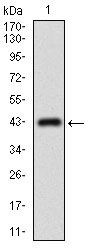
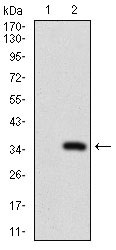
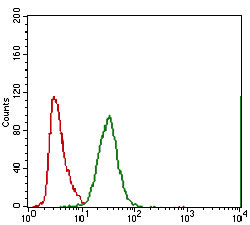
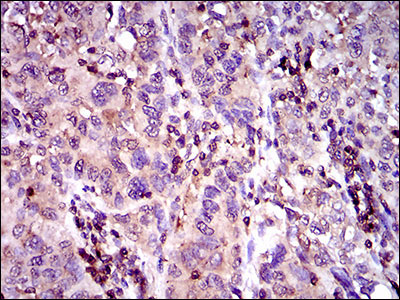
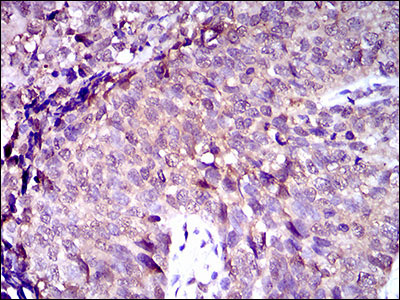
- 产品详情
- 实验流程
- 背景知识
Application 
| WB, IHC, FC, E |
|---|---|
| Primary Accession | O15439 |
| Reactivity | Human |
| Host | Mouse |
| Clonality | Monoclonal |
| Clone Names | 2D2A9 |
| Isotype | IgG1 |
| Calculated MW | 149527 Da |
| Description | The protein encoded by this gene is a member of the superfamily of ATP-binding cassette (ABC) transporters. ABC proteins transport various molecules across extra- and intra-cellular membranes. ABC genes are divided into seven distinct subfamilies (ABC1, MDR/TAP, MRP, ALD, OABP, GCN20, White). This protein is a member of the MRP subfamily which is involved in multi-drug resistance. The specific function of this protein has not yet been determined; however, this protein may play a role in cellular detoxification as a pump for its substrate, organic anions. Alternative splicing results in multiple splice variants encoding different isoforms. |
| Immunogen | Purified recombinant fragment of human ABCC4 (AA: 631-692) expressed in E. Coli. |
| Formulation | Purified antibody in PBS with 0.05% sodium azide |
| Gene ID | 10257 |
|---|---|
| Other Names | Multidrug resistance-associated protein 4, ATP-binding cassette sub-family C member 4, MRP/cMOAT-related ABC transporter, Multi-specific organic anion transporter B, MOAT-B, ABCC4, MRP4 |
| Dilution | WB~~1/500 - 1/2000 IHC~~1/200 - 1/1000 FC~~1/200 - 1/400 E~~1/10000 |
| Storage | Maintain refrigerated at 2-8°C for up to 6 months. For long term storage store at -20°C in small aliquots to prevent freeze-thaw cycles. |
| Precautions | ABCC4 Antibody is for research use only and not for use in diagnostic or therapeutic procedures. |
For Research Use Only. Not For Use In Diagnostic Procedures.
| Name | ABCC4 |
|---|---|
| Synonyms | MOATB, MRP4 {ECO:0000303|PubMed:29175180 |
| Function | ATP-dependent transporter of the ATP-binding cassette (ABC) family that actively extrudes physiological compounds and xenobiotics from cells (PubMed:11856762, PubMed:12523936, PubMed:15364914, PubMed:38886124, PubMed:40138312). Transports a range of endogenous molecules that have a key role in cellular communication and signaling, including cyclic nucleotides such as cyclic AMP (cAMP) and cyclic GMP (cGMP), bile acids, steroid conjugates, urate, and prostaglandins (PubMed:11856762, PubMed:12523936, PubMed:12835412, PubMed:12883481, PubMed:15364914, PubMed:15454390, PubMed:16282361, PubMed:17959747, PubMed:18300232, PubMed:26721430, PubMed:38886124, PubMed:40138312). Mediates the ATP-dependent efflux of glutathione conjugates such as leukotriene C4 (LTC4) and leukotriene B4 (LTB4) too. The presence of GSH is necessary for the ATP-dependent transport of LTB4, whereas GSH is not required for the transport of LTC4 (PubMed:17959747). Mediates the cotransport of bile acids with reduced glutathione (GSH) (PubMed:12523936, PubMed:12883481, PubMed:16282361). May contribute to hepatic, intestinal and renal excretion of steroid conjugates. Selectively transports steroid glucuronates and sulfates. Mediates the efflux of estrogens glucuronated at C-16 and C-17 positions, but has no transporter activity toward estrogens glucuronated at C-3. Has high affinity for dehydroepiandrosterone-3-sulfate and can also transport testosterone-17-sulfate, but has no transporter activity toward androsterone and etiocholanolone sulfate conjugates. Does not transport estrone 3-sulfate (PubMed:29175180, PubMed:39993711). Displays low affinity and high transport velocity for folates (PubMed:12036927). Transports a wide range of drugs and their metabolites. including anticancer, antiviral and antibiotic molecules (PubMed:11856762, PubMed:12105214, PubMed:15454390, PubMed:17344354, PubMed:18300232). May confer resistance to anticancer agents. Can mediate the efflux of methotrexate but is inactive toward polyglutaminated methotrexate, which is the predominant intracellular form (PubMed:11106685, PubMed:12036927). |
| Cellular Location | Basolateral cell membrane; Multi-pass membrane protein. Apical cell membrane; Multi-pass membrane protein. Note=Its localization to the basolateral or apical membranes is tissue-dependent. |
| Tissue Location | Widely expressed, with particularly high levels in prostate, but is barely detectable in liver. sinusoidal membrane of hepatocytes |
Provided below are standard protocols that you may find useful for product applications.
BACKGROUND
The protein encoded by this gene is a member of the superfamily of ATP-binding cassette (ABC) transporters. ABC proteins transport various molecules across extra- and intra-cellular membranes. ABC genes are divided into seven distinct subfamilies (ABC1, MDR/TAP, MRP, ALD, OABP, GCN20, White). This protein is a member of the MRP subfamily which is involved in multi-drug resistance. The specific function of this protein has not yet been determined; however, this protein may play a role in cellular detoxification as a pump for its substrate, organic anions. Alternative splicing results in multiple splice variants encoding different isoforms. ; ;
REFERENCES
1. Biochem Pharmacol. 2012 Aug 1;84(3):366-73. 2. Arch Dermatol Res. 2012 Jan;304(1):57-63.

终于等到您。ABCEPTA(百远生物)抗体产品。
点击下方“我要评价 ”按钮提交您的反馈信息,您的反馈和评价是我们最宝贵的财富之一,
我们将在1-3个工作日内处理您的反馈信息。
如有疑问,联系:0512-88856768 tech-china@abcepta.com.


