


 癌症的基本特征包括细胞增殖、血管生成、迁移、凋亡逃避机制和细胞永生等。找到癌症发生过程中这些通路的关键标记物和对应的抗体用于检测至关重要。
 为您推荐一个泛素化位点预测神器——泛素化分析工具,可以为您的蛋白的泛素化位点作出预测和评分。
 细胞自噬受体图形绘图工具为你的蛋白的细胞受体结合位点作出预测和评分,识别结合到自噬通路中的蛋白是非常重要的,便于让我们理解自噬在正常生理、病理过程中的作用,如发育、细胞分化、神经退化性疾病、压力条件下、感染和癌症。
Rab13 Antibody
Purified Mouse Monoclonal Antibody
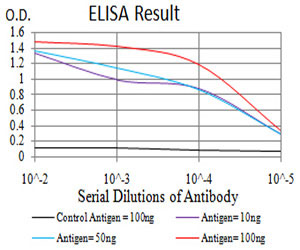
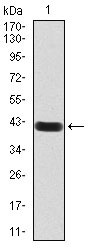
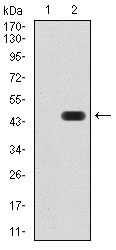
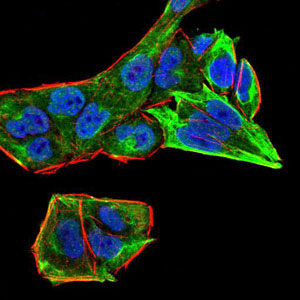
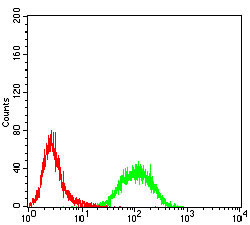
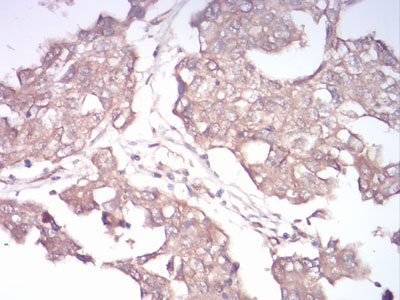
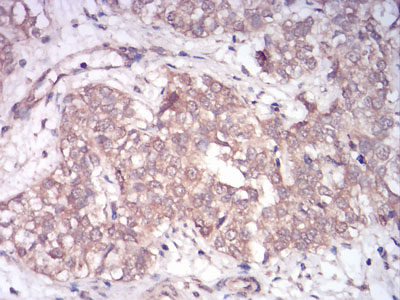
- 产品详情
- 实验流程
Application 
| WB, IHC, FC, ICC, E |
|---|---|
| Primary Accession | P51153 |
| Reactivity | Human |
| Host | Mouse |
| Clonality | Monoclonal |
| Clone Names | 7G8A4 |
| Isotype | IgG1 |
| Calculated MW | 22774 Da |
| Description | This gene is a member of the Rab family of small G proteins and plays a role in regulating membrane trafficking between trans-Golgi network (TGN) and recycling endosomes (RE). The encoded protein is involved in the assembly of tight junctions, which are components of the apical junctional complex (AJC) of epithelial cells. The AJC plays a role in forming a barrier between luminal contents and the underlying tissue. Additional functions associated with the protein include endocytic recycling of occludin, regulation of epithelial cell scattering, neuronal regeneration and regulation of neurite outgrowth. Alternately spliced transcript variants have been observed for this gene. A pseudogene associated with this gene is located on chromosome 12. |
| Immunogen | Purified recombinant fragment of human Rab13 (AA: 66-200) expressed in E. Coli. |
| Formulation | Purified antibody in PBS with 0.05% sodium azide |
| Gene ID | 5872 |
|---|---|
| Other Names | Ras-related protein Rab-13, Cell growth-inhibiting gene 4 protein, RAB13 |
| Dilution | WB~~1/500 - 1/2000 IHC~~1/200 - 1/1000 FC~~1/200 - 1/400 ICC~~N/A E~~1/10000 |
| Storage | Maintain refrigerated at 2-8°C for up to 6 months. For long term storage store at -20°C in small aliquots to prevent freeze-thaw cycles. |
| Precautions | Rab13 Antibody is for research use only and not for use in diagnostic or therapeutic procedures. |
For Research Use Only. Not For Use In Diagnostic Procedures.
| Name | RAB13 (HGNC:9762) |
|---|---|
| Function | The small GTPases Rab are key regulators of intracellular membrane trafficking, from the formation of transport vesicles to their fusion with membranes. Rabs cycle between an inactive GDP-bound form and an active GTP-bound form that is able to recruit to membranes different sets of downstream effectors directly responsible for vesicle formation, movement, tethering and fusion. RAB13 is involved in endocytic recycling and regulates the transport to the plasma membrane of transmembrane proteins like the tight junction protein OCLN/occludin. Thereby, it regulates the assembly and the activity of tight junctions. Moreover, it may also regulate tight junction assembly by activating the PKA signaling pathway and by reorganizing the actin cytoskeleton through the activation of the downstream effectors PRKACA and MICALL2 respectively. Through its role in tight junction assembly, may play a role in the establishment of Sertoli cell barrier. Plays also a role in angiogenesis through regulation of endothelial cells chemotaxis. Also involved in neurite outgrowth. Has also been proposed to play a role in post-Golgi membrane trafficking from the TGN to the recycling endosome. Finally, it has been involved in insulin-induced transport to the plasma membrane of the glucose transporter GLUT4 and therefore may play a role in glucose homeostasis. |
| Cellular Location | Cell membrane; Lipid-anchor; Cytoplasmic side. Cytoplasmic vesicle membrane; Lipid-anchor; Cytoplasmic side. Cell junction, tight junction. Golgi apparatus, trans-Golgi network membrane Recycling endosome membrane. Cell projection, lamellipodium {ECO:0000250|UniProtKB:Q9DD03}. Note=Tight junctions or associated with vesicles scattered throughout the cytoplasm in cells lacking tight junctions (PubMed:8294494) Relocalizes to the leading edge of lamellipodia in migrating endothelial cells (By similarity). {ECO:0000250|UniProtKB:Q9DD03, ECO:0000269|PubMed:8294494} |
| Tissue Location | Detected in several types of epithelia, including intestine, kidney, liver and in endothelial cells |
Research Areas
Application Protocols
Provided below are standard protocols that you may find useful for product applications.
REFERENCES
1.J Histochem Cytochem. 2012 Jul;60(7):537-49.2.J Cell Biol. 2008 Sep 8;182(5):845-53.

终于等到您。ABCEPTA(百远生物)抗体产品。
点击下方“我要评价 ”按钮提交您的反馈信息,您的反馈和评价是我们最宝贵的财富之一,
我们将在1-3个工作日内处理您的反馈信息。
如有疑问,联系:0512-88856768 tech-china@abcepta.com.
¥ 1,250.00
Cat# AO2102a


