


 癌症的基本特征包括细胞增殖、血管生成、迁移、凋亡逃避机制和细胞永生等。找到癌症发生过程中这些通路的关键标记物和对应的抗体用于检测至关重要。
 为您推荐一个泛素化位点预测神器——泛素化分析工具,可以为您的蛋白的泛素化位点作出预测和评分。
 细胞自噬受体图形绘图工具为你的蛋白的细胞受体结合位点作出预测和评分,识别结合到自噬通路中的蛋白是非常重要的,便于让我们理解自噬在正常生理、病理过程中的作用,如发育、细胞分化、神经退化性疾病、压力条件下、感染和癌症。
ABCC3 Antibody (Center) 精选
Affinity Purified Rabbit Polyclonal Antibody (Pab)
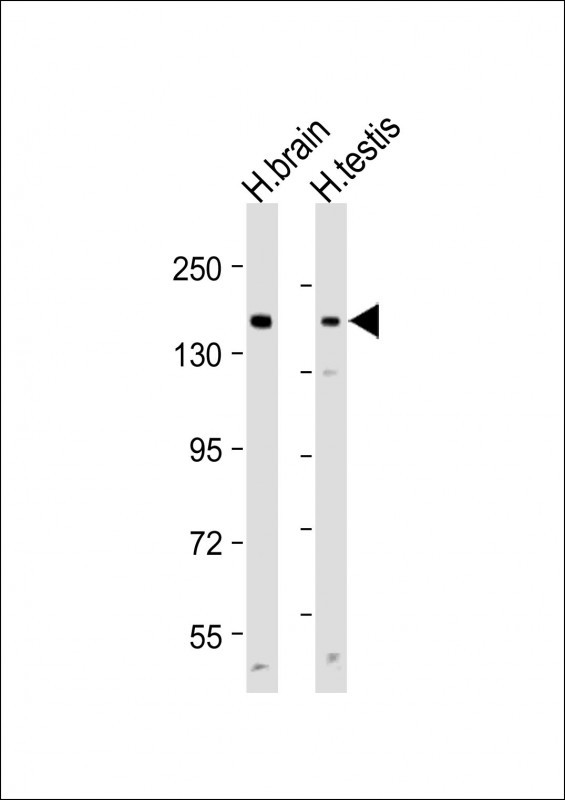
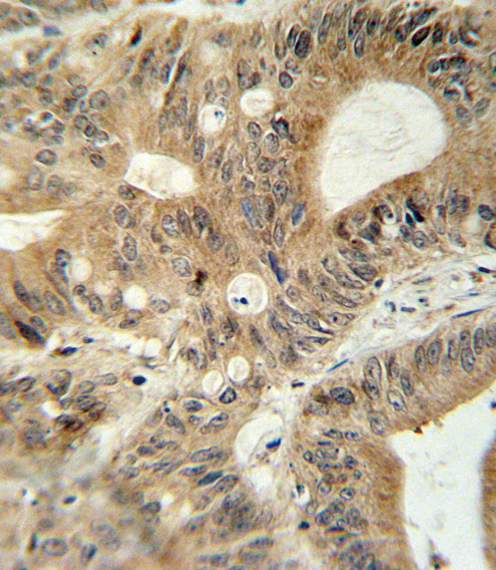
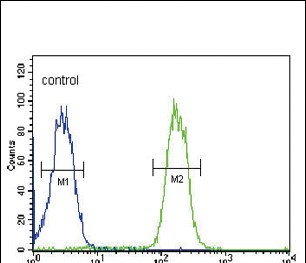
- 产品详情
- 实验流程
- 背景知识
Application 
| WB, IHC-P, FC, E |
|---|---|
| Primary Accession | O15438 |
| Other Accession | NP_003777.2, NP_001137542.1 |
| Reactivity | Human |
| Host | Rabbit |
| Clonality | Polyclonal |
| Isotype | Rabbit IgG |
| Calculated MW | 169343 Da |
| Antigen Region | 899-925 aa |
| Gene ID | 8714 |
|---|---|
| Other Names | Canalicular multispecific organic anion transporter 2, ATP-binding cassette sub-family C member 3, Multi-specific organic anion transporter D, MOAT-D, Multidrug resistance-associated protein 3, ABCC3, CMOAT2, MLP2, MRP3 |
| Target/Specificity | This ABCC3 antibody is generated from rabbits immunized with a KLH conjugated synthetic peptide between 899-925 amino acids from the Central region of human ABCC3. |
| Dilution | WB~~1:1000 IHC-P~~1:100~500 FC~~1:10~50 E~~Use at an assay dependent concentration. |
| Format | Purified polyclonal antibody supplied in PBS with 0.09% (W/V) sodium azide. This antibody is purified through a protein A column, followed by peptide affinity purification. |
| Storage | Maintain refrigerated at 2-8°C for up to 2 weeks. For long term storage store at -20°C in small aliquots to prevent freeze-thaw cycles. |
| Precautions | ABCC3 Antibody (Center) is for research use only and not for use in diagnostic or therapeutic procedures. |
For Research Use Only. Not For Use In Diagnostic Procedures.
| Name | ABCC3 (HGNC:54) |
|---|---|
| Synonyms | CMOAT2, MLP2, MRP3 |
| Function | ATP-dependent transporter of the ATP-binding cassette (ABC) family that hydrolyzes ATP to enable active transport of substrates conjugated with glucuronate, glutathione or sulfate. Operates at basolateral membranes of polarized cells such as hepatocytes and intestinal epithelial cells, where it mediates the efflux of conjugated substrates from intestine and liver into the bloodstream (PubMed:10359813, PubMed:11581266, PubMed:15083066, PubMed:29175180, PubMed:30959153, PubMed:31704245, PubMed:39993711, PubMed:37485728). Involved in enterohepatic recirculation of steroid glucuronates. Shares substrate specificity with MRP2, displaying higher affinity for both estrogen and androgen glucuronates such as 17beta-estradiol, estrone, testosterone and 5alpha-dihydrotestosterone glucuronates (PubMed:29175180, PubMed:30959153, PubMed:31704245, PubMed:37485728). Involved in sinusoidal efflux of mono- and bis-glucuronidated bilirubin from hepatocytes into the blood for renal uptake and excretion (PubMed:15083066). May selectively transport steroid sulfate conjugates. Has transporter activity toward androgen sulfates such as androsterone and dehydroepiandrosterone sulfates but is inactive toward estrone 3-sulfate (PubMed:29175180, PubMed:39993711). Can transport various bile acid conjugates such as taurocholate, glycocholate, taurochenodeoxycholate-3-sulfate and taurolithocholate-3-sulfate. Does not contribute substantially to bile acids physiology, but provides an alternative route for the export of bile acids and glucuronate conjugates from cholestatic hepatocytes to avoid liver damage (By similarity). Can also transport glutathione conjugates such as leukotriene C4 (LTC4) (PubMed:11581266). Transports various xenobiotics. Confers resistance to anticancer drugs, methotrexate, tenoposide and etoposide, by decreasing accumulation of these drugs in cells (PubMed:10359813, PubMed:11581266). May contribute to the transport of organic compounds in testes across the blood-testis- barrier (Probable). |
| Cellular Location | Basolateral cell membrane; Multi-pass membrane protein. Basal cell membrane; Multi-pass membrane protein. Note=Localized to the basolateral membrane of enterocytes (PubMed:28408210). Localized to the basal membrane of Sertoli cells (PubMed:35307651). |
| Tissue Location | Mainly expressed in the liver. Also expressed in small intestine, colon, prostate, testis, brain and at a lower level in the kidney. In testis, localized to peritubular myoid cells, Leydig cells, along the basal membrane of Sertoli cells and moderately in the adluminal compartment of the seminiferous tubules (PubMed:35307651) |
Provided below are standard protocols that you may find useful for product applications.
BACKGROUND
The protein encoded by this gene is a member of the superfamily of ATP-binding cassette (ABC) transporters. ABC proteins transport various molecules across extra- and intra-cellular membranes. ABC genes are divided into seven distinct subfamilies (ABC1, MDR/TAP, MRP, ALD, OABP, GCN20, White). This protein is a member of the MRP subfamily which is involved in multi-drug resistance. The specific function of this protein has not yet been determined; however, this protein may play a role in the transport of biliary and intestinal excretion of organic anions. Alternatively spliced variants which encode different protein isoforms have been described; however, not all variants have been fully characterized.
REFERENCES
Bailey, S.D., et al. Diabetes Care 33(10):2250-2253(2010)
Hoffman, A.D., et al. Protein J. 29(5):373-379(2010)
Liu, C.Y., et al. Carcinogenesis 31(7):1259-1263(2010)
Rose, J.E., et al. Mol. Med. 16 (7-8), 247-253 (2010) :
Moyer, A.M., et al. Cancer Epidemiol. Biomarkers Prev. 19(3):811-821(2010)

终于等到您。ABCEPTA(百远生物)抗体产品。
点击下方“我要评价 ”按钮提交您的反馈信息,您的反馈和评价是我们最宝贵的财富之一,
我们将在1-3个工作日内处理您的反馈信息。
如有疑问,联系:0512-88856768 tech-china@abcepta.com.


